
Airframe Component Tracking for Maintenance Teams

Airframe Component Tracking for Maintenance Teams
The most reliable way to manage life-limited airframe components is a unified two-layer approach that links regulatory documents, like Form 8130-3 and logbook records, to continuous physical visibility through RFID and DO-160 rated IoT devices. Neither layer works alone. A perfect paperwork trail means nothing if you cannot verify where a part physically sits right now, and a live GPS ping is worthless without a certificate proving the part’s history back to birth.
Here’s what putting that approach into practice actually requires:
- Confirm back-to-birth (BtB) traceability exists for every life-limited part in your fleet, not just the top-level assembly.
- Tag high-turnover rotables and internal sub-components, not only the parent unit that carries the visible serial number.
- Pilot DO-160 approved transit trackers on AOG shipments before rolling the hardware out fleet-wide.
- Cross-reference every Form 8130-3 against the FAA’s Order 8130.21H formatting requirements before you accept a part into inventory.
Pro Tip: Run a sample audit over a typical maintenance cycle on your highest-cycle rotables before committing to any tracking platform. If you find even one gap in BtB documentation during that sample, you already know where your real risk sits.
Platforms like SquawkFree build toward this same model by tying flight-data import and logbook digitization to one compliance record, which is the direction the rest of this guide will walk through in detail.
Key Takeaways
Reliable airframe component tracking depends on linking regulatory documentation to continuous physical visibility, since neither layer alone can prove a part’s full history or current condition.
| Point | Details |
|---|---|
| Track sub-components, not just assemblies | Internal life-limited parts inside a larger unit need their own serial-level history. |
| Match hardware to the environment | Use DO-160 rated trackers for anything riding in a cargo hold or unpressurized bay. |
| Capture all three time metrics | Cycles, flight hours, and calendar time must all be recorded since any one can hit its limit first. |
| Build on existing standards | GS1 EPCIS and SAE ARP6943 already define how event data and BtB records should connect. |
| Unify document and physical layers | Platforms like SquawkFree tie flight data import, AD tracking, and logbook records into one system. |
Table of Contents
- What Are Life-Limited Airframe Components, and Why Does Tracking Them Matter?
- What Records Does the FAA Require for Component Traceability?
- What Technologies Track Physical Aircraft Component Location and Condition?
- What Data Fields Are Required for Compliant Component Tracking?
- Which Standards Govern Aircraft Parts Provenance and Traceability?
- How Do You Integrate Tracking Into Existing Maintenance Workflows?
- What Are the Most Common Compliance Risks in Component Tracking?
- How Much Does Component Tracking Actually Save an Operator?
- How Do You Choose the Right Component Tracking System?
- How Does a Unified Platform Close the Gaps Between Document and Physical Tracking?
- What Do Successful Component Tracking Rollouts Have in Common?
- A Recommended Solution: How SquawkFree Meets Component-Tracking Needs
- Frequently Asked Questions
- Sources
What Are Life-Limited Airframe Components, and Why Does Tracking Them Matter?
A life-limited part (LLP) is any component with an FAA-mandated maximum service life, expressed in flight cycles, flight hours, or calendar time, after which it must be removed regardless of its physical condition. Landing gear trunnions, certain turbine disks, and specific gearbox internals are classic examples. The part doesn’t have to look worn or fail an inspection. Once it hits its number, it comes off the aircraft.
The mistake many shops make is tracking only the top-level assembly serial number. A landing gear strut might carry one serial number on its housing, but inside that housing are bushings, pins, and bearings that each carry their own independent life limit. Duncan Aviation’s own guidance on this is blunt: failing to track internal life-limited parts to the serial level creates “unknown-time” parts, meaning nobody can prove how many cycles that internal bushing has actually accumulated.
When an internal sub-component’s history goes dark, the entire parent assembly becomes suspect. Inspectors don’t split the difference. An unknown-time part gets treated as a part at its absolute limit until proven otherwise.
That single gap cascades fast:
- A pre-purchase inspection rejects the aircraft outright, or the buyer demands a price reduction to cover the unknown liability.
- A scheduled inspection becomes an unscheduled removal, grounding the aircraft while a replacement part gets sourced.
- Resale value drops because the next owner inherits the same documentation hole you did.
Precise component lifecycle tracking isn’t paperwork for its own sake. It’s the difference between a part that flies its full approved life and one that gets pulled early out of caution, or worse, one that keeps flying past its limit because nobody caught the gap in time.
What Records Does the FAA Require for Component Traceability?
The document layer is the paper trail (physical or electronic) that proves a part’s identity, history, and legal right to be installed on your aircraft. At minimum, that layer needs to include the original Authorized Release Certificate, every logbook entry tied to installation and removal, repair station work orders, and a continuous BtB chain connecting the part back to its manufacture date.
Form 8130-3 is the document most maintenance professionals recognize on sight, and it’s worth understanding exactly what it certifies. It’s an airworthiness release, not a maintenance record. It confirms a part or article conforms to its approved design data and is in a condition for safe operation at the moment of release. FAA Order 8130.21H spells out precisely how these certificates must be completed, who can sign them, and how long they need to be retained, and deviations from that format are one of the fastest ways to fail an audit.
Electronic recordkeeping is fully acceptable to the FAA when it meets the right standard. Advisory Circular AC 120-78A lays out when electronic signatures and digital records serve as legitimate equivalents to paper under the relevant parts of 14 CFR. If your shop is still relying on filing cabinets because you assume the FAA won’t accept a digital record, that assumption is outdated.
Retention isn’t optional and it isn’t short. Life-limited part records need to survive the part’s entire installed life, plus whatever period your operations specifications or repair station manual specifies beyond that.
Use this sequence to close common provenance gaps during receiving and installation:
- Match the part’s physical serial number against the 8130-3 or maintenance release before it ever touches the shelf.
- Verify the BtB chain is continuous, with no unexplained time or cycle gaps between owners or repair events.
- Confirm the issuing repair station or manufacturer’s certificate is current and their FAA certification hasn’t lapsed.
- Log the installation event immediately, tying it to the aircraft’s current total time and cycles, not an estimate filled in later.
- Flag any part missing a document instead of installing it “pending paperwork.” That habit is how BtB chains break in the first place.
What Technologies Track Physical Aircraft Component Location and Condition?
The physical layer answers a question paperwork can’t: where is this part right now, and what condition is it in? Passive RFID and barcode systems handle identification well but only produce episodic reads, meaning you know where a part was the last time someone scanned it, not where it is this minute. Active IoT and GNSS trackers close that gap by reporting location continuously, which matters enormously once a part leaves your hangar for repair or transit.
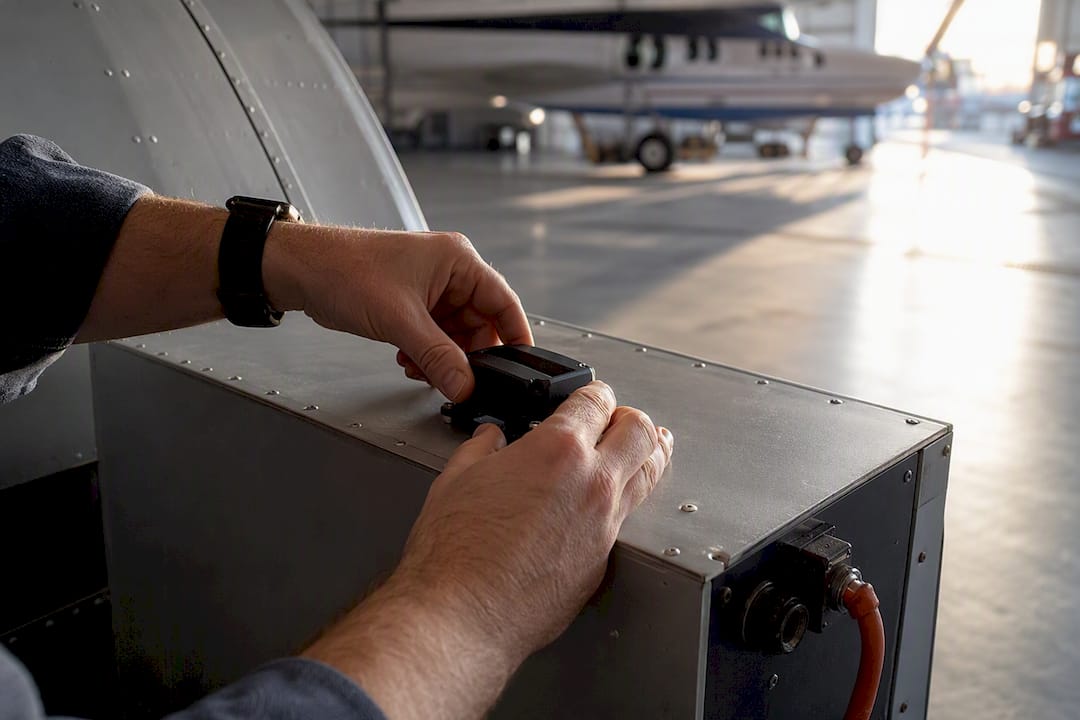
Passive RFID under ISO 18000-6C is the workhorse for warehouse and hangar identification. It’s cheap, durable, and doesn’t need a battery, so it can sit on a shelf part for years and still read correctly. Its limitation is coverage: if nobody scans the tag, the system has no idea the part moved.
Active cellular and GPS trackers solve the transit blind spot, but they introduce a hardware question most shops overlook until it costs them: is the device rated for the environment it’s riding in?
When you actually need DO-160 certification
Any tracker riding inside a cargo hold, tail cone, or unpressurized bay during flight needs to survive real aviation stress: temperature swings, vibration, and electromagnetic interference. DO-160 environmental testing verifies a device can take that punishment without failing or, worse, interfering with aircraft systems. Most consumer-grade GPS trackers, the kind built for shipping containers or delivery vans, are not DO-160 certified. Strapping one to a life-limited part headed for overhaul on a cargo flight can create an airworthiness conformity problem you didn’t intend to create.
If the part is moving by ground transport or sitting in a container yard rather than flying inside the aircraft envelope, a container-mounted or pallet-level tracker without DO-160 certification is usually fine. Reserve the certified hardware for anything that flies.
Condition sensors round out the physical layer for parts sensitive to environmental exposure, batteries, composite structures, and certain avionics units that degrade under humidity or temperature swings outside their storage spec. A shock sensor on a rotable during shipping can also flag mishandling before the part ever reaches your bench, saving you a failed incoming inspection later.
Pro Tip: Before buying trackers in bulk, ask the vendor for their DO-160 test report by category, not just a marketing claim of “aviation grade.” Categories cover different stress profiles, and a device certified for temperature but not vibration isn’t fully cleared for cargo-hold use.
What Data Fields Are Required for Compliant Component Tracking?
Your tracking system needs to capture enough data on every component to let anyone, an inspector, a buyer, or your own maintenance team, reconstruct that part’s entire life on demand. Miss a field and you’ve created a future audit finding, even if the part itself is perfectly airworthy.
| Data field | Why it matters |
|---|---|
| Part number and serial number | Uniquely identifies the component and links it to its specific manufacturing record. |
| Manufacturer/CAGE code | Confirms the issuing organization and supports certificate verification. |
| Date of manufacture | Anchors the start of the BtB chain and calendar-time calculations. |
| BtB record link | Connects this part to its full ownership and repair history without gaps. |
| Cycles, flight hours, calendar time | All three are required for LLPs since a part can hit its limit on any one metric first. |
| Installation and removal history | Documents every aircraft the part has served on and for how long. |
| Maintenance events | Records repairs, overhauls, and inspections tied to this specific serial number. |
| Supporting 8130-3 references | Ties the physical part to its legal airworthiness release documentation. |
Notice that cycles, hours, and calendar time all appear together. That’s deliberate, and it’s the point SAE ARP6943 makes explicit in its recommended practice for LLP traceability. A part can be well within its cycle limit but past its calendar limit due to corrosion risk or elastomer aging, so tracking only one metric leaves you blind to the other two failure paths.
A few practical notes on getting this data in reliably:
- Automated capture, pulling hours and cycles directly from flight data, beats manual logbook entry every time because it removes the transcription error that creeps in after a long flight day.
- Partial-life rotable exchanges (installing a part that already has accumulated time from a prior aircraft) need that prior time entered immediately, not estimated later from memory.
- Every automated entry still needs a spot-check verification step. Sensors and importers can misread; a human confirming the numbers against the source document catches that before it becomes a permanent record error.
Which Standards Govern Aircraft Parts Provenance and Traceability?
Component tracking doesn’t happen in a vacuum, and you don’t need to invent your own data model from scratch. A handful of standards and FAA guidance documents already define how provenance and traceability should work, and building your system around them makes your records defensible in an audit rather than merely convenient for your own team.
GS1 EPCIS is the standard most worth understanding if you’re evaluating any tracking software. It’s an event data model built for supply-chain visibility, capturing what happened, when, where, and why for any tracked object. Applied to aircraft parts, an EPCIS event is what turns a bare RFID scan into a meaningful record: “this serial number was received at this location, at this time, under this work order.” That link between a physical scan and a document record is exactly the connective tissue the two-layer model depends on.
A scan without a linked document tells you a part moved. A scan tied to an EPCIS event and a document record tells you what moved, under whose authority, and whether it’s still airworthy. That distinction is the whole reason the standard exists.
For the traceability requirements specific to life-limited parts, SAE ARP6943 recommends a harmonized method for tracking cycles, hours, and calendar time together and defines what a complete BtB record actually contains. It’s the closest thing the industry has to a shared definition of “fully traceable.”
On the regulatory side, FAA Order 8130.21H governs how 8130-3 certificates get issued and retained, while AC 120-78A confirms electronic records satisfy those same obligations. Some researchers are also exploring permissioned blockchain systems, including one proposed Hyperledger Fabric based architecture for aircraft parts traceability, though that approach remains largely experimental rather than something you’ll find deployed at scale today.
How Do You Integrate Tracking Into Existing Maintenance Workflows?
Buying tracking hardware or software solves nothing if the data it generates doesn’t flow into the systems your team already uses every day. Integration is where most tracking initiatives quietly fail, not because the technology doesn’t work, but because nobody built the workflow connecting a physical scan to an actual maintenance record.
Start with these integration priorities:
- Confirm your MRO or logbook platform can ingest event data, ideally through an EPCIS feed or a standard API, rather than requiring manual re-entry of every scan.
- Map every physical tracking event (received, installed, removed, shipped) to a corresponding maintenance record field so nothing lives only in the tracking system and nowhere else.
- Build a single source of truth for remaining life calculations. If your tracking hardware and your logbook disagree on cycles remaining, someone will eventually trust the wrong number.
Once the systems talk to each other, the daily workflow needs its own discipline. A practical receiving-to-installation checklist looks like this:
- Scan and log the part on receipt, before it moves off the loading dock.
- Verify BtB documentation matches the physical serial number the same day, not at end of week.
- Tag any part lacking a permanent RFID or barcode identifier before it enters inventory.
- Enter the installation event into the maintenance record within the same shift it happens.
- Route any discrepancy (mismatched serial, missing certificate, gap in cycle history) to a named person for resolution, not a general inbox.
Governance is the piece teams skip and then regret. Decide, in writing, who has authority to update a component’s status in your system, whether that’s marking a part removed, extending an inspection interval, or closing out a repair event. Keep an audit trail of every change, including who made it and when, because an inspector will eventually ask not just “what does the record say” but “who entered this and can you prove it.” Set a retention policy for tracking data that matches or exceeds your document retention requirements. A system that quietly purges scan history after 90 days can leave you unable to reconstruct a BtB chain exactly when you need it most.
What Are the Most Common Compliance Risks in Component Tracking?
Every fraud vector and audit failure in this industry traces back to one of a few recurring patterns, and most of them are preventable with the right checks in place. Forged or altered 8130-3 certificates remain a persistent problem, particularly for parts moving through multiple brokers before reaching a shop. A certificate that looks legitimate at a glance can still carry a fabricated signature, a reused certificate number, or a part condition statement that doesn’t match the part’s actual history.
Broken BtB chains are the quieter version of the same risk. Nobody forged anything. The paperwork just has a gap, an ownership transfer with no accompanying logbook page, or a repair event nobody documented. Mismatched serial numbers between the physical part and its accompanying certificate, and undocumented internal repairs on assemblies that were supposedly untouched, round out the most common findings.
| Risk vector | Root cause | Mitigation |
|---|---|---|
| Forged 8130-3 | Fraudulent or altered certificate paperwork | Automated document matching against known issuer databases |
| Broken BtB chain | Missing ownership or repair records | Incoming inspection requiring continuous documentation before acceptance |
| Mismatched serials | Data entry error or intentional substitution | Barcode/RFID scan verification against certificate serial at receiving |
| Transit visibility loss | Paper-only or siloed vendor systems | Container or DO-160 rated trackers on high-value shipments |
The operational gaps behind these failures are almost always structural, not individual. A shop relying on multiple vendors who each keep their own paper records, with no shared system between them, is set up for exactly this kind of failure. Periodic reconciliation, actually cross-checking your inventory system against physical stock and documentation on a set schedule, catches most of these problems before an external auditor does.
How Much Does Component Tracking Actually Save an Operator?
Component tracking earns its keep through a handful of measurable indicators: AOG incidents avoided, mean time to receipt for incoming rotable parts, inventory holding days, hours spent preparing for audits, and preserved resale value on parts with clean documentation. Track these consistently and the ROI case becomes obvious within a year.
A simple example makes the math concrete. Say an AOG event costs your operation $2,000 per hour in grounded aircraft revenue and labor, and better transit visibility on a shipped part shaves four hours off your average time to locate and reroute a delayed component. That’s $8,000 recovered on a single incident. Multiply that across a fleet that averages even a few AOG events per year tied to lost-in-transit parts, and the tracking system pays for itself well before you factor in labor savings from reduced manual logbook entry or audit prep time cut in half because your records are already reconciled.
- AOG incidents avoided: fewer grounded aircraft events tied to missing or unlocated parts.
- Mean time to receipt: how long it takes a rotable part to move from order to installation readiness.
- Audit prep hours: time saved when records are already reconciled rather than assembled under deadline pressure.
- Resale value preserved: aircraft with clean BtB documentation command stronger offers at sale.
The intangible side matters too. A shop that can produce a complete BtB chain in minutes during a surprise ramp check faces a fundamentally different conversation with an inspector than one scrambling through filing cabinets. That difference doesn’t show up on a balance sheet, but every maintenance manager who has lived through both scenarios knows which one they’d rather repeat.
How Do You Choose the Right Component Tracking System?
Evaluate any tracking platform against the same dimensions that actually determine whether it will hold up under audit and daily operational load: what it tracks, how it supports traceability, whether visibility is real-time or episodic, how deeply it integrates with your existing systems, how complex it is to deploy, and how it governs data access.
Run through this checklist before you commit to a platform:
- Does it track sub-components independently, or only the top-level assembly serial number?
- Does it support full BtB documentation storage, not just a scan history with no linked paperwork?
- Is visibility continuous (active IoT/GNSS) or episodic (barcode/passive RFID), and does that match how your parts actually move?
- Can it integrate with your existing MRO, ERP, or logbook system through EPCIS or a standard API, rather than requiring double entry?
- What’s the actual deployment timeline and training burden for your team?
When you’re talking to a vendor directly, these questions separate a platform built for aviation from one adapted from a generic asset-tracking product:
- Are your hardware trackers DO-160 certified, and for which specific test categories?
- Does your system support EPCIS event export or import for interoperability with other platforms?
- Can it ingest and permanently store Form 8130-3 documents tied to specific serial numbers?
- Does every data change generate an audit log entry showing who made it and when?
- Can it track internal sub-components separately from their parent assembly?
Before rolling any platform out fleet-wide, pilot it on a limited set of high-risk parts, your AOG-critical rotables and life-limited components, for at least one full maintenance cycle. Set clear acceptance criteria upfront: does the BtB chain reconstruct correctly, does the data match your manual records within an acceptable margin, and does your team actually use it without falling back to paper. A vendor’s demo always looks clean. Your own pilot data won’t lie to you the way a sales presentation can.
How Does a Unified Platform Close the Gaps Between Document and Physical Tracking?
The recurring theme through every section of this guide is that document and physical tracking fail when they live in separate systems maintained by separate people. A unified platform closes that gap by making the two layers update each other automatically instead of relying on someone to manually reconcile them at month’s end.
The workflow looks like this in practice: a physical event occurs (an RFID read, a GNSS ping from an active tracker), that event gets logged in an EPCIS-compatible format, the system automatically looks up the linked document record, and the maintenance record updates in lock step. No separate spreadsheet. No waiting for someone to type the scan into the logbook later that week.
Consider a shop juggling three vendors and a paper logbook for a mixed fleet of training aircraft. Every AD search means cross-referencing a binder against each aircraft’s individual paper records, and every audit means pulling files from multiple cabinets. A shop that moves flight data, maintenance history, and AD tracking into one connected system typically cuts that reconciliation time dramatically, because the records are already tied together by the time the audit request comes in.
The single biggest time cost in most audits isn’t producing documents, it’s proving those documents actually match the physical part in question. Unify the two layers and that proof is instant instead of a multi-day scramble.
SquawkFree approaches this by auto-importing flight data through its Flight Intelligence feature, eliminating the manual entry step that introduces most transcription errors in the first place, while also handling AD tracking and logbook digitization so historical paper records become part of the same searchable system as new flight data going forward. That’s the practical shape of the two-layer model: not two systems you check separately, but one record that reflects both.
What Do Successful Component Tracking Rollouts Have in Common?
The teams that get this right don’t try to tag every part in their inventory on day one. They start with the parts that carry the most operational and compliance risk: AOG-critical rotables and life-limited sub-components buried inside larger assemblies. Get those right first, prove the workflow holds up under real conditions, then expand.
Change management matters more than the technology choice itself. A tracking system only stays accurate if the people entering data actually use it consistently, and that means training that goes beyond a single onboarding session. Build the habit of scanning at receipt and logging at installation into the actual shift routine, not as an extra task bolted onto the existing process. Assign clear ownership: one person per shift responsible for catching discrepancies before they become permanent records.
Six to twelve months in, success looks like a measurable drop in audit prep time, a BtB chain you can produce on demand without a scramble, and zero unknown-time parts discovered during inspections. If you’re still finding documentation gaps at the twelve-month mark, the problem usually isn’t the software. It’s that the rollout skipped the training and governance work that makes any system stick.
A Recommended Solution: How SquawkFree Meets Component-Tracking Needs
If you’ve read this far, you already know the two-layer approach works best when it lives in one system instead of stitched together from a logbook binder, a spreadsheet, and a separate tracking app. SquawkFree is built around exactly that connection: automated flight data import through Flight Intelligence, FAA AD search and tracking, logbook digitization with human verification, and cloud document storage that keeps your 8130-3 certificates and maintenance history tied to the same aircraft record.

The Flight Intelligence feature auto-imports flight data without manual entry, feeding accurate hours and cycles directly into your compliance record instead of relying on someone to transcribe a Hobbs reading correctly every time. Combine that with AD tracking that flags open directives against your actual fleet and document storage that keeps every certificate searchable in one place, and you’ve got the document layer and the operational layer talking to each other instead of living in separate silos. Whether you’re a single aircraft owner tracking your own maintenance history or a flight school managing dispatch and billing across a fleet, that connection is what keeps you audit-ready without the weekly paperwork scramble.
SquawkFree offers a 60-day free trial, so you can run your own pilot on your highest-risk parts before committing to anything. Start your free trial at SquawkFree and see how much of your current tracking gap closes on its own.
Frequently Asked Questions
What is the difference between a life-limited part and a rotable part?
A life-limited part has a hard maximum service limit set by cycles, hours, or calendar time, after which it must be removed regardless of condition. A rotable is any part that gets repaired or overhauled and reinstalled rather than discarded. A part can be both: a rotable component that also carries an internal life-limited sub-part.
Is electronic recordkeeping acceptable for FAA compliance?
Yes. AC 120-78A confirms electronic records and signatures satisfy FAA requirements under relevant parts of 14 CFR when the system meets that guidance, so a well-built digital platform is not a compliance risk compared to paper.
Do I need DO-160 certified trackers for every part I ship?
Only for trackers that will physically ride inside an aircraft, such as a cargo hold or unpressurized bay, during flight. A part moving by ground transport or sitting in a container yard can typically use a non-certified tracker without airworthiness conformity concerns.
What does back-to-birth traceability actually mean?
It means a continuous, unbroken documentation chain covering a part from its original manufacture date through every owner, repair, and installation up to the present. Any gap in that chain creates an unknown-time part, which inspectors treat as a liability regardless of the part’s actual physical condition.
How often should we audit our component tracking records?
Most operators benefit from a quarterly reconciliation cycle, cross-checking physical inventory against documentation, plus a full review before any major inspection or pre-purchase evaluation. Waiting until an external audit to check your own records is how small gaps become large findings.
Sources
Keep these references on hand for compliance work and deeper study on component traceability standards:
- FAA Order 8130.21H
- ARP6943: Component Traceability Requirements for Life-Limited Parts
- Are You Tracking Your Life-Limited Aircraft Component Parts? | Duncan Aviation
Recommended
No credit card required · read-only after trial