
Best Aircraft Scheduling Software for Flight Schools, Clubs & Corporate Ops
For most U.S. flight schools, flying clubs, and GA operations, SquawkFree is our pick - and since we build it, weigh that accordingly and check the alternatives below. It combines maintenance tracking, FAA airworthiness directive (AD) compliance, and scheduling in one system, with an optional ADS-B add-on that pre-fills your flights so the team spends less time on logbook bookkeeping and more time flying.
Other strong fits by use case:
- Best for flight schools needing proven rostering: Flight Schedule Pro or FlightLogger
- Best for flying clubs and co-ownerships: Flight Circle or Flightnet
- Best for corporate flight departments: FL3XX or Avianis
- Best for dispatch-to-planning integration: myairops
- Best for charter operators and marketplace exposure: Avinode / Schedaero
- Best for maintenance-first compliance operations: CAMP Systems or Traxxall
- Best for GA owners wanting simplicity: SquawkFree or Tailplane
To find your fit quickly, request a demo or start a free trial with your top two candidates before committing. SquawkFree’s trial is 60 days with no credit card up front; other vendors vary, and several are demo-only.
Table of Contents
- What’s the best aircraft scheduling software for your operation?
- How we selected and evaluated these products
- Per-product snapshots: SquawkFree and the full shortlist
- How to choose the right aircraft scheduling software for your operation
- What good aircraft scheduling software actually does
- Key Takeaways
- What operators actually find out after go-live
- SquawkFree: the integrated pick for flight schools and GA operations
- Useful sources and vendor pages
What’s the best aircraft scheduling software for your operation?
| Software | Best For | Core Scheduling | Maintenance & Compliance | Crew/Instructor Scheduling | Dispatch & Trip-Building | Integrations | Pricing Model | Mobile/Offline |
|---|---|---|---|---|---|---|---|---|
| SquawkFree | Flight schools, GA owners, clubs | Visual schedule, multi-aircraft and CFI rows, conflict detection | AD tracking, optional ADS-B import, logbook OCR with human review | Instructor scheduling, availability, privilege sign-offs | Dispatch + billing for schools | ADS-B (add-on), Stripe billing | Flat monthly or annual, per account | Responsive web |
| SkyDuty | Flight schools, small operators | Gantt timeline, multi-leg trips, day/week views | Limited | Crew rostering | Multi-leg trip containers | Calendar sync | Per-user / quote | Offline-first iOS/iPad |
| Airplane Manager | Corporate flight departments | Progressive web app, calendar sync | Maintenance integration | Role-based crew scheduling | Trip messaging, multi-leg | Accounting, e-signature, calendar | Enterprise / quote | Mobile-responsive PWA |
| Flightnet | Flying clubs, co-ownerships | Reservations, recurring bookings | License/medical expiry alerts | Instructor availability | Reservation-to-invoice flow | Billing, statistics export | Per-user / quote | Web-based |
| Optifly | Large airline networks | Constraint-based optimization | Limited | Network crew scheduling | AI-driven route optimization | Airline systems | Enterprise / quote | Web |
| Aeriel | Charter, business aviation | Real-time scheduling, conflict detection | Service status indicators | Crew conflict detection | Handling + PNR integration | Handling requests, PNR | Enterprise / quote | Web + mobile |
| FlightLogger | Flight schools | Training-focused scheduling | Basic | Student/instructor rostering | - | Student billing | Per-user / quote | Web + mobile |
| Flight Schedule Pro | Flight schools, FBOs | Mature scheduling, instructor rostering | Basic | Instructor + student bookings | - | Calendar, billing | Per-aircraft / quote | iOS app |
| Aviatize | FBOs, flight schools | Calendar feeds, bookings | Basic | Instructor scheduling | - | Billing gateways | Per-user / quote | Web + mobile |
| Flight Circle | Flying clubs, small schools | Simple booking, aircraft tracking | Basic | Instructor availability | - | Basic integrations | Per-aircraft / quote | Web |
| FL3XX | Corporate flight departments | Enterprise scheduling, reporting | Maintenance integration | Crew qualifications | Multi-leg, duty rules | Accounting, ops systems | Enterprise / quote | Web + mobile |
| Avianis | Charter, corporate ops | Dispatch-grade scheduling | Compliance tracking | Crew qualifications | Trip-building, duty rules | Enterprise integrations | Enterprise / quote | Web + mobile |
| CAMP Systems | Maintenance-first operators | Scheduling integration | Deep AD + maintenance tracking | - | - | Fleet reporting | Per-aircraft / quote | Web |
| Traxxall | Compliance-heavy operators | Scheduling integration | Maintenance records, compliance | - | - | Compliance reporting | Per-aircraft / quote | Web |
| Avinode / Schedaero | Charter operators, brokers | Charter-focused scheduling | - | - | Marketplace + trip-building | Charter marketplace | Per-transaction / quote | Web + mobile |
| myairops | Dispatch-to-planning operators | Dispatch + flight planning | Basic | Crew scheduling | Integrated dispatch/planning | Flight planning tools | Enterprise / quote | Web + mobile |
| Talon Systems | Flight departments | Ops + scheduling | Maintenance + training tracking | Training records | - | Ops integrations | Enterprise / quote | Web |
| Tailplane | GA operators | Fleet scheduling | Basic | - | - | Basic | Per-aircraft / quote | Web |
| Avinode Group (Schedaero) | Charter operators | Charter scheduling | - | - | Charter trip-building | Marketplace | Enterprise / quote | Web + mobile |
Pricing note: Most enterprise and corporate platforms (FL3XX, Avianis, Aeriel, myairops, Talon Systems) are quote-only. Flight school tools (Flight Schedule Pro, FlightLogger, Aviatize, Flight Circle) typically price per aircraft or per user. Optifly targets large airline networks and is outside the typical budget range for schools or clubs.
Quick pros/cons:
- SquawkFree: Pros: maintenance + scheduling in one system, optional ADS-B flight import, free MyFBO migration, 60-day trial with no credit card. Cons: focused on GA and schools, not built for large charter networks; no native or offline mobile app; no multi-leg trip building.
- Flight Schedule Pro: Pros: widely adopted, mature feature set. Cons: pricing not publicly listed; limited maintenance depth.
- SkyDuty: Pros: strong Gantt timeline, offline-first mobile. Cons: lighter on maintenance compliance.
- FL3XX / Avianis: Pros: enterprise-grade dispatch and crew management. Cons: complex onboarding, enterprise pricing.
- CAMP Systems / Traxxall: Pros: deep maintenance and AD tracking. Cons: scheduling is secondary to maintenance; less suited as a standalone scheduler.
How we selected and evaluated these products
Every product on this list was evaluated against a consistent set of criteria relevant to U.S. flight schools, flying clubs, and corporate flight departments. The scope excludes pure airline network optimizers (such as Optifly) except as a reference point for enterprise buyers.
Selection criteria:
- Visual scheduling capability (Gantt or calendar-based)
- Maintenance and AD compliance integration
- Instructor and crew rostering with qualifications tracking
- Mobile access and offline functionality
- Integrations with logbooks, accounting, ADS-B data, and billing
- U.S. market availability and support
- Pricing transparency and trial or demo availability
- Onboarding support and documentation quality
Evaluation methods:
- Review of vendor feature documentation and published product pages
- Vendor-provided demos and screenshots
- Product trial access where available
- Customer evidence and published user feedback
- Cross-referencing published feature lists against stated capabilities
Scope limits: Pricing is not publicly listed for most enterprise platforms; where exact figures are unavailable, pricing shape (per-aircraft, per-user, enterprise/quote) is noted instead. Optifly is included for completeness but is designed for large airline networks, not the typical flight school or club buyer.
Per-product snapshots: SquawkFree and the full shortlist
SquawkFree
SquawkFree ties scheduling directly to maintenance tracking and FAA AD compliance, which is the combination most schedulers leave to a second system. The optional Flight Intelligence add-on imports flights from ADS-B with date, route, and duration pre-filled; you confirm each one and enter the tach and Hobbs readings, since no ADS-B feed can read a mechanical meter. Hours-based inspections also get a projected due date computed from recent utilization and upcoming bookings. For schools switching from legacy systems, free MyFBO data migration removes the biggest onboarding barrier. The logbook digitization service puts a human on every entry on top of OCR, which reduces post-migration cleanup compared with fully automated approaches.
- Pros: Maintenance + scheduling in one system; AD tracking; dispatch and billing for schools; free MyFBO migration; 60-day free trial with no credit card
- Cons: Designed for GA and educational operations, not large charter networks or airline-scale scheduling; responsive web only, with no native app and no offline mode; no multi-leg trip building
- Pricing model: Flat subscription per account ($4.99/month individual, $55/month flight school), plus $3/aircraft/month for ADS-B flight import and quoted fees for logbook digitization
- Best for: Flight schools, flying clubs, GA co-owners, and small corporate GA operations
SkyDuty
SkyDuty centers its product on a Gantt-style visual timeline that shows aircraft as rows and trips as color-coded bars across day, three-day, and week views. Dispatchers can build multi-leg trip containers directly on the timeline, which cuts the cognitive load of managing overlapping bookings. Its offline-first mobile design for iPhone and iPad lets users create and edit schedules without cellular service, with automatic sync on reconnection. Maintenance integration is lighter than SquawkFree’s, so operations that need deep AD tracking should pair it with a dedicated maintenance tool. Its offline-first mobile design is genuinely something SquawkFree does not match.
- Pros: Strong Gantt timeline; offline-first mobile; multi-leg trip containers
- Cons: Limited maintenance and compliance depth
Airplane Manager
Airplane Manager is built as a progressive web app, which means it runs in any browser without a native install while still delivering a mobile-friendly experience. It covers role-based security, e-signatures, document sharing, calendar sync, and integrations with accounting and maintenance systems, making it a practical fit for corporate flight departments that need reporting and audit trails. Trip messaging and multi-leg routing are included. Pricing is enterprise/quote-only.
- Pros: Wide integrations; role-based security; e-signature; PWA design
- Cons: Enterprise pricing; less suited to small flight schools
Flightnet
Flightnet handles the full reservation-to-invoice workflow for clubs and co-ownerships. Its license management feature restricts bookings to pilots with the correct type or class rating and flags expiring medicals or ratings at the time of reservation. That alone saves club administrators significant manual checking. Billing integration and statistics export round out the feature set.
- Pros: Club-focused reservation flows; license/medical expiry alerts; billing integration
- Cons: Less suited to corporate dispatch or multi-leg trip building
FlightLogger
FlightLogger is a training-focused scheduling platform popular with flight academies. It handles student and instructor rostering, training progress tracking, and student billing in one system. It lacks the deep maintenance and AD integration that GA owners need, but for a school whose primary pain point is managing CFI availability and student bookings, it covers the essentials well.
Flight Schedule Pro
Flight Schedule Pro is one of the most widely adopted scheduling tools for U.S. flight schools and FBOs. Its iOS app lets pilots book flights and check aircraft availability from their phones. The feature set is mature and covers instructor rostering, student bookings, and calendar integration. Pricing is not publicly listed; contact the vendor for a quote. Maintenance depth is basic.
Aviatize
Aviatize blends FBO and flight school workflows with calendar feeds, booking management, and billing gateways. It suits operations that need scheduling and billing together without enterprise complexity. The interface is web and mobile accessible.
Flight Circle
Flight Circle keeps things simple: aircraft booking, usage tracking, and instructor availability for flying clubs and smaller schools. If your club’s main need is a clean booking calendar with basic tracking, it delivers that without unnecessary complexity.
FL3XX
FL3XX is an enterprise aviation management platform built for corporate flight departments. It covers scheduling, crew qualifications, duty rules, multi-leg trip building, and integrations with accounting and operations systems. Onboarding is complex and pricing is enterprise/quote-only, but for a flight department managing a mid-size fleet with strict compliance requirements, it has the depth to match.
Avianis
Avianis targets charter and corporate operators that need dispatch-grade features: trip-building, crew qualifications, duty rule enforcement, and enterprise support. It competes directly with FL3XX at the high end of the market. Implementation typically requires dedicated onboarding resources.
CAMP Systems
CAMP Systems leads with maintenance tracking and airworthiness compliance, with scheduling as a secondary capability. For operators whose primary concern is keeping aircraft airworthy and AD-compliant across a business aviation fleet, CAMP’s depth in maintenance records and fleet reporting is hard to match. It pairs well with a dedicated scheduling tool.
Traxxall
Traxxall focuses on maintenance records and compliance workflows. Like CAMP, it is best understood as a maintenance-first platform that integrates with scheduling rather than replacing it. Strong for compliance-heavy turbine operations.
Avinode / Schedaero
Avinode and Schedaero (both part of Avinode Group) serve charter operators and brokers. Schedaero handles trip-building and scheduling while Avinode provides marketplace exposure to sell block time or charter flights. If charter revenue is a core part of your business model, the marketplace connectivity is a genuine differentiator.
myairops
myairops integrates dispatch and flight planning workflows in one platform, which suits operators who need a direct line from scheduling to flight plan submission. It is a stronger fit for commercial operators than for flight schools.
Talon Systems
Talon Systems covers operations, maintenance, and training tracking for flight departments that want all three in one system. It is a niche but capable option for departments that manage their own maintenance and training records alongside scheduling.
Tailplane
Tailplane is a GA-focused scheduling and fleet management tool that prioritizes simplicity. For a small GA operation or club that does not need enterprise dispatch features, it offers straightforward fleet visibility without a steep learning curve.
How to choose the right aircraft scheduling software for your operation
Step-by-step selection checklist
- Define your operation type. Flight school, flying club, corporate flight department, charter operator, or GA owner-operator. Each has different scheduling priorities.
- List your must-have features. Use this as your baseline:
- Visual Gantt or calendar scheduling
- Multi-leg trip containers (corporate/charter)
- Maintenance and AD integration (GA, schools, corporate)
- Instructor and crew qualifications tracking (schools, corporate)
- ADS-B or flight data auto-import
- Billing and student billing (schools, FBOs)
- Calendar feed export (Google Calendar, Outlook)
- Mobile access and offline capability
- Score each vendor on your must-haves. A simple 1–3 scale (1 = missing, 2 = partial, 3 = full) across your top criteria gives you a defensible shortlist of two or three.
- Request demos with test data. Ask vendors to demonstrate your specific workflows, not a generic tour.
- Test mobile behavior. Try it on a real phone, and test offline too if your ramp has dead zones. Most web-based tools need a connection; only some vendors ship offline-first mobile apps.
- Ask about data migration. Get specifics: what formats are accepted, how long migration takes, and whether human review is part of the process.
- Run a 30-day pilot. Involve at least one CFI and one dispatcher or club officer in the pilot. Their adoption is the real test.
Questions to ask vendors during demos
- How does your system handle ADS-B or flight data import? Is it automatic or manual?
- What is the migration path from our current system? Do you support MyFBO exports?
- Can we test offline scheduling on a mobile device right now?
- What API access is available for accounting or maintenance integrations?
- What are your SLAs for support response, and is U.S.-based support included?
- What does onboarding look like, and how long does a typical school take to go live?
- Can we get a sandbox or test account before signing?
Red flags to watch for
- No mobile access at all (as distinct from web-based access that needs a connection, which is the norm)
- Pricing only available after a sales call with no published model
- Maintenance and compliance features are add-ons or absent entirely
- Onboarding is self-serve only with no dedicated support
- No data migration assistance or migration requires manual re-entry
Suggested criteria weighting by operation type
| Criterion | Flight School | Flying Club | Corporate Ops |
|---|---|---|---|
| Maintenance & AD integration | High | Medium | High |
| Instructor/crew rostering | High | Medium | High |
| Visual Gantt scheduling | Medium | High | High |
| Mobile access (offline optional) | High | High | Medium |
| Billing & student billing | High | Medium | Low |
| Multi-leg trip building | Low | Low | High |
| ADS-B auto-import | High | Medium | Medium |
What good aircraft scheduling software actually does
At its core, aircraft scheduling software replaces the whiteboard, the shared spreadsheet, and the phone call. The best systems do considerably more.
Visual Gantt timeline. A Gantt view shows each aircraft as a horizontal row with bookings rendered as color-coded bars. Dispatchers can see fleet utilization, maintenance downtime, and scheduling conflicts at a glance, which makes multi-leg trip planning faster and reduces double-bookings. Gantt timelines with day, three-day, and week views improve situational awareness and cut the cognitive load of managing overlapping trips.
Multi-leg trip building. Corporate and charter operations need to chain legs into a single trip container, assign crew across legs, and track duty time. A system without multi-leg support forces manual workarounds that introduce errors.
Instructor and crew rostering. For flight schools, this means tracking CFI availability, qualifications, and currency alongside student bookings. For corporate departments, it means crew qualifications, recurrency dates, and duty rule compliance.
Maintenance and AD linkage. Integrating scheduling with maintenance records and AD tracking materially reduces compliance risk. When a maintenance event blocks an aircraft on the schedule automatically, your dispatchers do not need to check a separate system. This is the feature most often underweighted during demos and most regretted after go-live.
Integrations. Flight-planning and scheduling are separate buyer needs; the best scheduling platforms accept flight plan imports or connect to ADS-B data feeds so flight records update automatically. Accounting integrations, billing gateways, and calendar feeds (Google Calendar, Outlook) reduce duplicate data entry across your operation.
Billing and student billing. For schools and FBOs, the ability to generate invoices from flight records, track student accounts, and export to accounting software is a time-saver that pays for itself quickly.
Pro Tip: Decide early how much offline capability you actually need, then test it. Disconnect your device, open the scheduling tool, and try to create a booking. Web-based platforms - SquawkFree included - generally need a connection, so if your ramp and hangar have real dead zones, weight offline-first mobile apps accordingly. If your staff schedule from an office or a covered ramp with usable signal, it matters far less than the vendor demo will suggest.
Key Takeaways
For most U.S. flight schools and GA operations, SquawkFree combines maintenance compliance, scheduling, and optional ADS-B flight import in a single platform, with a 60-day free trial and free MyFBO migration.
| Point | Details |
|---|---|
| SquawkFree fits schools and GA | Maintenance, AD tracking, and scheduling in one system, with optional ADS-B import and a 60-day free trial. |
| Match the tool to your operation type | Flight schools need rostering and billing; corporate ops need multi-leg dispatch; clubs need simple booking. |
| Test mobile access before committing | Try a booking from a phone; decide how much offline capability your ramp and hangar coverage actually require. |
| Data migration quality drives adoption | Human-verified OCR reduces post-migration cleanup and builds instructor trust in the new system’s logbooks. |
| Enterprise platforms need enterprise budgets | FL3XX, Avianis, and Aeriel are quote-only and require dedicated onboarding; right-size your selection to your fleet. |
What operators actually find out after go-live
The gap between a polished demo and day-to-day use is where most scheduling software decisions get second-guessed. Based on customer feedback trends and published operator evidence, a few patterns show up consistently.
Onboarding time is the most common surprise. Platforms with deep feature sets, particularly enterprise tools like FL3XX and Avianis, often require four to eight weeks of configuration before a flight department is fully operational. Schools and clubs that underestimate this end up running parallel systems longer than planned, which erodes adoption. SquawkFree’s free MyFBO migration is aimed squarely at shortening that window, since the data move is the part schools most often underestimate.
Hidden costs surface in two places: per-user pricing that scales faster than expected as a school grows, and add-on fees for integrations that were implied to be included. Before signing, ask for a fully loaded price at your current fleet size and at 150% of it.
Support quality separates the field more than features do. Operators consistently report that U.S.-based support with a real response SLA matters more than an extra feature they use twice a year. When evaluating vendors, ask for the support tier included in your base plan, not just what is available at a premium.
The operators who report the smoothest transitions are the ones who ran a genuine 30-day pilot with real users, tested offline behavior in the field, and confirmed data migration accuracy before going live. That process is not glamorous, but it is the difference between a system your team trusts and one they work around.
SquawkFree: the integrated pick for flight schools and GA operations
Most scheduling tools make you choose between a clean booking calendar and real maintenance compliance. SquawkFree gives you both. It is built specifically for U.S. flight schools, flying clubs, and GA owner-operators who need FAA AD tracking, ADS-B flight import, and scheduling tied to maintenance status, without stitching together three separate systems.
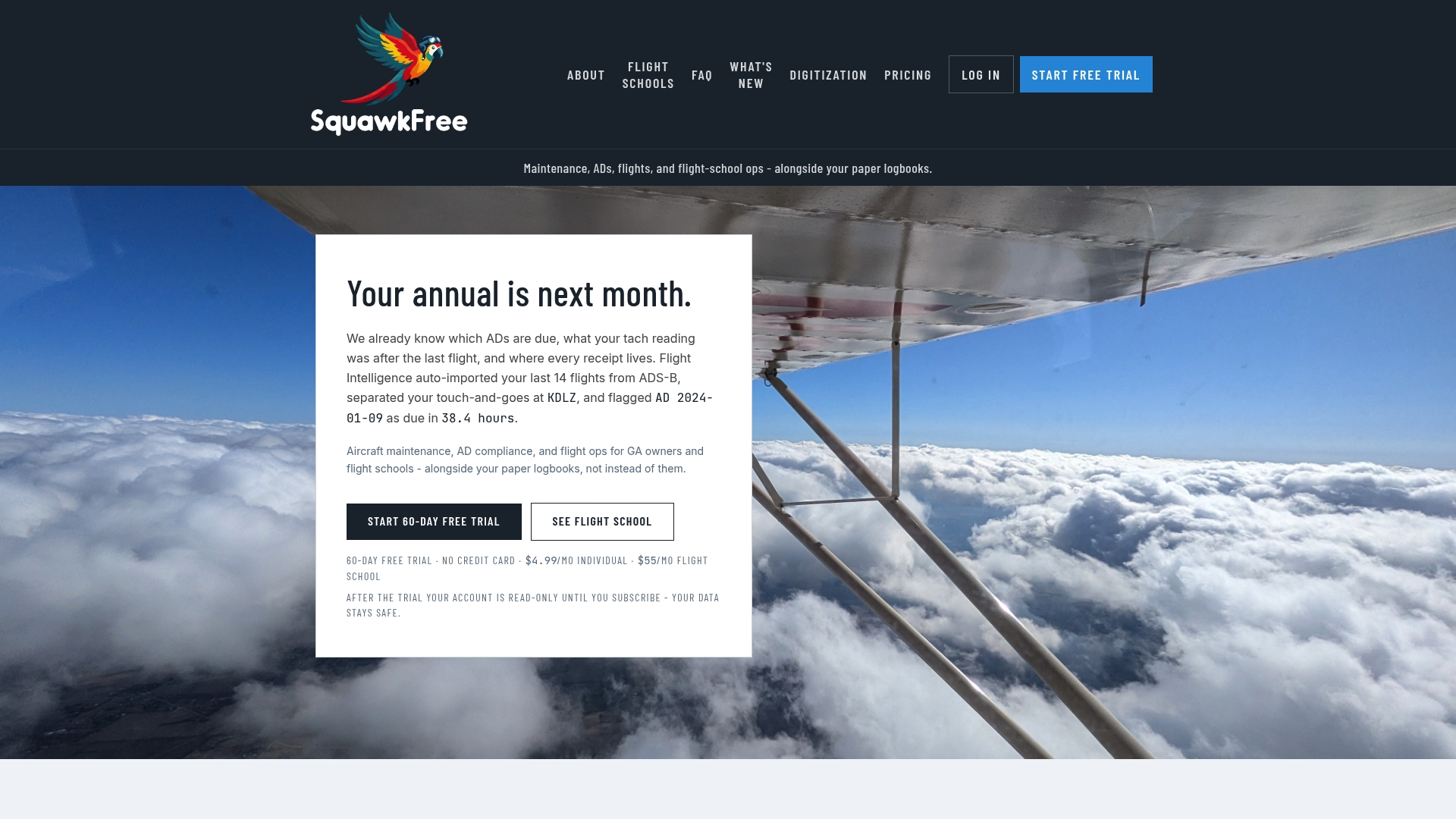
The optional Flight Intelligence add-on pulls flight data from ADS-B so each flight arrives ready to confirm rather than reconstructed from memory; the tach and Hobbs readings are yours to enter, and hours-based due dates are projected from your actual utilization. If you are moving from MyFBO, free data migration is included. Logbook digitization puts a human on every OCR’d entry, so you are not spending weeks on post-migration cleanup. The 60-day free trial gives your team enough time to run a real pilot with actual flight data before you commit.
Start your 60-day free trial at squawkfree.com to see the maintenance-to-scheduling workflow in action.
Useful sources and vendor pages
Use these links to inspect feature documentation, request demos, and verify current pricing directly with vendors.
- SquawkFree - Maintenance, AD tracking, scheduling, and Flight Intelligence for flight schools and GA owners. Start a 60-day free trial or request a demo.
- SquawkFree MyFBO migration - Details on free data migration for schools moving from MyFBO.
- SquawkFree logbook digitization - Human-verified OCR logbook digitization service for onboarding and migration.
- SquawkFree feature updates - Changelog and recent product releases.
- SkyDuty scheduling features - Gantt timeline, offline-first mobile, and multi-leg trip containers.
- Airplane Manager - Progressive web app scheduling for corporate jets with integrations and role-based security.
- Flightnet - Club and co-ownership scheduling with license management and billing.
- Optifly - Airline network scheduling OS; enterprise/airline scope only.
- Aeriel - Real-time business aviation scheduling with conflict detection and handling integration.
Before you sign: ask every vendor for a sandbox or test account, a sample data migration preview, and a written SLA for support response time. Those three requests will tell you more about a vendor’s operational maturity than any demo.
Recommended
No credit card required · read-only after trial