
Best FAA Audit Software for Aviation Compliance in 2026
What is the best FAA audit software?
The best FAA audit software depends on your operation type, but the leading options for U.S. aviation compliance in 2026 are SMS Pro, QMSmart, Ideagen, Inspectly360, CORRIDOR, and SquawkFree. Each addresses a distinct segment: SMS Pro serves airlines and FBOs at scale, QMSmart delivers full audit lifecycle management with offline capability, Ideagen brings AI-driven compliance monitoring to large enterprises, and SquawkFree focuses specifically on general aviation owners and flight schools with automated AD tracking and flight data import.
The core job of any aviation audit platform is to replace fragmented spreadsheets and paper checklists with a single, dated, auditable record that satisfies FAA inspectors on demand. FAA Part 139 §139.327 requires self-inspection records to be retained for twelve consecutive calendar months, and AC 150/5200-18D (which cancelled AC 150/5200-18C) directs that corrective actions be documented on checklists or separate work order systems. Software that automates that documentation trail is not a convenience; it is the compliance foundation.
Here is how the eleven leading solutions compare across the dimensions that matter most to compliance officers and quality assurance managers.
| Tool | Best For | Key Features | FAA Compliance Support | Mobile/Offline | Export/Reporting |
|---|---|---|---|---|---|
| SquawkFree | GA owners, flight schools | DRS AD search and tracking, maintenance logs, pre-flight checklists, cloud storage, optional ADS-B flight import | FAA AD compliance, airworthiness tracking | Responsive web (no offline mode) | ZIP export: JSON, CSV, PDF maintenance summary, ForeFlight and MyFlightbook logbook formats |
| SMS Pro | Airlines, airports, FBOs | Audit scheduling, CAPA tracking, safety management integration | Part 139, SMS compliance | Yes | Audit reports, regulatory documentation |
| QMSmart | Airlines, MROs, airports | Annual planning, regulation-linked checklists, CAPA tracking, offline sync | Part 139 and multi-regulation linkage | Yes, offline sync | Timestamped records, compliance reports |
| Ideagen | Large aviation enterprises | AI semantic search, predictive monitoring, automated scheduling, dashboards | Multi-regulation, enterprise compliance | Yes | Dashboard exports, findings reports |
| Inspectly360 | Operations directors, compliance managers | Timestamped photo evidence, corrective-action tracking, branded PDF reports | Defensible audit trail | Yes, offline capture | Branded PDF, portfolio dashboards |
| CORRIDOR | MROs, operators | Aviation-specific compliance workflows, designed by aviation professionals | MRO and operator compliance | Yes | Compliance documentation |
| Soma Software | Airlines, airports, operators | Full audit lifecycle management | Multi-operator compliance | Yes | Audit lifecycle reports |
| SafetyCulture (iAuditor) | Airports, FBOs, safety teams | Flexible checklists, safety audits, team collaboration | Adaptable to aviation safety domains | Yes | PDF and CSV exports |
| Baldwin ASMS | Operators needing safety/compliance integration | Integrated safety and audit management | Safety and compliance workflows | Yes | Safety management reports |
| Web Manuals | Airports, MRO facilities | Document revision control, compliance tracking | Document compliance | Yes | Revision history, compliance exports |
| Ideagen Risk Management / Ideagen Coruson | Large aviation enterprises | Enterprise risk and audit management, compliance specialization | Comprehensive risk and compliance | Yes | Enterprise risk reports |
Key value propositions across the category:
- Audit scheduling and annual planning tied directly to FAA regulatory cycles
- Checklist management with regulation-linked items for Part 139, Part 135, and Part 145
- CAPA tracking that closes the audit loop with verified corrective actions
- Mobile and offline data capture for field inspections at remote aviation sites
- Export compatibility with industry audit packs including Wyvern PASS™ and ARGUS CHEQ™
Table of Contents
- How do the top FAA compliance tools compare in depth?
- How does aviation audit software support FAA compliance?
- How do you choose the right FAA audit software for your operation?
- FAA audit compliance insights and SquawkFree’s approach for GA
- Trust signals and reliability in FAA audit software
- SquawkFree gives GA owners a focused alternative to enterprise audit platforms
- Key Takeaways
How do the top FAA compliance tools compare in depth?
Choosing among these platforms requires more than a feature checklist. The differences that matter in practice come down to operator fit, pricing transparency, and whether the software genuinely closes the audit loop or just opens it.
SMS Pro is the most widely deployed solution in this group, with over 450 airlines, airports, and FBOs using it for safety and quality management. The vendor claims it reduces audit preparation time by 40%, a figure that reflects its integrated approach to scheduling, findings management, and CAPA workflows. For any operator running a formal Safety Management System alongside audit obligations, SMS Pro’s depth is hard to match.
QMSmart stands out for its regulation-linked checklist architecture. Auditors can work offline in the field, and responses sync automatically once connectivity is restored. Closing the audit loop with verified corrective actions and document revision control in the same system prevents the fragmented records that trip up aviation quality teams during FAA reviews.
Ideagen targets large enterprises that need predictive compliance rather than reactive audit management. Its AI-driven platform uses semantic search to surface regulation changes and dashboards to track findings trends across multiple sites. For a single-location FBO, that level of complexity is overkill. For a multi-airport operator or a regional airline, it fits.
Inspectly360 takes a different angle: every audit record captures the inspector’s identity, timestamp, and photos, producing a defensible evidence trail that holds up under FAA scrutiny. Its mobile offline capture and corrective-action workflows are purpose-built for aircraft audits where connectivity is unreliable and documentation gaps are costly.
CORRIDOR was built by aviation professionals specifically for MRO and operator compliance workflows. That origin matters because the checklist logic and workflow structure reflect how maintenance organizations actually operate, not how a generic compliance platform assumes they do.
SafetyCulture (iAuditor) is the most flexible tool in the group. It is not aviation-specific, but its adaptable checklist builder and broad integration library make it a practical choice for airports and FBOs that need a general safety audit tool without the cost of a dedicated aviation platform.
Web Manuals focuses on document revision control and compliance tracking, making it a natural fit for MRO facilities and airports where manual version management is a persistent audit risk. Baldwin ASMS integrates safety management with audit workflows for operators who need both in one system. Soma Software covers the full audit lifecycle for airlines and multi-operator environments.
Ideagen Risk Management / Ideagen Coruson extends Ideagen’s core platform into enterprise risk management, combining audit compliance with risk registers and governance workflows for large aviation enterprises.
For Part 135 operators specifically, audit pack export to Wyvern PASS™ and ARGUS CHEQ™ is a critical differentiator. One-click export of fully indexed binders with cross-referenced documentation cuts the time spent preparing for third-party safety audits from days to minutes.
Pricing transparency varies widely across this group. Most enterprise platforms (Ideagen, CORRIDOR, Baldwin ASMS, Soma Software, Web Manuals, Ideagen Coruson) publish no public pricing and require a quote. QMSmart and Inspectly360 offer tiered plans, though specific figures are not publicly listed. SquawkFree publishes flat pricing - $4.99/month for an individual owner and $55/month for a flight school, with ADS-B flight import a $3/aircraft/month add-on - which makes cost predictable for small GA operations and flight schools. SafetyCulture (iAuditor) offers a free tier with paid plans for advanced features.
Pro Tip: Before requesting vendor quotes, document your exact regulatory obligations: which FAA parts apply, how many inspection cycles you run annually, and whether you need audit pack export for Wyvern PASS™ or ARGUS CHEQ™. That list cuts vendor demos from two hours to thirty minutes.
How does aviation audit software support FAA compliance?
Aviation audit software is the system that replaces paper checklists, shared spreadsheets, and email chains with a single platform that plans, executes, documents, and tracks every inspection activity required by the FAA.
The regulatory foundation is specific. FAA AC 150/5200-18D, which cancelled the 2004 revision C, addresses Part 139 airport safety self-inspection records, and §139.327 requires that self-inspection records be retained for at least twelve consecutive months as a written record of conditions and follow-up actions. That is not a suggestion; it is the minimum standard an FAA inspector will check. Software that automates date-stamping, record retention, and corrective-action documentation removes the human compliance risk from that requirement.
The audit management workflow in a well-configured platform covers four stages:
- Annual planning: Schedule inspection cycles, assign auditors, and map checklist items to specific FAA regulations before the audit year begins.
- Inspection execution: Auditors complete checklists on mobile devices, capturing findings with photos and timestamps in the field, with or without cell service.
- Findings management: Unsatisfactory conditions generate corrective-action requests automatically, routed to the responsible party with a due date.
- CAPA closure: Corrective and preventive actions are verified and closed within the same system, maintaining an unbroken audit trail.
The contrast with manual methods is concrete. A paper checklist filed in a binder requires a staff member to physically retrieve it, confirm the date, and verify that the corrective action note matches the work order. An auditor reviewing a digital record can confirm all of that in seconds, with a timestamped photo as supporting evidence. Mobile offline capability is not a luxury feature; aviation sites regularly have dead zones in hangars, on ramps, and in remote areas where inspections still need to happen.
For Part 135 operators, the compliance picture extends to pilot currency tracking, OpSpecs, and drug and alcohol program records. Audit pack compatibility with Wyvern PASS™ and ARGUS CHEQ™ formats means the documentation assembled for an FAA audit can be exported in the same format required by third-party safety auditors, eliminating duplicate preparation work.
Regulatory anchor: FAA Part 139 §139.301 specifies retention periods across six record categories, with self-inspection records at twelve consecutive calendar months and personnel training records at twenty-four. Software that enforces those retention windows automatically is the difference between a clean audit and a finding.
How do you choose the right FAA audit software for your operation?
The right platform is the one that matches your regulatory obligations, your team’s technical capacity, and your budget, not the one with the longest feature list.
Start with operator type. An MRO operating under Part 145 has different checklist requirements than a Part 139 airport or a Part 135 charter operator. CORRIDOR and QMSmart are built for MRO and multi-regulation environments. SMS Pro and Ideagen scale to airline and multi-airport operations. SquawkFree is purpose-built for GA owners and flight schools where the primary compliance obligations are AD tracking, airworthiness records, and pre-flight documentation.
Critical selection criteria:
- FAA regulation coverage: Confirm the platform explicitly supports the parts that govern your operation (Part 139, Part 135, Part 145, or Part 91). Generic audit tools may require manual configuration to align with FAA-specific requirements.
- Checklist and audit pack support: If you face Wyvern PASS™ or ARGUS CHEQ™ audits, native export capability is a hard requirement, not a nice feature.
- Offline and mobile usability: Field inspections happen where connectivity does not. Test the offline mode before committing to any platform.
- CAPA tracking and audit trail integrity: The platform must close the loop from finding to verified corrective action within a single, unbroken record.
- Integration with existing systems: Document management, maintenance tracking, and scheduling tools you already use should connect to the audit platform without manual data re-entry.
Total cost of ownership goes beyond the subscription fee. Factor in onboarding time, training for your inspection team, and the cost of data migration from your current system. Enterprise platforms like Ideagen and Ideagen Coruson typically require professional services for implementation. Lighter platforms like SquawkFree and SafetyCulture (iAuditor) are designed for faster self-service setup.
Vendor support quality is a practical differentiator during an actual FAA inspection. Ask each vendor specifically how they handle urgent support requests and what their average response time is. A compliance platform that goes dark during a ramp check is worse than a well-maintained spreadsheet.
Pro Tip: Request a sandbox environment and run a simulated Part 139 self-inspection cycle before signing any contract. Specifically test the retention and audit-trail controls to confirm they meet the twelve-month record requirement under §139.327 without manual intervention.
FAA audit compliance insights and SquawkFree’s approach for GA
The most common gap in aviation audit programs is not missing checklists. It is missing evidence. FAA inspectors expect a dated, inspectable written record that links each inspection to its corrective action, and that record must be retrievable by inspection cycle without relying on a staff member’s memory of where it was filed.
FAA AC 150/5200-18D is explicit: corrective actions must be documented on the self-inspection checklist or on a separate work order system, and the connection between the finding and the action must be traceable. Software that stores checklists in one module and work orders in another, with no automated link between them, creates exactly the fragmented record that fails an audit review.
For general aviation owners and flight schools, the compliance picture is different from Part 139 airports but no less demanding. Airworthiness directives must be tracked against each aircraft’s specific configuration, maintenance records must be current and accessible, and pre-flight documentation needs to be consistent and dated. SquawkFree was built specifically for this environment.
What SquawkFree delivers for GA and flight school compliance:
- Optional ADS-B flight import that proposes each flight with date, route, and duration filled in, so flights are reviewed and confirmed rather than reconstructed from memory; you enter the tach and Hobbs readings
- FAA Dynamic Regulatory System AD search by make and model, with the directives you determine apply imported against that aircraft and tracked for compliance
- Maintenance log management with cloud document storage, accessible to co-owners, CFIs, and maintenance personnel with role-based permissions
- Pre-flight checklist management with consistent, dated records for every flight
- Logbook digitization using OCR plus human review of every entry, converting paper records into structured, searchable digital records
- Scheduling tools for flight schools managing fleet availability and dispatch
The AD compliance tracking in SquawkFree addresses one of the most time-consuming manual tasks in GA maintenance management. Cross-referencing every applicable AD against an aircraft’s configuration, then confirming compliance status, is work that takes hours per aircraft when done manually. SquawkFree pulls the DRS search into the app and keeps compliance status against each imported directive, so open and due-soon items show up on the dashboard. Deciding applicability against your serial and part numbers is still yours to do; the software tracks the answer, it does not determine it.
For flight schools specifically, the combination of automated flight logging, fleet scheduling, and maintenance tracking in a single platform reduces the administrative load that typically falls on the chief flight instructor or director of maintenance. That means more time on instruction and less on paperwork.
Compliance note: Regulators expect an inspectable, dated written record trail that links inspections and corrective actions. Software retention mechanics are as important as the user interface. A platform that produces the right records but cannot retrieve them by inspection cycle fails the same test as paper.
Trust signals and reliability in FAA audit software
Trust in aviation compliance software is built on track record, not marketing claims. The signals that matter to a compliance officer are adoption by peer organizations, documented regulatory alignment, and vendor responsiveness when something goes wrong.
SMS Pro’s adoption by over 450 operators across airlines, airports, and FBOs is the most concrete adoption signal in this category. That scale means the platform has been tested against a wide range of FAA audit scenarios and has survived real regulatory reviews. It also means the vendor has a large enough customer base to fund ongoing regulatory updates as FAA requirements evolve.
Ideagen’s enterprise customer base in regulated industries, including aviation, energy, and life sciences, signals that its compliance architecture has been validated in high-stakes audit environments. Its AI-driven monitoring and predictive compliance features reflect investment in keeping pace with regulatory change rather than just documenting current state.
Inspectly360’s approach to trust is evidence-based in a literal sense. Every audit record captures the inspector’s identity, the exact time, and photographic evidence, producing a record that is defensible not just to the FAA but to any third-party auditor reviewing the documentation. That timestamped evidence trail is the kind of detail that matters when an audit finding is disputed.
For GA owners and flight schools evaluating SquawkFree, the trust signal is specificity. A platform built exclusively for general aviation, with direct ADS-B integration and FAA AD search built into the core product, reflects a depth of domain knowledge that general-purpose audit tools cannot replicate. The logbook digitization service with human-verified OCR adds a layer of accuracy assurance that automated-only digitization cannot match, which matters when those records are the foundation of an airworthiness determination.
The practical test for any vendor’s reliability is their support model during an active FAA inspection. Ask for references from operators who have used the platform during an actual audit, not just during routine compliance management. The vendors who can provide those references have earned the trust signal; the ones who cannot have not yet proven it under pressure.
SquawkFree gives GA owners a focused alternative to enterprise audit platforms
Most of the platforms compared in this article are built for airlines, airports, and MROs. They are priced, configured, and supported for organizations with dedicated compliance teams and IT departments. If you are a GA aircraft owner, a co-owner group, or a flight school, you do not need an enterprise audit platform. You need a tool that tracks your ADs, logs your flight hours automatically, and keeps your maintenance records organized and accessible when the FAA asks for them.
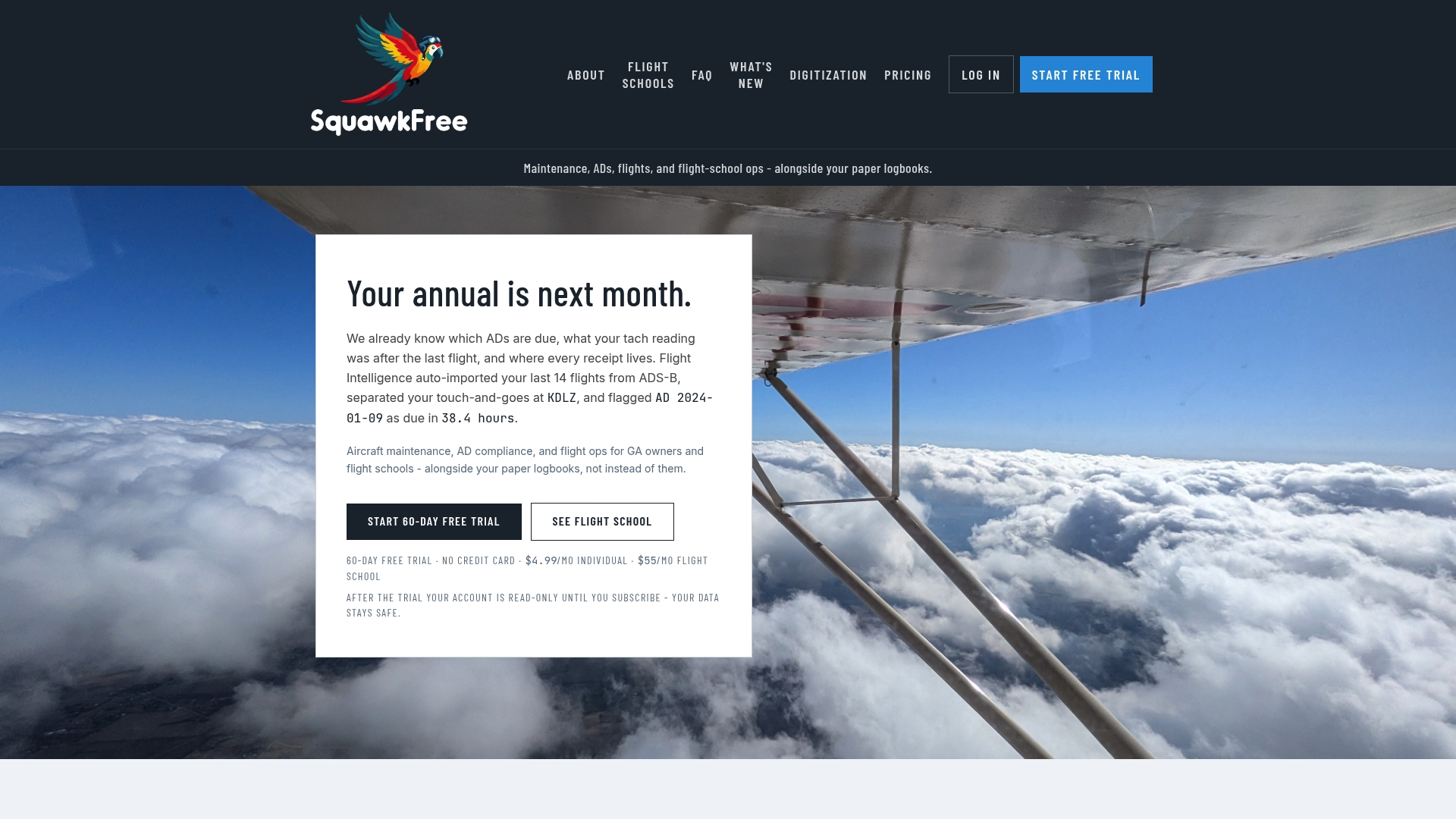
SquawkFree is that tool. An optional ADS-B add-on proposes your flights for review so the hours stay current with minimal typing, DRS AD search runs inside the app against the directives you have imported for each aircraft, and your maintenance records sit in cloud storage with per-aircraft permissions for your A&P, co-owners, and CFIs. Flight schools get dispatch, billing, and fleet scheduling built in alongside the compliance tools. Pricing is a flat $4.99/month for an individual owner or $55/month for a flight school, plus $3/aircraft/month if you enable ADS-B flight import, rather than an enterprise contract you will never fully use.
If your paper logbooks need to be audit-ready, SquawkFree’s logbook digitization service converts them to searchable digital records using human-verified OCR, not just automated scanning. Start with the 60-day free trial at squawkfree.com and see how much of your current compliance workload disappears in the first week.
Key Takeaways
The most defensible FAA audit program combines regulation-linked checklists, automated CAPA tracking, and immutable dated records that can be retrieved by inspection cycle without manual effort.
| Point | Details |
|---|---|
| Record retention is non-negotiable | FAA Part 139 §139.327 requires self-inspection records for twelve consecutive calendar months; software must enforce this automatically. |
| CAPA closure in one system | Fragmented records across separate checklist and work order tools create audit gaps; verified corrective actions must live in the same audit trail. |
| Offline mobile capability matters | Aviation sites have connectivity dead zones; platforms like QMSmart and Inspectly360 sync offline responses automatically when back online. |
| Match the platform to your operation | Enterprise tools like Ideagen and SMS Pro fit airlines and multi-airport operators; GA owners and flight schools are better served by SquawkFree’s focused feature set. |
| SquawkFree for GA compliance | SquawkFree covers DRS AD search, compliance tracking, and maintenance log management for GA owners and flight schools, with ADS-B flight import as an add-on. |
Recommended
No credit card required · read-only after trial