
Digital Aircraft Records: The FAA Compliance Guide for GA Owners

Digital Aircraft Records: The FAA Compliance Guide for GA Owners
Digital aircraft records are FAA-acceptable when stored in a controlled electronic recordkeeping system that enforces audit trails, role-based access, version control, and secure immutable backups. That is the short answer. The longer one is that the FAA has provided clear guidance through AC 120-78B and 14 CFR §91.417 on exactly what those controls must look like, and most operators who think they have a digital system actually have a folder of scanned PDFs that would not survive an inspection.
Your immediate next step: run your current setup against the AC 120-78B checklist and verify retention compliance under §91.417. If your system cannot produce a timestamped audit trail on demand, it is not yet compliant. Squawkfree’s 60-day free trial gives you a working, FAA-aligned system to test against your current records today.
Key Takeaways
Digital aircraft records are FAA-acceptable under AC 120-78B and 14 CFR §91.417 when stored in a governed system with audit trails, role-based access, and secure backups — not merely as scanned images in a shared folder.
| Point | Details |
|---|---|
| FAA acceptance is conditional | Digital records comply only when the system provides audit trails, access controls, and electronic signatures per AC 120-78B. |
| Retention rules are specific | Records like total time in service and life-limited part status must be kept indefinitely and transfer with the aircraft under §91.417. |
| Digitization requires staged QA | Prioritize high-value records first; use human-verified OCR and a two-person QA check for safety-critical entries. |
| Security is a compliance requirement | MFA, role-based access, geo-redundant backups, and full export capability are not optional — they are part of what AC 120-78B evaluates. |
| Squawkfree covers the full requirement | Squawkfree combines AD tracking, human-verified logbook digitization, and Flight Intelligence automated import in one FAA-aligned platform. |
Table of Contents
- What counts as digital aircraft records?
- Are digital records accepted by the FAA?
- What features must a compliant digital records system provide?
- How do you convert paper logbooks to verified digital records?
- How do you protect the integrity of your digital records?
- How do you choose the right digital records system?
- Why Squawkfree fits this need
- What the digitization process actually demands from operators
- Squawkfree gives you a compliant digital records system from day one
- Sources
What counts as digital aircraft records?
The term “digital aircraft records” covers every document and data entry that supports airworthiness, maintenance history, and regulatory compliance for a specific aircraft. Knowing which records belong in a digital system is the first step before you scan a single page.
Record types that must be in scope:
- Airframe, engine, and propeller logbook entries (tach hours, Hobbs time, dates, squawks, sign-offs)
- FAA Form 337s for major repairs and alterations
- Supplemental Type Certificate (STC) documentation
- Component and life-limited part histories (serial numbers, times-in-service, removal/installation dates)
- Airworthiness Directive (AD) compliance evidence, including method of compliance and sign-off credentials
- Overhaul and inspection records (annual, 100-hour, progressive)
- Inspection worksheets and return-to-service entries
Structured digital records with searchable fields and linked documents give maintenance directors and auditors a clearer, retraceable history than paper alone. That advantage disappears if you store only flat image files with no metadata.
Acceptable file formats and their limits:
Searchable PDFs work for narrative entries and scanned documents, but only when paired with indexed metadata. XML and JSON exports handle structured fields like component times and AD tracking data. CSV files suit manifest-level records. Scanned images alone, stored in a shared drive with no indexing, are not sufficient under AC 120-78B.
Metadata fields to capture for every record:
- Aircraft registration (N-number) and serial number
- Engine and propeller serial numbers
- Total time in service and time since overhaul at the time of entry
- Technician name, certificate number, and signature credential
- Entry timestamp and document type tag (logbook entry, 337, AD compliance, etc.)
Capturing this metadata at ingestion, rather than retrofitting it later, is what separates a compliant migration from a compliance liability.
Are digital records accepted by the FAA?
Yes, unambiguously. AC 120-78A established that electronic recordkeeping is an acceptable means for records required by 14 CFR when implemented within documented procedures and controls. AC 120-78B updated and strengthened that guidance, specifying that compliance depends on system controls, not on the medium itself.
What the FAA actually evaluates during an audit is governance: documented procedures, a software management program, and operator-level controls that make the electronic system traceable and tamper-evident. A well-governed digital system is more audit-ready than a paper logbook, not less.
Retention periods under 14 CFR §91.417
14 CFR §91.417 draws a clear line between records you keep indefinitely and records with finite retention:
Keep indefinitely (transfer with the aircraft):
- Total time in service for the airframe, engines, and propellers
- Current status of life-limited parts
- Time since last overhaul of components required to be overhauled on a fixed schedule
- Current inspection status and time since last inspection
- Records of major alterations and repairs (Form 337s)
Keep for 12 months (or until superseded):
- Records of maintenance, preventive maintenance, and alterations performed
- Records of 100-hour, annual, and progressive inspections
Audit-readiness checklist
Your digital system must be able to demonstrate each of the following to an FAA inspector on short notice:
- Electronic signatures tied to certificate holder credentials
- Traceable approvals with timestamps for every entry
- Indexed retrieval by aircraft, date, record type, and component
- Preservation of the original scanned image alongside structured data fields
- Documented procedures for how records are created, modified, and retained
Pro Tip: Keep a printed one-page index of your digital system’s folder structure and retention schedule in the aircraft’s physical records envelope. Inspectors appreciate a quick reference, and it demonstrates that your governance is real, not theoretical.
AC 43-9C reinforces these standards for maintenance documentation quality and points operators directly to AC 120-78 when implementing electronic systems.
What features must a compliant digital records system provide?
Moving to digital is not just scanning paper to PDF. For a system to qualify as an FAA-compliant electronic recordkeeping system under AC 120-78B, it must provide specific technical controls. The table below maps each required feature to its compliance or operational purpose.
| Feature | Compliance or Operational Purpose |
|---|---|
| Role-based access control | Limits who can create, edit, or approve entries; supports least-privilege security |
| Immutable audit trail | Demonstrates chain of custody to an inspector; shows every change, who made it, and when |
| Electronic signature controls | Ties sign-offs to certificate credentials; satisfies AC 120-78B signature requirements |
| Full-text search and indexing | Enables rapid retrieval during audits; reduces inspector wait time |
| AD and SB tracking with alerts | Automates compliance monitoring; flags overdue or upcoming directives |
| Component history linking | Connects part serial numbers to installation, removal, and overhaul records |
| Geo-redundant backups | Protects records against data loss; supports business continuity |
| Export and handover packages | Allows full records transfer at aircraft sale or operator change |
On the technical side, look for SAML or SSO identity management so user credentials are centrally managed and revocable. Encryption at rest and in transit is a baseline expectation, not a premium feature. Export formats should include both human-readable PDFs and machine-readable structured data (CSV or JSON) so records remain usable regardless of which platform you use in the future.
Cloud platforms and modern digital authentication tools are increasingly used to secure and manage aircraft records, improving transferability and auditability across ownership changes. Software platforms that link maintenance events to flight data also reduce manual entry and improve aircraft uptime, as reporting on business aviation has documented.
For a deeper look at how these features translate to day-to-day tracking, the aircraft maintenance tracking guide covers integration expectations and software selection criteria in detail.
How do you convert paper logbooks to verified digital records?
Digitization is a project, not a one-time scan. Operators who treat it as a quick task end up with incomplete records that create more compliance risk than the paper they replaced. A staged approach keeps the process manageable and the output defensible.
The six-stage digitization process
- Audit current records. Inventory every physical document: logbooks, 337s, STCs, AD compliance records, component histories. Note condition issues (faded ink, water damage, missing pages) before you start.
- Classify and prioritize. High-value records come first: engine and propeller times, life-limited part histories, Form 337s, and AD compliance evidence. Lower-priority logs (routine squawk entries, older inspection worksheets) can follow in a second pass.
- Scan and OCR. Scan at a minimum of 300 DPI for legibility. Run optical character recognition (OCR) to produce searchable text. Flag any page where OCR confidence falls below your acceptance threshold.
- Structured data capture. Extract key fields (dates, times-in-service, certificate numbers, part serials) into structured database fields. This step is what separates a compliant system from a folder of images.
- Verification and QA. Every safety-critical entry (life-limited parts, AD compliance sign-offs, overhaul records) requires two-person verification: one person reviews the OCR output against the original scan, a second person confirms acceptance. Document any migration exceptions in a QA log.
- Import into your chosen system. Load verified records into your digital platform with full metadata. Confirm that audit trails are active before decommissioning paper originals.
Pro Tip: Never discard original paper logbooks immediately after digitization. Keep them for at least one full inspection cycle while you confirm the digital records pass an inspector’s review. Some operators retain originals indefinitely as a secondary backup.
Typical timeline and cost drivers
Timeline and cost vary by scope. A single-aircraft general aviation logbook with clean handwriting typically takes several weeks from scan to verified import. A multi-aircraft fleet with decades of mixed handwriting and condition issues can take several months.
The main cost drivers are page volume, handwriting legibility, and whether you use human-verified OCR. Human-verified OCR, where machine output is reviewed by a qualified person, produces fewer migration exceptions and smoother audits than automated OCR alone. Squawkfree’s logbook digitization service combines OCR with human verification specifically to meet this standard.
A staged migration, starting with high-value records, also reduces operational disruption. You can have your most critical compliance evidence in a searchable digital system within weeks, even if the full migration takes longer.
How do you protect the integrity of your digital records?
Security and backup practices are not optional extras. They are part of what makes a digital system compliant under AC 120-78B. An inspector who asks how your records are protected against unauthorized modification or data loss expects a specific answer.
Operational security checklist:
- AES-256 encryption at rest and TLS in transit for all record data
- Multi-factor authentication (MFA) for all user accounts
- Role-based access policies that limit editing rights to authorized personnel
- SSO integration so that departing employees lose access immediately when their organizational credentials are revoked
- Least-privilege access: dispatchers and students see what they need; only certificated technicians can create or approve maintenance entries
Backup and handover practices:
Geo-redundant backups, stored in at least two geographically separate data centers, protect against regional outages. Your system should allow you to export a complete records package, including original scanned images and structured data, at any time. This matters most at aircraft sale or transfer: a buyer’s lender or inspector will want a full records package, and a system that cannot produce one creates a transaction risk.

Pro Tip: Schedule a quarterly export of your full records set and store it in a separate, encrypted location outside your primary platform. If your vendor experiences an outage or goes out of business, you have a complete, portable copy.
Audit trails should be time-stamped, tamper-evident, and retained for the life of the record. Every entry should show who created it, when, from which credential, and whether it was subsequently modified. That log is your chain-of-custody evidence.
How do you choose the right digital records system?
The market has no shortage of options, and the differences between them matter more than the marketing suggests. Use this checklist to cut through the noise.
Must-have criteria
- Documented AC 120-78B compliance with audit trail, access control, and electronic signature controls
- Full data export in portable formats (PDF + structured data) at any time, without vendor assistance
- Human-verified OCR option for legacy handwritten logbooks
- AD and SB tracking with automated alerts tied to your specific aircraft
- Role-based access with MFA and SSO support
- Geo-redundant backups with a documented recovery time objective
Nice-to-have criteria
- ADS-B or avionics integration for automated flight data import
- Scheduling and dispatch tools for flight schools or co-ownership groups
- Mobile access for pre-flight checks and squawk entry
- Analytics dashboards for fleet health and maintenance forecasting
Red flags to watch for
- No audit trail, or an audit trail that can be edited or deleted
- No data export option, or export requires a support ticket and a waiting period
- Unclear retention policy: the vendor cannot tell you where your data is stored or for how long
- No handover package process for aircraft sale or platform migration
- Vendor will not provide a written statement of AC 120-78B readiness
Vendor questions to ask
- Can you provide a written statement confirming your system meets AC 120-78B requirements for audit trails, access control, and electronic signatures?
- What is your process for exporting a complete records package, and how long does it take?
- How do you handle human verification for handwritten legacy logbooks?
- How does your AD tracking work, and how quickly are new directives added after FAA publication?
- What are your SLAs for uptime and data recovery?
- Who owns the data if we cancel our subscription?
Trust signals worth weighting: a vendor that publishes its FAA compliance documentation, maintains a documented QA process for digitization, and can point to real operator case studies is meaningfully different from one that claims compliance without evidence. The aircraft recordkeeping compliance guide covers what to look for in detail.
Why Squawkfree fits this need
Squawkfree was built specifically for general aviation owners, co-owners, and flight schools, which means its feature set maps directly to the compliance and operational requirements covered in this guide.
| GA Owner/Operator Need | Squawkfree Capability |
|---|---|
| FAA-compliant audit trail | Immutable, timestamped entry log with credential-linked sign-offs |
| AD tracking and alerts | Direct FAA AD search integration with automated compliance alerts |
| Logbook digitization | Human-verified OCR service for legacy paper logbooks |
| Automated flight data import | Flight Intelligence feature imports ADS-B data without manual entry |
| Role-based access | Configurable roles for owners, instructors, dispatchers, and students |
| Cloud document storage | Secure, geo-redundant storage with full export capability |
| Scheduling and dispatch | Built-in tools for flight school scheduling, billing, and fleet management |
Onboarding typically begins with a records audit and import of your existing maintenance history. For operators using the logbook digitization service, human-verified OCR converts paper logs into structured, searchable records before they enter the platform. Flight Intelligence then takes over for ongoing flight data, pulling ADS-B data automatically so tach hours and flight times stay current without manual entry.
The practical outcome is faster audits, because every record is indexed and retrievable in seconds, and fewer missed ADs, because the system monitors your specific aircraft’s compliance status continuously. For flight schools, the dispatch and billing tools add operational efficiency on top of the compliance foundation.
Squawkfree’s AD compliance resources and airworthiness directive explainer also give operators the background knowledge to understand what the system is tracking and why.
What the digitization process actually demands from operators
Most operators underestimate the governance side of going digital. The technology is the easy part. What actually determines whether your digital records hold up in an audit is whether you have documented procedures for how entries are created, who can approve them, and what happens when a record needs correction.
The FAA’s consistent message across AC 120-78A and AC 120-78B is that a compliant electronic system is a governed system. That means written procedures, not just software. Operators who deploy a capable platform but skip the procedure documentation are still exposed.
My practical advice: treat your first digitization project as a process design exercise, not just a data migration. Build your QA log, your role assignments, and your exception-handling procedure before you scan the first page. The operators who do this find that their first post-digitization inspection goes smoothly. The ones who skip it often discover gaps at the worst possible time.
Squawkfree gives you a compliant digital records system from day one
Paper logbooks and shared drives leave gaps that show up at the worst time: during an annual, at aircraft sale, or when an AD deadline is closer than you realized. Squawkfree closes those gaps with a purpose-built platform that handles AD tracking, maintenance logging, and logbook digitization in one place, backed by human-verified OCR for legacy records.
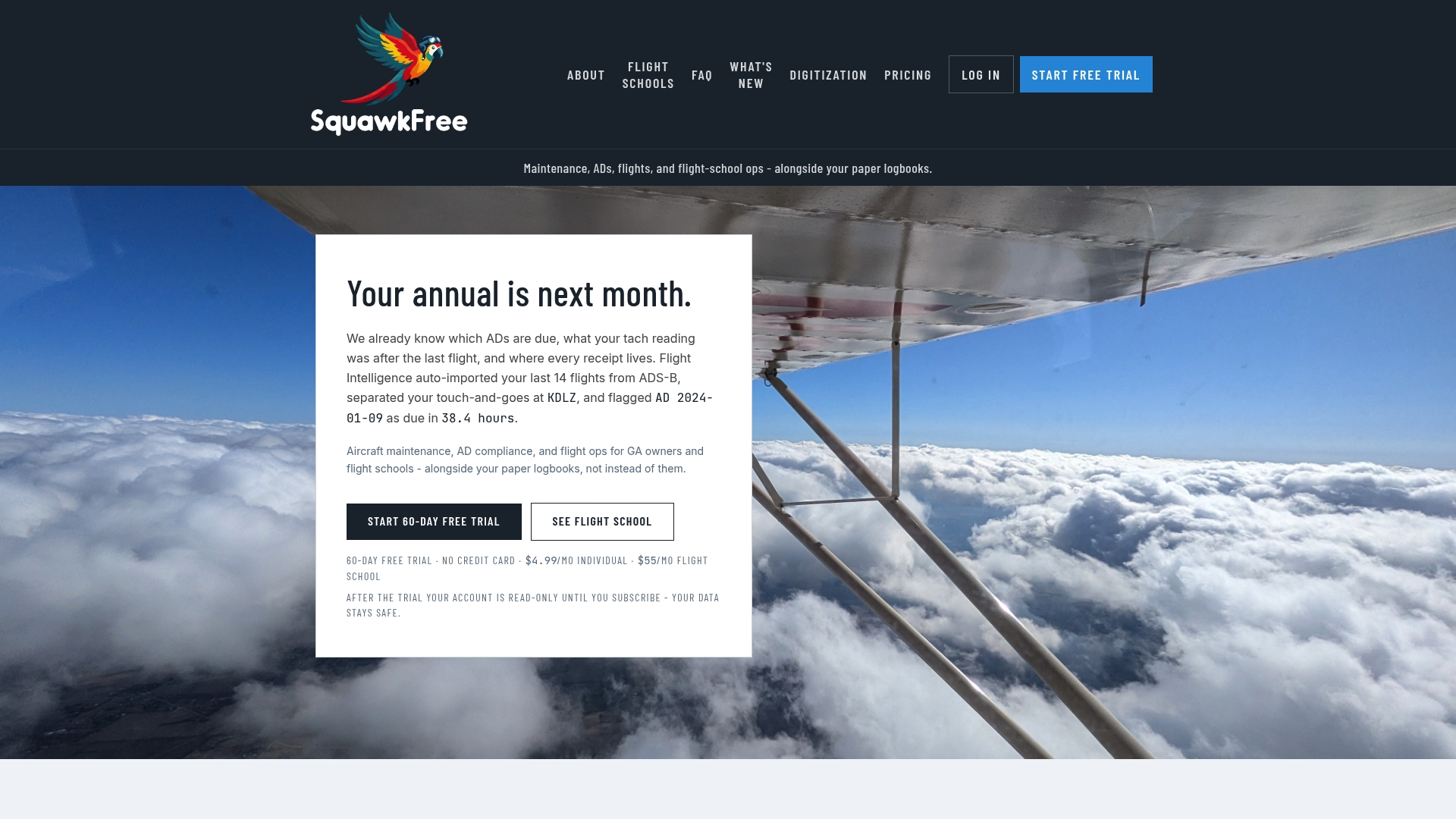
The 60-day free trial gives you full access to the platform so you can import your maintenance history, set up role-based access, and see how AD alerts work against your specific aircraft before you commit. The logbook digitization add-on is available when you are ready to convert paper records to verified, searchable digital files. Start your free trial at Squawkfree today and have a compliant, audit-ready records system running before your next inspection.
Sources
The sources below are the authoritative references behind this guide. When preparing your internal compliance documentation or responding to an inspector’s questions, citing these directly strengthens your position.
- AC 120-78B - Electronic Signatures, Electronic Recordkeeping, and Electronic Manuals
- 14 CFR §91.417 - Maintenance, preventive maintenance, and alteration records
When documenting your compliance evidence internally, reference the specific AC section or CFR paragraph that applies to each control your system implements. Inspectors respond well to operators who can point to the regulatory basis for their procedures, not just assert that their system is compliant.
Recommended
No credit card required · read-only after trial