
Pilot Logbook Digitization Cost: What to Expect in 2026

Pilot Logbook Digitization Cost: What to Expect in 2026
Professional conversion costs for a single pilot logbook vary widely based on entry count, handwriting legibility, and verification level, with multi-logbook career packages generally costing more. For U.S. pilots who need career-accurate records, Squawkfree’s human-verified OCR service is the recommended option. Standard turnaround usually takes one to three weeks, and expedited delivery often incurs an additional fee.
Key budget benchmarks at a glance:
- Student logbook (under 200 entries): $75–$150
- Private pilot logbook (500–1,000 entries): $150–$300
- Career logbook (2,500–3,500 entries): $300–$600+
- Multi-logbook career package: $450–$900+
- Expedited fee (where offered): $70–$249 additional
Keep your original paper logbooks after conversion. AOPA reporting confirms that originals may still be required for insurance, legal verification, or FAA inspections, even when a verified digital copy exists.
Key Takeaways
Professional logbook digitization costs $75–$600 for most U.S. pilots, with human-verified services costing more but delivering the accuracy that career-critical records require.
| Point | Details |
|---|---|
| Typical cost range | Single logbooks run $75–$450; career multi-logbook packages reach $450–$900 or more. |
| Per-entry pricing scales | Rates drop from $0.20/entry at low volumes to $0.05/entry at 5,000+ entries with tiered providers. |
| Human verification matters | AOPA reporting endorses human-verified services for airline applications; AI-only tools shift QC work back to you. |
| Expedited fees add up | Expedited delivery typically adds $70–$249; plan lead time to avoid this cost on standard jobs. |
| Squawkfree recommendation | Squawkfree offers human-verified OCR with formatted export and FAA compliance integration for U.S. pilots. |
Table of Contents
- How do providers charge for logbook digitization?
- What factors raise or lower your digitization quote?
- What service levels can you buy?
- Sample cost calculations for three logbook sizes
- How do you choose the right digitization provider?
- DIY vs. professional conversion: which makes sense for you?
- Squawkfree’s digitization service: what’s included
- What SLA and contract terms should you expect?
- Recommended U.S.-based digitization services
- Ready to get an accurate quote from Squawkfree?
- Sources
How do providers charge for logbook digitization?
Pricing models vary more than most pilots expect, and understanding them is the only way to compare quotes accurately.
Per-entry pricing is the most common model for pilot logbook conversion. Each flight row counts as one entry. CrossCheck Hub publishes a tiered structure that illustrates how this scales: $0.20 per entry for up to 500 entries, dropping to $0.17 per entry for 501–750, and continuing down to $0.05 per entry at 5,000 or more entries. Volume discounts are real, so a career logbook with 3,000 entries costs significantly less per entry than a student book with 150.
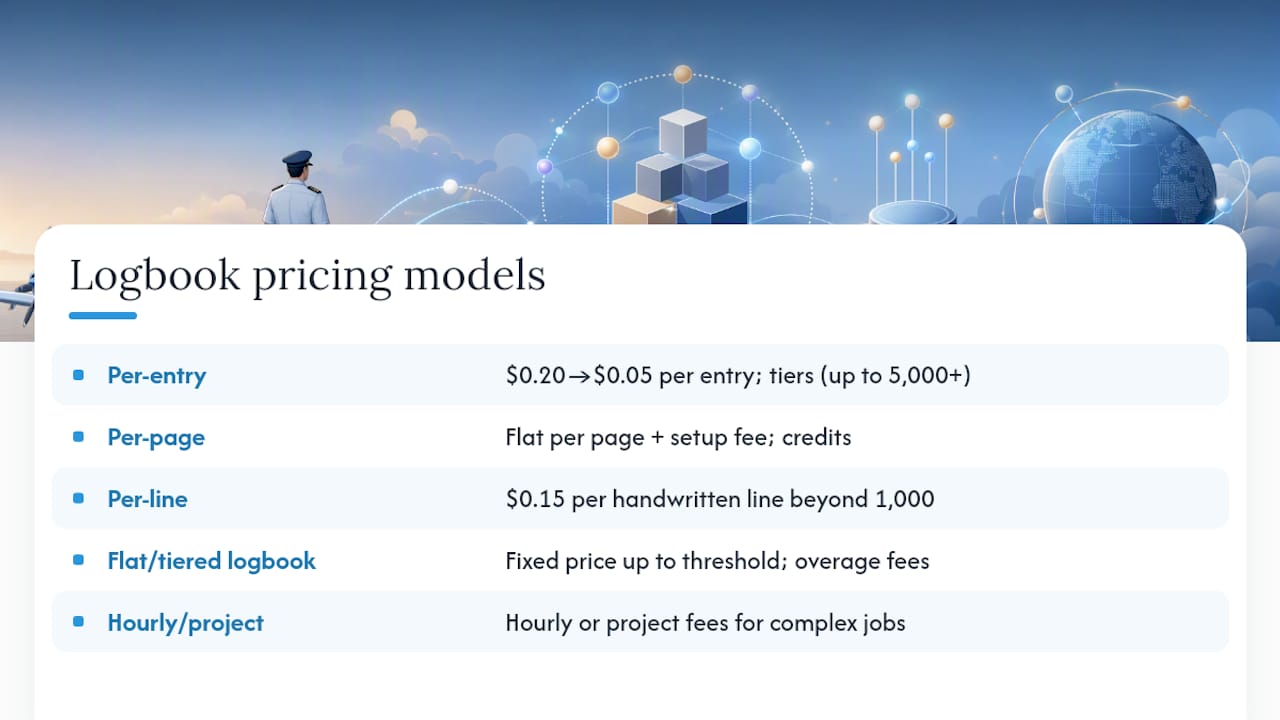
Per-page pricing suits logbooks with dense, multi-column pages where counting individual entries is impractical. Some providers charge a flat rate per scanned page plus a setup fee, with membership or annual plan credits that offset the base cost.
Per-line pricing is a variant used by some services for handwritten remarks. Beyond Blue Logbooks, for example, charges $0.15 per handwritten line beyond 1,000 confirmed lines, which means a logbook heavy with endorsements and remarks can cost noticeably more than the base quote suggests.
Flat or tiered per-logbook pricing works well for straightforward books with standard formats. A provider quotes a fixed price for a logbook up to a certain page or entry count, then charges overage fees beyond that threshold.
Hourly or project-based fees apply to complex jobs: dual logbooks with cross-referenced entries, non-standard formats, or full audit packages for airline applications.
What factors raise or lower your digitization quote?
The base rate is only the starting point.
- Handwriting legibility. Faded ink, cramped columns, or personal shorthand forces human reviewers to spend more time per entry. Providers often flag this during a sample review and adjust the quote accordingly.
- Entry count vs. page count. A logbook with many short entries per page can be more expensive under per-entry pricing than per-page pricing. Run both calculations before you commit to a vendor.
- Remarks, endorsements, and attachments. Extra handwritten remarks, instructor signatures, medical certificate scans, or attached documents are almost always billed separately. Ask for a line-item breakdown before you approve the estimate.
- Desired output format. A plain CSV export costs less than a formatted import file built for LogTen Pro or a custom template. If you need the data imported directly into a platform, budget for that step.
- Turnaround speed. Standard service (one to three weeks) is priced into the base rate. Expedited delivery typically adds a flat fee, with vendor examples ranging from $70 to $249.
- Shipping and return of originals. If you mail physical books, factor in two-way shipping. Some providers offer scan-only service where originals are returned; others offer secure destruction after scanning.
Pro Tip: Before you send your logbook, photograph every page with your phone. This gives you a personal backup and a reference if any dispute arises about the condition of the original.
What service levels can you buy?
Not every conversion service delivers the same thing, and the price difference between tiers is substantial.
Scan-only (image capture) produces a PDF or image archive of your logbook pages. You get a searchable image file, but no structured data. This is appropriate for archival purposes or insurance documentation, not for building a flight-hour summary you can hand to an airline recruiter.
AI/OCR-only conversion uses optical character recognition to extract text from scanned pages and populate a spreadsheet or database. Cost is lower, but aviation abbreviations, non-standard column headers, and faded ink create errors that the software cannot flag. The quality-control burden shifts back to you. Some services, such as LogbookScan, offer a few free pages to let you test output quality before committing.
Human-verified transcription is the tier recommended for career records. A trained reviewer checks every OCR-generated entry against the original image, corrects misreads, and confirms hour totals. AOPA’s reporting on pilot logbook digitization specifically endorses human verification for airline applications and interview packages, noting that aviation handwriting and abbreviations create meaningful error risk for automated tools alone.

Formatted import services go one step further: the provider delivers a file structured for a specific platform (Excel, CSV, LogTen Pro, or a custom importer). Some platforms charge an additional import or setup fee on top of the transcription cost.
Privacy and security vary by vendor. Look for encrypted file transfer, a clear data-retention policy, and written confirmation of whether originals are returned or destroyed.
Sample cost calculations for three logbook sizes
These worked examples use representative market rates to help you approximate your own conversion expense.
The student logbook total reflects a typical minimum-job fee that most providers apply regardless of entry count, which is why the math on 150 entries at $0.20 each ($30) still lands closer to $75–$100 in practice.
For the career scenario, one real-world data point anchors the range: an AOPA author paid approximately $600 for two logbooks through a professional service, describing the DIY alternative as “soul-sucking” and the paid result as worth every dollar for the peace of mind it provided before an airline application.
If a provider offers an online cost calculator or instant estimate tool, use it with your actual entry count and a sample page image. Calculators that factor in handwriting quality and remarks density will give you a more accurate number than any generic table.
How do you choose the right digitization provider?
A short checklist and a few pointed questions will protect you from vague quotes and missed deliverables.
- Confirm your required output format before you contact anyone. Know whether you need a CSV, a LogTen-compatible file, or a formatted import for a specific platform.
- Ask how entries are counted. Do remarks lines count as separate entries? Are endorsements included in the base price?
- Request a sample conversion of two to three pages before you pay. Any reputable provider will accommodate this.
- Get a written estimate that itemizes base fee, remarks charges, expedited fees, and shipping. A verbal quote is not a contract.
- Confirm the accuracy guarantee and dispute process. What happens if totals are wrong after delivery? Is a redo included, or is there a correction fee?
- Review the privacy and data-handling policy. Confirm encrypted transfer, data-retention limits, and whether originals are returned or destroyed.
- Check turnaround time in writing. Standard and expedited timelines should appear in the service agreement, not just on a marketing page.
Red flags to watch for: quotes with no sample review, unlimited “per-page” assumptions applied to a book the vendor has not seen, and no written SLA for accuracy or turnaround. Walk away from any provider that cannot produce a written scope before you pay.
DIY vs. professional conversion: which makes sense for you?
DIY digitization is free in dollars and expensive in hours. Manually re-entering 1,000 flight entries into a spreadsheet takes most pilots eight to fifteen hours, and that estimate assumes clean handwriting and a consistent column format. Errors in totals are common, and a wrong hour count on an airline application is a serious problem.
AI-only tools reduce the time investment but do not eliminate the accuracy risk. Aviation logbooks use abbreviations, non-standard column layouts, and handwritten remarks that confuse OCR engines. You still need to review every entry, which often takes nearly as long as manual entry would have.
Pro Tip: DIY works well for a personal backup of a small student logbook. For anything you plan to submit to an airline, a Part 135 operator, or a prospective buyer in an aircraft sale, pay for human verification. The cost of a single rejected application or a disputed hour count far exceeds the price of a professional conversion.
Professional human-verified services make the most sense when:
- You are preparing for an airline interview or ATP certificate application
- You are selling an aircraft and need verified maintenance and flight records
- Your logbook spans multiple books with cross-referenced totals
- You simply do not have eight to fifteen hours to spend on data entry
Squawkfree’s digitization service: what’s included
Squawkfree’s human-verified OCR digitization is built specifically for U.S. general aviation pilots, aircraft owners, and flight schools that need accurate, platform-ready records.
What the service includes:
- Human-verified OCR transcription with a trained reviewer checking every entry against the original image
- Searchable digital output delivered as a structured file, not just a scanned image
- Formatted export options including CSV and platform-compatible import files
- Verification audit confirming hour totals and flagging any entries that required manual interpretation
- Encrypted file transfer and clear data-handling policy covering retention and original-return options
- Integration with the Squawkfree maintenance platform, so converted logs connect directly to AD tracking, maintenance scheduling, and compliance recordkeeping
For aircraft owners and flight schools, that last point matters. Digitized logs that feed into FAA maintenance and compliance tracking create a single source of truth for airworthiness records, not just a standalone spreadsheet. Squawkfree subscribers can offset conversion costs through their existing plan, making the per-logbook expense lower than standalone pricing for active platform users.
What SLA and contract terms should you expect?
A written service agreement for logbook conversion should cover at minimum: scope (entry count, page count, format), price (itemized), turnaround time (standard and expedited), accuracy guarantee (what constitutes an error and how corrections are handled), data handling (retention period, destruction or return of originals), and dispute resolution (redo policy, refund conditions).
Turnaround commitments are the most commonly disputed term. Standard service of one to three weeks is typical across the market. Expedited service, where available, is usually defined as three to five business days and carries an additional flat fee. If a provider does not put turnaround time in writing, treat that as a contract gap and ask for it before you sign.
Accuracy guarantees vary widely. Some providers guarantee a specific error rate (for example, fewer than one error per 100 entries); others offer a blanket redo policy with no defined threshold. A redo policy is better than nothing, but a defined accuracy standard is stronger protection for career-critical records.
Data-retention clauses matter for privacy. Confirm how long the provider stores your scanned images and transcribed data after delivery, and get written confirmation that data is deleted or returned on request.
Recommended U.S.-based digitization services
For U.S. pilots, the market includes a range of options from AI-first tools to full human-verified services.
Squawkfree is the recommended option for pilots who need human-verified records integrated with an FAA-compliant maintenance platform. The service covers OCR transcription, human review, formatted export, and platform integration. Contact and quote options are available at Squawkfree.
CrossCheck Hub offers tiered per-entry pricing with volume discounts, suitable for pilots who want straightforward transcription without platform integration.
Beyond Blue Logbooks uses per-line pricing and is transparent about overage charges for remarks-heavy logbooks.
AvvA provides per-page pricing with annual plan credits, appealing for pilots who want a low upfront cost and are comfortable with a membership model.
For pilots testing quality before committing, some AI-first services offer a small number of free pages. These are useful for evaluating output format and legibility, but are not a substitute for human verification on career records.
The case for human verification over cheap AI
The cheapest digitization option is rarely the right one for a pilot’s career records. AI tools have improved, but they still struggle with faded ink, personal shorthand, and the non-standard abbreviations that fill most logbooks written before 2010. A misread “PIC” as “P1C” or a dropped decimal in total hours is a small OCR error with a large downstream consequence when an airline’s HR team is reviewing your application package.
Paying for human verification is not a luxury for high-time pilots only. Even a 200-entry student logbook submitted for a first job deserves accurate totals. The cost difference between AI-only and human-verified service is often $50–$100 on a small logbook. That is a reasonable premium for records that define your professional history.
Keep your paper originals regardless of which service you use. Digital files are convenient; originals are authoritative.

Ready to get an accurate quote from Squawkfree?
Squawkfree gives U.S. pilots a faster path to verified digital records than manual re-entry or AI-only tools, with human review built into every conversion and direct integration into FAA maintenance tracking. There is no guesswork about hour totals, no reformatting your CSV by hand, and no separate platform to manage your compliance records.
To get an accurate quote, have the following ready when you reach out: your estimated entry count (or page count), a sample image of a representative page, your preferred output format, and your target delivery date. Squawkfree will return a written, itemized estimate. Subscribers on active plans may qualify for a reduced conversion rate as a plan benefit.
Start your logbook conversion at squawkfree.com, or visit the digitization service page to review deliverables and request a quote. Expedited pricing is available for time-sensitive applications.
Sources
- Digitizing logbooks - AOPA
Recommended
No credit card required · read-only after trial