
100-Hour Inspection Rules for Owners & Flight Schools
100-Hour Inspection Rules for Owners & Flight Schools
Under 14 CFR §91.409(b), any aircraft carrying persons for hire or used for flight instruction for hire must receive an inspection every 100 hours of time in service. That inspection must be performed and documented in accordance with Part 43. The owner or operator remains responsible for compliance under §91.405, even though a certificated mechanic makes the actual logbook entry.
Two obligations follow from this:
- The inspection must be completed before the aircraft accumulates 100 hours since the last inspection (subject to a limited extension, covered below).
- The approving person must make a maintenance entry that meets the requirements of §43.11, identifying the inspection program, the scope performed, and a statement of conformity.
FAA Advisory Circular AC 43-9C reinforces that owners should be familiar with these entry requirements even though they do not make the entries themselves.
Key Takeaways
The 100-hour inspection requirement under 14 CFR §91.409(b) applies to any aircraft used for hire or flight instruction for hire, and the owner bears compliance responsibility regardless of who performs the work.
| Point | Details |
|---|---|
| When the rule applies | Any for-hire passenger flight or flight instruction for hire in a school-furnished aircraft triggers the 100-hour requirement. |
| 10-hour extension math | Extension hours must be subtracted from the next 100-hour interval; plan inspections at 95 hours to preserve the buffer. |
| Annual vs. 100-hour | An annual satisfies the 100-hour requirement; a 100-hour inspection does not substitute for an annual. |
| Owner compliance responsibility | Under §91.405, the owner is accountable for compliance even though the mechanic makes the §43.11 entry. |
| Squawkfree for compliance | Squawkfree tracks 100-hour and annual intervals, flags approaching due times, and stores §43.11 entries digitally for all aircraft in your fleet. |
Table of Contents
- Does the 100-hour rule apply to your operation?
- How progressive inspection programs work and how to get FAA approval
- Who can perform the inspection and who owns the compliance responsibility?
- How the 10-hour extension works, with worked examples
- Common compliance mistakes and how to avoid them
- A compact 100-hour inspection checklist and record-entry template
- The part of 100-hour compliance most operators underestimate
- Squawkfree keeps your 100-hour compliance on track automatically
- Useful sources and further reading
Does the 100-hour rule apply to your operation?
The rule applies to two specific operations: carrying any person (other than a required crewmember) for compensation or hire, and providing flight instruction for hire in an aircraft furnished by the instructor or school. If your flight school owns the Cessna 172 a student trains in, that aircraft needs a 100-hour inspection. If the student brings their own aircraft for instruction, AOPA confirms that aircraft is exempt from the 100-hour requirement.
Operations exempt under §91.409© include:
- Aircraft operating under a special flight permit
- Aircraft with an experimental airworthiness certificate
- Light-sport aircraft with a special airworthiness certificate
- Operations conducted under Parts 125 or 135 (which have their own inspection programs)
- Turbine-powered rotorcraft under certain conditions
Aircraft enrolled in an approved progressive inspection program are also exempt from the standard 100-hour interval, provided the program remains current and FAA-approved.
How progressive inspection programs work and how to get FAA approval
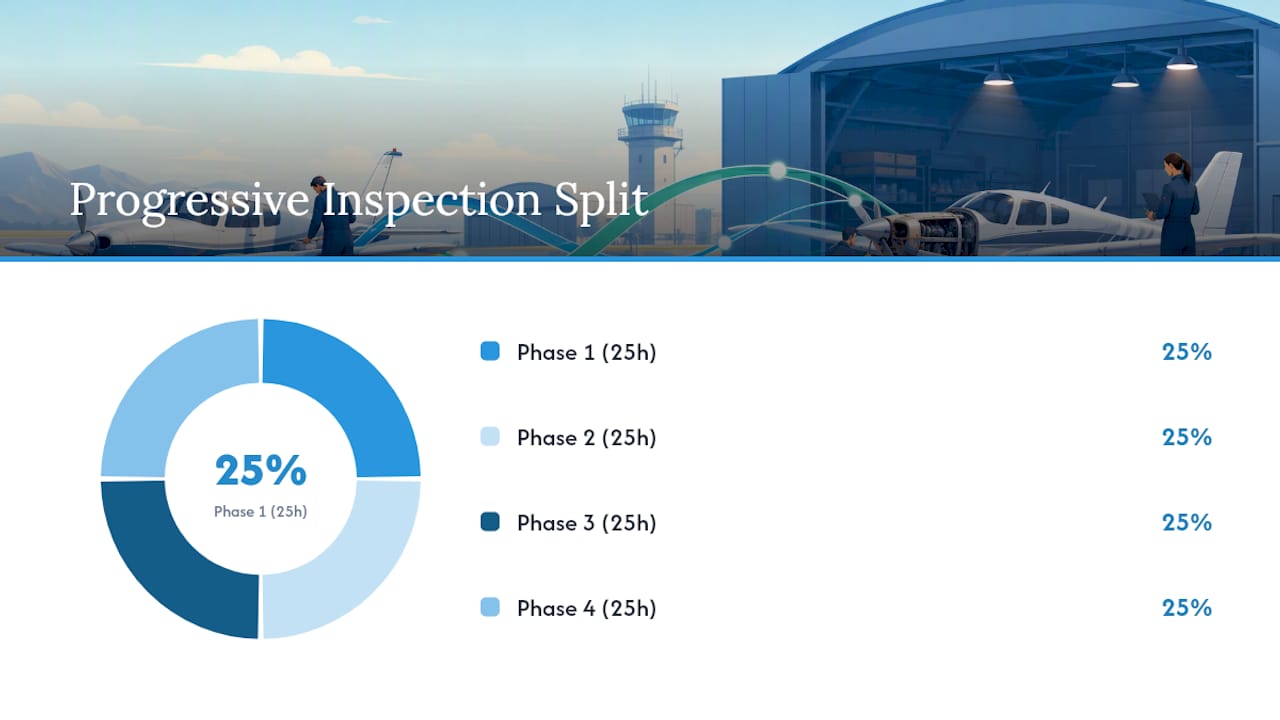
A progressive inspection program lets you break the full inspection scope into phases spread across shorter intervals, typically four segments of 25 hours each. AOPA recommends this approach for active flight schools because it reduces single-event downtime and fits the continuous-use pattern of training fleets.
To get FAA approval under §91.409(d), you must submit:
- A written request to your FSDO
- An inspection procedures manual describing the program
- Identification of a qualified supervisor responsible for the program
- Confirmation that adequate facilities and equipment are available
- A plan ensuring continuity of inspection responsibility
Pro Tip: Keep your progressive inspection manual current. If the program is discontinued, the aircraft must receive a full annual or 100-hour inspection before returning to for-hire operations, and the next due date resets from that point.
If you discontinue a progressive program mid-cycle, the aircraft is not automatically grounded, but it must receive a complete inspection before resuming covered operations. The FAA Advisory Circular AC 20-106 frames maintenance intervals as a regulatory floor, not a ceiling. For high-utilization training aircraft, phased inspections often catch wear earlier than a single annual event would.
Who can perform the inspection and who owns the compliance responsibility?
Any appropriately rated certificated mechanic can perform and approve a 100-hour inspection. An IA is not required, unlike for an annual. Certificated repair stations with the appropriate ratings may also perform and approve the work.
The approving person must make a maintenance entry per §43.11. That entry must include:
- The date and aircraft total time in service
- The inspection program used and the segment or portion completed
- A description of the work performed
- A statement that the aircraft is approved for return to service (or a description of any discrepancies)
- The signature and certificate number of the approving person
AC 43-9C clarifies that a single maintenance record is acceptable for both annual and 100-hour entries. You do not need separate logbooks. What you do need is a complete, legible entry every time. Owners carry the compliance responsibility under §91.405 regardless of who holds the wrench. If your mechanic makes an incomplete entry, the FAA holds you accountable for operating with inadequate records.
Keeping digital aircraft maintenance logs reduces the risk of incomplete entries and makes it easier to verify that every required element is present before the aircraft returns to service.
How the 10-hour extension works, with worked examples
§91.409 allows a single extension of not more than 10 hours beyond the 100-hour limit, but only to fly to a location where the inspection can be performed. You cannot use the extension to complete a revenue flight and then head to the shop. Any hours flown beyond the 100-hour mark must be subtracted from the next interval.
Example 1: Your aircraft’s last inspection was at 1,200 tach hours. The next inspection is due at 1,300 hours. You reach 1,305 hours en route to your maintenance shop. The inspection is completed at 1,305 hours. Your next inspection is due at 1,395 hours (1,305 + 100 – 10 = 1,395).
Example 2: You use only 4 hours of extension, completing the inspection at 1,304 hours. Your next interval is 96 hours, so the next inspection is due at 1,400 hours.
Pro Tip: Build your inspection appointment at 95 hours, not 100. That 5-hour buffer absorbs scheduling delays without touching the extension allowance, and it keeps you well clear of any enforcement exposure.
Cumulative overages compound quickly in high-utilization operations. A flight school running three aircraft on tight schedules can find itself with two aircraft in the shop simultaneously if inspections are not staggered. Scheduling tools that flag approaching intervals help prevent that kind of bottleneck.
Common compliance mistakes and how to avoid them
Most 100-hour inspection violations fall into a handful of recurring patterns:
- Lapsed progressive programs: — Allowing the FAA-approved program to lapse without completing a full inspection before resuming operations.
Enforcement consequences range from grounding and civil penalties to certificate action for repeat or willful violations. The FAA treats recordkeeping failures as seriously as the missed inspection itself.
A compact 100-hour inspection checklist and record-entry template
Component-group checklist
| Component Group | Key Items to Verify |
|---|---|
| Fuselage / hull | Skin condition, structural integrity, system routing |
| Cabin / cockpit | Seats, belts, instruments, controls, windows |
| Engine / nacelle | Mounts, exhaust, cooling, fuel/oil systems, ignition |
| Landing gear | Tires, brakes, struts, retraction (if applicable) |
| Wings / center section | Spars, skin, flight controls, fuel vents |
| Empennage | Stabilizers, control surfaces, attachment hardware |
| Propeller | Blades, hub, spinner, governor |
| Radio | Security of mount, condition, antenna attachment |
| Miscellaneous | Emergency equipment, lights, battery, placards |
Sample §43.11 maintenance entry
If discrepancies exist, list each one and note that the aircraft is not approved for return to service until they are corrected and a new entry is made.
A single maintenance record covering both annual and 100-hour entries is fully acceptable under AC 43-9C, provided every §43.11 element is present. For multi-aircraft operations, logbook digitization with verified entries makes audits faster and reduces the chance of a missing field going unnoticed.
The part of 100-hour compliance most operators underestimate
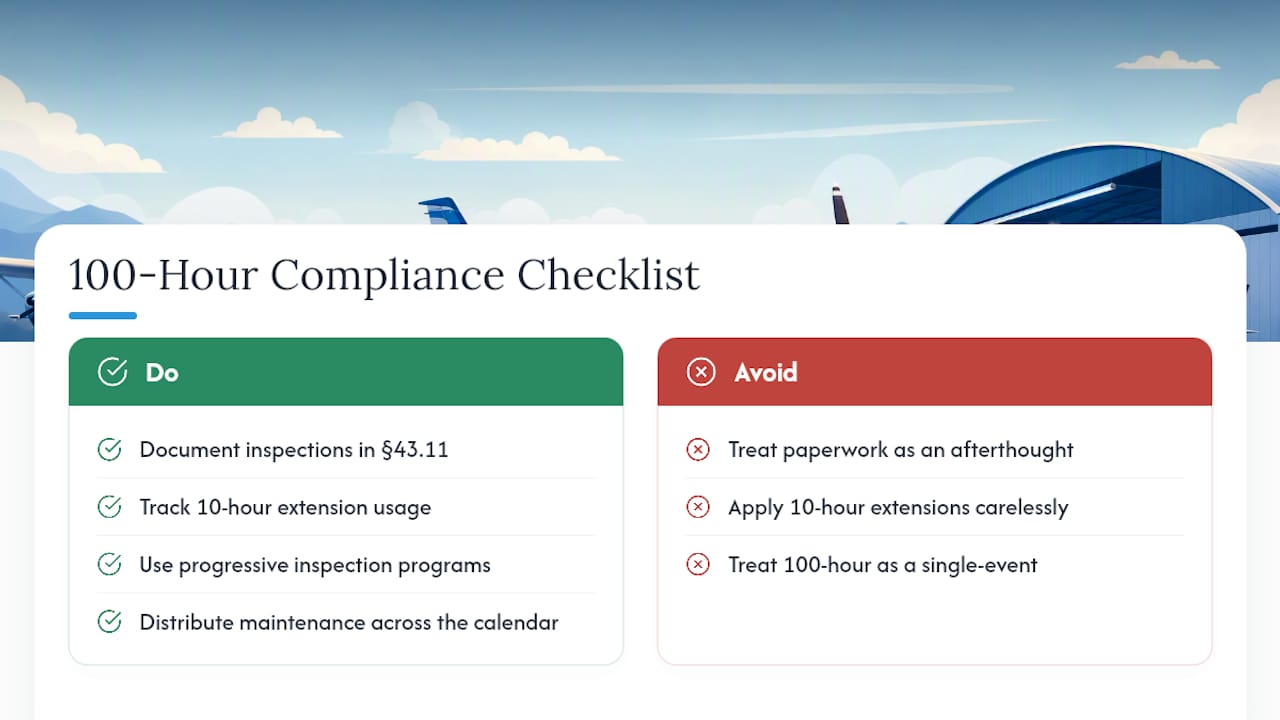
Most operators focus on the inspection itself and treat the paperwork as an afterthought. That is exactly backwards. The FAA’s enforcement record shows that incomplete or missing §43.11 entries generate as many compliance actions as missed inspections. An aircraft that was inspected but has a deficient logbook entry is, from a regulatory standpoint, an aircraft with an unverifiable inspection history.
The second thing operators consistently underestimate is the compounding effect of the 10-hour extension on high-utilization fleets. One extension used carelessly shortens the next interval. Two in a row, and you are scheduling inspections at 80-hour intervals without realizing it. For a flight school running four aircraft, that math adds up to a maintenance scheduling problem within a single semester.
Progressive inspection programs solve both issues when they are set up correctly. The phased structure forces regular documentation, keeps intervals predictable, and distributes maintenance load across the calendar. The operators who struggle with 100-hour compliance are almost always the ones treating it as a single-event obligation rather than a continuous tracking discipline.
Squawkfree keeps your 100-hour compliance on track automatically
Staying current on 100-hour intervals across a fleet of training aircraft is where manual logbooks and spreadsheets break down. Squawkfree gives you a single platform that auto-imports flight hours via ADS-B, flags each aircraft’s approaching 100-hour and annual due times, and stores every §43.11 maintenance entry in a searchable digital record.
For flight schools managing progressive inspection programs, Squawkfree tracks each segment separately so you always know which phase is next and when it is due. AD compliance runs in parallel, so an approaching inspection never catches you off guard by a newly issued directive. Every entry is timestamped, tied to the aircraft’s total time, and accessible to your maintenance team and FSDO if needed.
Start your 60-day free trial at Squawkfree and see how automated interval tracking removes the manual work from 100-hour compliance.
Useful sources and further reading
The primary regulatory text and authoritative guidance for 100-hour inspection compliance:
- § 91.409 14 CFR Ch. I (1–1–23 Edition)
- 14 CFR § 91.409 — Inspections. | LII / Legal Information Institute
- 14 CFR Appendix D to Part 43 — Scope and Detail of Items (as Applicable to the Particular Aircraft) To Be Included in Annual and 100-Hour Inspections | LII / e-CFR
- Guide to Aircraft Inspections — AOPA
- § 91.409 — Inspections. | eCFR
Read the statutes (§91.409 and Part 43 Appendix D) for the binding legal requirements. Use the advisory circulars and AOPA guidance for interpretation and practical application.
Recommended
No credit card required · read-only after trial