
7 Aircraft Maintenance KPIs Every GA Owner Should Track

7 Aircraft Maintenance KPIs Every GA Owner Should Track
Track these seven aircraft maintenance KPIs and you’ll know exactly where your airplane stands before a mechanic ever opens a cowling: AD compliance rate, logbook completeness rate, flight hours per aircraft, unscheduled maintenance events per 100 flight hours, time to next inspection, engine TBO remaining, and direct maintenance cost per flight hour. Each one answers a different question. AD compliance rate tells you if you’re legally airworthy. Logbook completeness rate tells you if you can prove it. Utilization and time-to-inspection drive your scheduling. Unscheduled events and engine TBO flag reliability risk before it becomes a grounded airplane. Cost per flight hour keeps your budget honest.
None of these numbers matter in isolation. A KPI only earns its place on your dashboard if it ties back to a safety outcome or a financial goal you actually care about. Owners who track flight data automatically, rather than reconstructing it from memory every 100 hours, tend to catch problems weeks before an owner relying on paper logs does. Tools like Squawkfree’s Flight Intelligence feature exist specifically to close that gap by pulling flight data in automatically instead of leaving it to manual entry.
Why this matters: nearly half of general aviation respondents in a 2026 industry survey named maintenance tracking and compliance recordkeeping as the operational areas working best for them. That’s not a coincidence. Recordkeeping discipline is the baseline maturity marker for GA maintenance programs, and it’s the cheapest KPI to fix first.
Key Takeaways
Aircraft maintenance KPIs only work when each metric ties to a specific safety or financial goal and pulls from a reliable, consistently captured data source.
| Point | Details |
|---|---|
| Track seven core KPIs | AD compliance rate, logbook completeness, utilization, unscheduled events, time to next inspection, engine TBO, and cost per flight hour. |
| Set SMART targets | Tie every KPI to a specific, measurable, time-bound goal rather than tracking numbers without a benchmark. |
| Prioritize engine monitor data | Missing or unreviewed engine-monitor data is a leading cause of misdiagnosis and unnecessary repairs. |
| Roll out in stages | Use a 30/60/90-day plan to pick KPIs, build a dashboard, and audit data quality before expanding scope. |
| Automate data capture | Squawkfree’s Flight Intelligence and AD tracking features reduce manual entry and keep KPI data current automatically. |
Table of Contents
- How Do You Calculate Aircraft Maintenance KPIs?
- How Do You Set Realistic Targets for Maintenance KPIs?
- Where Does Aircraft Maintenance KPI Data Come From?
- What Does a 90-Day KPI Rollout Look Like?
- What Are the FAA Recordkeeping Requirements for GA Maintenance?
- Why Do Aircraft Maintenance KPIs Go Wrong?
- How Do Maintenance KPIs Fit Into Your Safety Management Plan?
- What Are Realistic Benchmark Values for GA Maintenance KPIs?
- Trent’s Perspective: Data Beats Memory Every Time
- How SquawkFree Helps You Track Maintenance KPIs
- Frequently Asked Questions
- Sources
How Do You Calculate Aircraft Maintenance KPIs?
Each of these aircraft maintenance metrics has a specific formula. Get the calculation wrong and the number becomes noise instead of signal.
-
AD compliance rate = (applicable ADs tracked and closed on time ÷ total applicable ADs) × 100. This is the single most important compliance metric you own, because an open airworthiness directive can ground your aircraft regardless of how good everything else looks. Track it against the FAA’s published AD list for your specific make, model, and serial number, not a generic fleet list.
-
Logbook completeness rate = (required entries present ÷ required entries expected) × 100. “Required” means every inspection, repair, alteration, and AD compliance entry that regulation demands, each signed and dated. A missing signature or an undated entry counts as incomplete, even if the work itself was done correctly. This KPI matters as much for resale value as for compliance, since a buyer’s prebuy inspector will flag every gap.
-
Flight hours per aircraft is simply logged hours over a defined period, typically monthly or quarterly. For a single-owner airplane this drives your own scheduling. For a flight school with three or four aircraft, it becomes a utilization metric that tells you whether one airplane is absorbing more wear than the others and needs to rotate into the schedule differently.
-
Unscheduled maintenance events per 100 flight hours normalizes reliability across aircraft with different usage levels. Count every squawk that pulled the airplane off the schedule outside a planned inspection, divide by total hours flown, multiply by 100. A rising trend here is often your earliest warning of a systemic issue, whether that’s a magneto reaching end of life or a fuel system developing intermittent problems.
-
Time to next inspection, or mean time between inspections if you’re tracking a pattern across several cycles, tells you how much runway you have before the airplane needs to come off the line. This is the number that drives parts ordering and hangar scheduling.
-
Engine TBO tracking means hours remaining to the manufacturer’s recommended overhaul interval, factored against actual engine condition rather than just the calendar. A substantial share of GA accidents between 2001 and 2010 involved engine maintenance errors as a contributing factor, which is why the FAA specifically recommends engine trend monitoring rather than relying on hours alone.
-
Direct maintenance cost per flight hour = total maintenance spend divided by flight hours in the period. Categorize invoices by scheduled versus unscheduled work so a spike in this number tells you something actionable rather than just something alarming.
How Do You Set Realistic Targets for Maintenance KPIs?
A KPI without a target is just a number you glance at occasionally. SMART goals turn that number into a decision trigger: Specific, Measurable, Achievable, Relevant, and Time-bound. Industry guidance on flight department management consistently comes back to this same framework, because a KPI that isn’t tied to a concrete goal tends to get ignored the first time you’re busy.
Two examples show how this plays out at different scales:
- Single-owner example: Target 100% AD compliance rate with zero overdue items, verified monthly, and a 10% reduction in direct maintenance cost per flight hour over 12 months by shifting from reactive repairs to scheduled component replacement.
- Small flight-school example (3 aircraft): Target 85% fleet utilization across all three airplanes, fewer than two unscheduled maintenance events per 100 flight hours per aircraft, and a spare-parts inventory threshold that covers the top five recurring parts for 60 days without reorder.
Small sample sizes make early targets noisy. One unscheduled event on an airplane that flies 20 hours a month swings your rate dramatically more than the same event on an airplane flying 200 hours a month. Treat your first two or three months of data as a baseline, not a verdict, and tighten targets once you have a full season of numbers behind you.
Pro Tip: Revisit targets quarterly rather than annually for your first year. Small fleets generate KPI data slowly enough that annual reviews miss trends you’d otherwise catch in real time. For a broader look at how small operations structure this kind of target-setting, this operational metrics guide walks through the same SMART logic applied outside aviation.
Where Does Aircraft Maintenance KPI Data Come From?
Every KPI above maps to a specific, findable data source. The trick isn’t collecting more data, it’s collecting the right data from the right place without duplicating effort.
- Engine monitor (EDM) data, pulled from an SD card or imported automatically, feeds engine TBO tracking and unscheduled-event detection.
- Logbooks, whether paper or digitized through OCR, feed logbook completeness rate and AD compliance rate.
- Maintenance invoices and work orders feed direct maintenance cost per flight hour, and should be categorized as scheduled or unscheduled at the point of entry.
- Parts inventory records support time-to-next-inspection planning by flagging what’s on hand versus what needs ordering.
- AD and service bulletin applicability checks, cross-referenced against your aircraft’s serial number, feed AD compliance rate directly.
Three capture methods cover most GA operations:
- Manual SD-card upload from your engine monitor after each flight or flight block, reviewed for anomalies before filing.
- Automated flight-data import through aircraft maintenance tracking platforms, which eliminates the upload step entirely.
- OCR-based logbook digitization with human verification, which converts years of paper entries into searchable, auditable digital records.
Data quality checks matter as much as collection. Timestamp every entry, cross-check every invoice against its matching work order, and retain records for the full period your local audit requirements demand. Practitioners who routinely capture and review engine monitor data report meaningfully better diagnostic accuracy than those relying on visual inspection alone, largely because trend data catches probe faults and sensor drift that mimic real mechanical failures.
What Does a 90-Day KPI Rollout Look Like?
You don’t need a full year to get a working KPI program off the ground. A staged 30/60/90-day rollout gets you from zero to functional dashboard in one flying season.
- Days 1 to 30: Pick four to six KPIs from the shortlist above rather than trying to track all seven at once. Confirm where each data source lives, turn on automated flight-data import wherever your avionics support it, and set initial SMART targets based on your best available baseline.
- Days 31 to 60: Stand up a weekly operational view covering utilization and upcoming inspections. Run a monthly maintenance-cost review. Assign one person, even if that’s just you, as the owner of each KPI so nothing falls through the cracks.
- Days 61 to 90: Audit your data quality. Investigate the root cause behind any KPI that’s trending worse than expected, particularly unscheduled events. Set your first quarterly improvement goals based on real numbers instead of guesses.
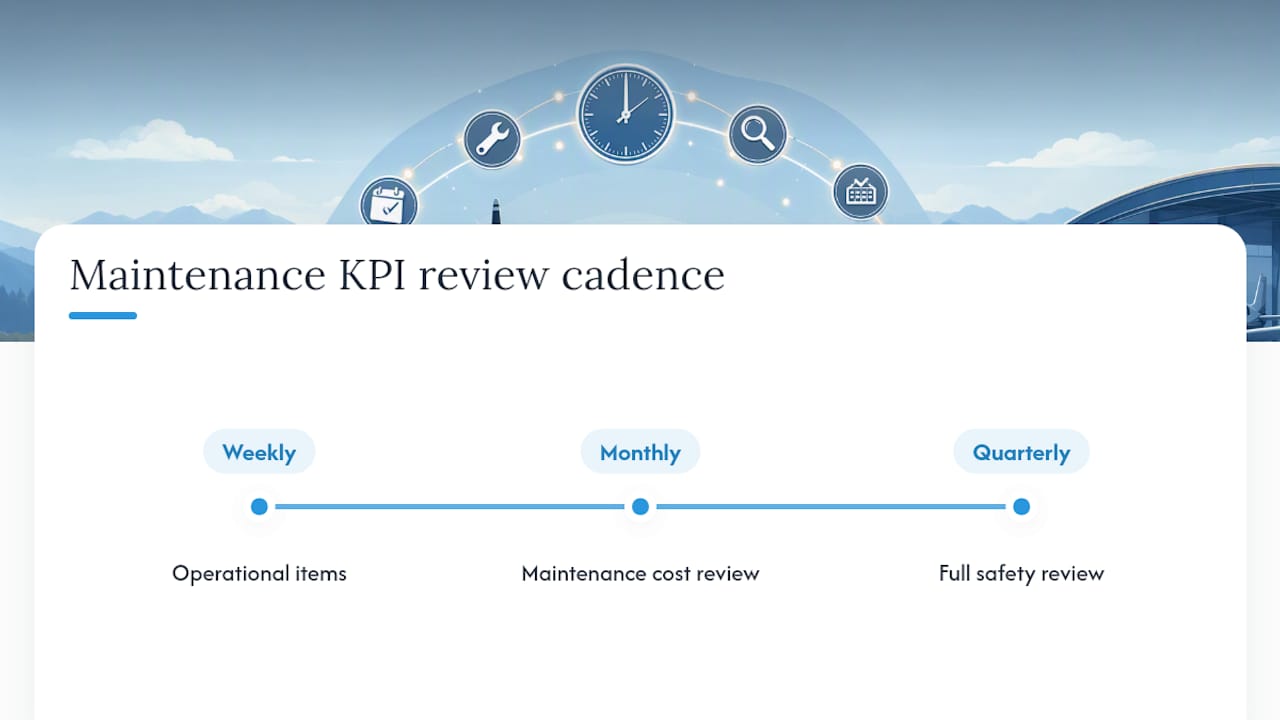
Reporting cadence should settle into three rhythms: weekly for operations (utilization, what’s coming due), monthly for maintenance and cost review, and quarterly for safety and target reassessment. For a single owner, that’s a standing calendar reminder. For a flight school, assign the weekly cadence to a dispatcher or chief instructor and keep the quarterly review with whoever owns the maintenance budget.
Pro Tip: Don’t wait for a full quarter of data before your first review. Even 30 days of consistent tracking will surface at least one surprise, usually a KPI you thought was fine that wasn’t.
What Are the FAA Recordkeeping Requirements for GA Maintenance?
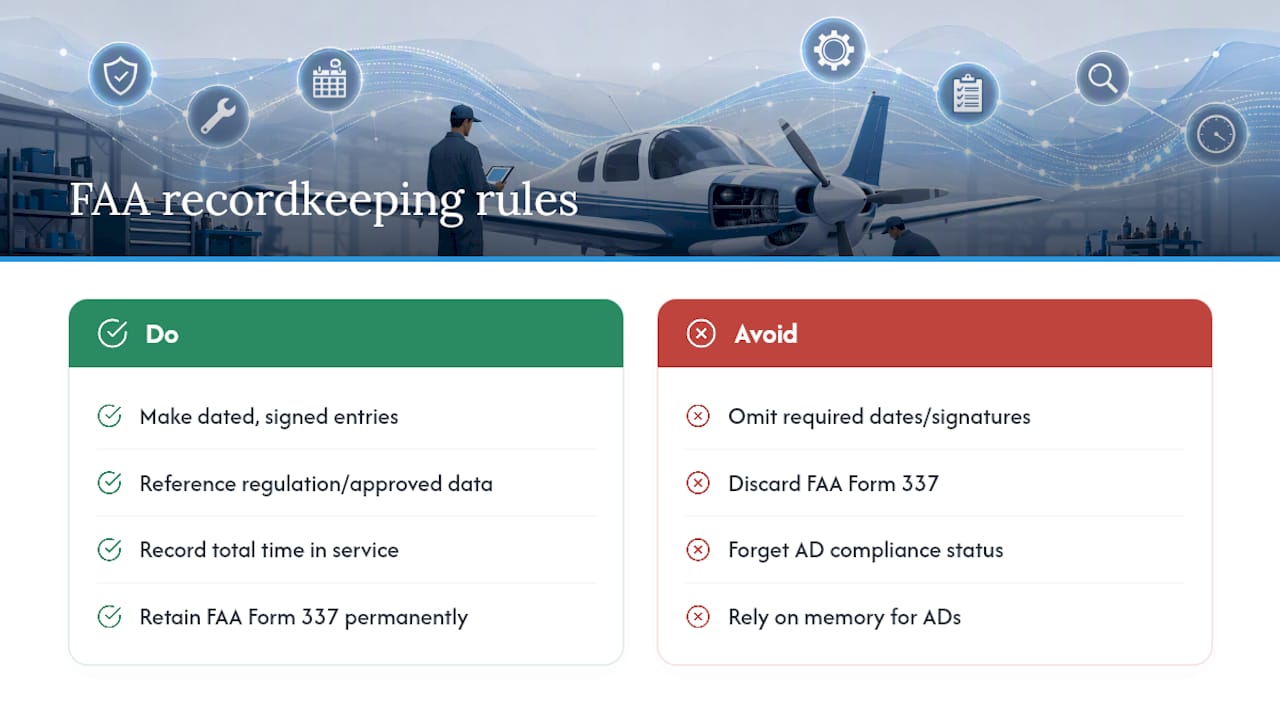
Federal Aviation Regulations require specific, dated, signed entries for every inspection, repair, and alteration performed on your aircraft, and those entries need to reference the applicable regulation or approved data used for the work. Total time in service must be recorded and current at all times, along with the status of every applicable airworthiness directive, not just the ones you remember. Records documenting the current inspection status, including time since the last inspection required by the applicable inspection program, must be retained until the work is superseded or repeated.
Major repairs and alterations carry their own documentation requirement, typically an FAA Form 337, which needs to stay with the aircraft records permanently rather than getting archived separately. This is where logbook completeness rate becomes more than an abstract metric. A logbook missing even one required signature or date can technically make an aircraft non-airworthy in the eyes of an inspector, regardless of whether the underlying maintenance was performed correctly.
Retention periods matter too. Records showing total time in service and current AD compliance status need to be retained for the life of the aircraft, while records for individual repairs and inspections generally need retention until the next equivalent inspection or work is performed and documented. Owners who digitize their logbooks tend to have an easier time meeting these requirements consistently, since digital recordkeeping makes gaps and missing signatures visible immediately instead of surfacing them during a prebuy inspection years later.
Why Do Aircraft Maintenance KPIs Go Wrong?
The most common failure in a GA maintenance KPI program isn’t a bad formula. It’s bad input. Three problems show up again and again.
Inconsistent data entry tops the list. If one flight gets logged to the tenth of an hour and the next gets rounded to the nearest half hour, your utilization and cost-per-hour numbers drift without any real change in the aircraft’s operation. The fix is simple discipline: log every flight the same way, every time, ideally through an automated system rather than end-of-month memory reconstruction.
Missing engine monitor data is a close second. Practitioners report that a surprisingly common cause of misdiagnosis is simply not having the engine data available when a problem occurs, whether because the SD card wasn’t installed, wasn’t backed up, or was overwritten before anyone pulled the file. That gap turns a five-minute trend review into an expensive teardown based on guesswork.
Small-sample distortion hits single-aircraft owners and small flight schools especially hard. One unscheduled event on a low-utilization airplane can spike your per-100-hour rate dramatically, making a normal maintenance month look like a crisis. The mitigation is patience: track a rolling three- or six-month average alongside the raw monthly number, and don’t overreact to a single data point.
Duplicate or conflicting records creep in when paper logbooks and digital systems run in parallel without reconciliation. Pick one system of record and treat every other document as a feed into it, not a competing source of truth.
How Do Maintenance KPIs Fit Into Your Safety Management Plan?
Maintenance performance measurement frameworks consistently recommend combining leading indicators with lagging indicators rather than relying on either alone. Leading indicators, like upcoming inspections, pending ADs, and engine-trend variances, give you a warning before something breaks. Lagging indicators, like unscheduled maintenance events and cost per flight hour, tell you what already happened. A KPI program that only tracks one type leaves a blind spot.
This pairing is exactly what a lightweight safety management approach looks like for a GA owner or small flight school, even without the formal structure larger operators use. Your engine TBO remaining and time-to-next-inspection numbers function as leading indicators, feeding directly into your scheduling decisions before a problem grounds the airplane. Your unscheduled-event rate and cost-per-hour numbers function as lagging indicators, confirming whether your preventive scheduling is actually working.
The integration point is simple: every KPI should trigger a specific action, not just a number on a screen. A rising unscheduled-event trend should trigger a root-cause review, not just a shrug. A shrinking TBO-remaining number should trigger a parts and budget conversation months before the overhaul date, not the week before. Industry guidance is direct about this: KPIs are measurement tools, not goals themselves, and the best flight department programs tie every metric to a specific downstream decision. Skip that step and you’ve built a dashboard, not a safety program.
What Are Realistic Benchmark Values for GA Maintenance KPIs?
Benchmarks vary by aircraft type, usage pattern, and maintenance philosophy, but a few reference points help set realistic first-year targets rather than arbitrary ones.
AD compliance rate should realistically target 100%, since this is the one KPI where “close enough” isn’t a legitimate target. Any open AD is a compliance failure regardless of how minor it seems.
Unscheduled maintenance events per 100 flight hours varies widely by aircraft age and engine type, but owners running data-driven, condition-based maintenance programs tend to report measurably fewer unnecessary repairs and lower unscheduled event rates than those on fixed-schedule-only maintenance, since trend data catches developing issues before they force an unscheduled grounding.
Flight hours per aircraft benchmarks depend entirely on your operation. A personally owned single continues to fly 50 to 150 hours a year in many cases, while a flight-school trainer often runs 400 to 800 hours annually. The right target isn’t a universal number, it’s whatever utilization keeps your aircraft earning its fixed costs without accelerating wear beyond your maintenance budget’s tolerance.
Engine TBO remaining targets should always include a buffer, since manufacturer TBO figures are recommendations, not hard limits, and actual overhaul timing should follow engine condition and trend data rather than the calendar alone.
Trent’s Perspective: Data Beats Memory Every Time
The pattern I keep seeing is straightforward: owners who centralize flight data and maintenance history resolve recurring problems faster than owners who rely on memory and paper. One case that sticks with me involved an intermittent rough-running complaint that three different mechanics couldn’t reproduce on the ground. Once someone actually pulled the engine monitor trend data across several flights, the pattern was obvious within minutes, a probe reading drift that looked like a cylinder problem but wasn’t.
That’s the real value of tracking KPIs consistently. It’s not the dashboard. It’s catching the pattern before it becomes a teardown.
How SquawkFree Helps You Track Maintenance KPIs
Squawkfree is built specifically to make the KPIs in this article easy to capture without adding to your workload. Instead of reconstructing flight hours and engine trends by hand every month, Flight Intelligence auto-imports flight data directly, so your utilization and unscheduled-event numbers stay current without you touching a spreadsheet.
The platform also tracks FAA airworthiness directives against your specific aircraft, digitizes existing logbooks through OCR with human verification, and keeps your maintenance history and cost records in one searchable place. That combination directly addresses the two KPIs most owners struggle with most: AD compliance rate and logbook completeness rate, both of which depend on records staying complete and current rather than reconstructed after the fact. Flight schools running several aircraft get the added benefit of comparing utilization and reliability trends across the whole fleet instead of tracking each airplane separately. If you’re ready to see what automated tracking looks like for your own aircraft, Squawkfree’s platform offers a straightforward starting point.
Frequently Asked Questions
What are the most important KPIs for a single-owner GA aircraft? AD compliance rate and logbook completeness rate come first, since both directly affect airworthiness and resale value. After that, direct maintenance cost per flight hour and engine TBO remaining give you the clearest picture of ongoing financial and reliability risk.
How often should a small flight school review maintenance KPIs? Weekly for operational items like utilization and upcoming inspections, monthly for maintenance cost review, and quarterly for a full safety and target reassessment across the fleet.
Do I need engine monitor data to track aircraft maintenance KPIs effectively? It’s not strictly required, but it substantially improves the accuracy of engine TBO tracking and unscheduled-event diagnosis. Owners without engine monitor data available at the time of a problem often face longer troubleshooting and higher repair costs than those with recorded trend data.
What counts as a complete logbook entry under FAA recordkeeping rules? A complete entry includes the date, description of the work performed, total time in service, the applicable regulation or approved data referenced, and a signature with certificate number from the person who performed or approved the work.
Can automated flight-data import replace manual logbook entries entirely? Automated import handles flight-hours and engine-trend data reliably, but maintenance entries documenting inspections, repairs, and AD compliance still require the mechanic’s or inspector’s signed entry under federal recordkeeping requirements.
Sources
- TBX releases 2026 annual survey: state of the GA maintenance industry
- Savvy maintenance: data-driven diagnosis
- Engine maintenance and performance monitoring — General Aviation Joint Steering Committee Safety Enhancement Topic
Recommended
No credit card required · read-only after trial