
Aircraft Maintenance Software Cost for GA Owners & Flight Schools

Aircraft Maintenance Software Cost for GA Owners & Flight Schools
Aircraft maintenance software pricing typically runs $200–$600 per year for a solo general aviation owner, $1,200–$6,000 per year for a 1–5-aircraft flight school or club, and $10,000–$50,000 or more annually for a 10–50-aircraft commercial operator once subscription fees, add-ons, and support are included. For GA owners and flight schools specifically, Squawkfree is a practical starting point: subscription SaaS pricing, per-aircraft add-ons for automated flight logging, and a 60-day free trial keep the entry cost low and the TCO predictable.
- Solo GA owner (1 piston aircraft): typical base subscription is modest with additional cost for flight-data import (Flight Intelligence) and optional logbook digitization
- 1–5-aircraft flight school or club: base fees modest with scheduling integration and dispatch/billing modules adding to costs
- 10–50-aircraft small commercial operator: annual cost can be substantial, and implementation, API integrations, and data migration can increase first-year expenses significantly
Before you collect vendor quotes, build a 5-year total cost of ownership (TCO) estimate. According to a detailed TCO analysis, aviation maintenance software’s five-year TCO is often multiple times the sticker price once implementation, training, integration, and exit costs are included. The sticker price is rarely the real number.
Key Takeaways
Aircraft maintenance software’s five-year TCO runs 3x–5x the sticker price, making transparent pricing models and a 5-year cost estimate the most important tools in any vendor evaluation.
| Point | Details |
|---|---|
| Sticker price vs. real cost | License fees cover only 15–25% of five-year TCO; budget for implementation, integration, training, and exit costs. |
| Cost by buyer type | Solo GA owners typically spend $200–$600/year; flight schools $1,200–$6,000/year; 20-aircraft operators $10,000–$50,000+/year. |
| Pricing model matters | Per-aircraft models suit small fleets best; per-user models scale poorly for schools with large instructor rosters. |
| Add-ons change the total | Flight-data import, AD tracking, and logbook digitization add cost but often deliver ROI that exceeds their annual price. |
| Squawkfree for GA buyers | Squawkfree offers subscription SaaS with per-aircraft add-ons, a 60-day free trial, and no module-locking on core compliance workflows. |
Table of Contents
- What does aircraft maintenance software actually cost across the market?
- How do the different pricing models work, and which fits your operation?
- What drives aircraft maintenance software cost higher than the sticker price?
- What do real budgets look like? Three sample scenarios
- How should you evaluate vendor pricing and avoid costly mistakes?
- What should you budget for implementation, migration, and contract terms?
- How do flight-data import, AD tracking, and logbook digitization affect your total cost?
- What most buyers get wrong about aircraft maintenance software pricing
- Squawkfree keeps GA maintenance costs predictable from day one
- Sources
What does aircraft maintenance software actually cost across the market?
The Capterra aviation maintenance software category aggregates vendor starting prices and free-trial signals from dozens of platforms, and the range is wide. Entry-level tools aimed at individual owners can start below $20/month. Mid-market platforms targeting flight schools and small MRO shops typically price between $100–$500/month. Enterprise MRO platforms built for large fleets or Part 145 repair stations often require custom quotes that start in the tens of thousands annually.
Vendors break out fees in a few standard ways:
- Per-aircraft monthly: Common for GA-focused tools; scales predictably as your fleet grows
- Per-user monthly: Common for MRO and flight school platforms; AMES pricing signals indicate starting prices around $150 per user per month, with onboarding fees that can vary widely in year one
- Flat-tier / seat-based: A fixed monthly fee for a defined number of users or aircraft; often the most predictable for small clubs
- Enterprise negotiated: Custom contracts for 50+ aircraft or multi-site operators; pricing is rarely published
Common add-ons that change the headline cost include flight-data import modules, FAA airworthiness directive (AD) tracking, OCR logbook digitization, scheduling and dispatch integration, and API connections to parts suppliers or ERP systems. Each of these can add hundreds to thousands of dollars per year depending on the vendor and your fleet size.
How do the different pricing models work, and which fits your operation?
Understanding the pricing model behind a vendor’s quote is as important as the number itself. The same annual cost can mean very different things depending on how it scales and what it excludes.
| Pricing model | Best fit | Typical price shape | Common hidden-cost risks |
|---|---|---|---|
| Per-aircraft monthly | Solo owners, small clubs | Scales linearly; predictable | Add-ons priced per aircraft multiply quickly |
| Per-user monthly | Flight schools, MRO shops | Scales with headcount | Onboarding fees, role-based access tiers |
| Flat-tier / seat-based | Small clubs, fixed teams | Fixed and predictable | Overage charges above seat limit |
| Tiered bundles | Mid-market operators | Step increases at fleet thresholds | Forced upgrades when fleet grows by one aircraft |
| Module / add-on pricing | Any buyer with specific needs | Base low, add-ons raise total | Easy to underestimate at quote stage |
| One-time professional services | All buyers at go-live | Lump sum at implementation | Scope creep; vague statements of work |
Hidden cost lines buyers frequently miss:
- Data migration and historical record formatting
- API or integration development for ERP, parts suppliers, or scheduling systems
- Mobile access modules (sometimes a separate license tier)
- Analytics or reporting dashboards sold as premium add-ons
- Support SLA tiers (standard email vs. phone vs. dedicated account manager)
- Data export or account termination fees
Pro Tip: When a vendor refuses to provide a sample invoice for your specific fleet size and user count, treat that as a negotiation red flag. Any reputable vendor can produce a line-item estimate. If they won’t, the final invoice will likely surprise you.
The per-aircraft model tends to yield the lowest TCO for solo owners and small clubs because costs scale only when the fleet grows. Per-user pricing can become expensive quickly for flight schools with many instructors and students in the system. Tiered bundles often look attractive until your fleet crosses a tier threshold and the price jumps.
What drives aircraft maintenance software cost higher than the sticker price?
The sticker price covers the license. The real cost of aircraft management software is shaped by a set of operational and technical factors that most vendors do not highlight in their marketing materials.
Primary cost drivers:
- Fleet size and asset complexity: More aircraft means more per-aircraft fees, more AD tracking records, and more data to migrate at go-live. Complex aircraft (turbines, multi-engine, experimental) often require more detailed maintenance workflows.
- Number of users and roles: Platforms that charge per user will cost more for flight schools with large instructor rosters. Role-based access (owner, CFI, dispatcher, student) sometimes requires a higher license tier.
- Required integrations: Connecting to an ERP system, a parts supplier catalog, or an ADS-B flight-data feed requires API work. That work is either billed as professional services or requires internal IT resources.
- Regulatory reporting needs: FAA aircraft maintenance log compliance and audit trail requirements add scope to implementation. Exportable, timestamped records and AD compliance tracking are features that sometimes sit behind a higher tier.
- Mobile and offline requirements: Some platforms charge extra for mobile access or offline sync, which matters for line maintenance in hangars without reliable Wi-Fi.
Secondary cost drivers:
- Historical data cleanup and formatting before migration
- OCR logbook digitization for paper records
- Custom workflow development for non-standard maintenance programs
- Premium support SLAs (guaranteed response times, dedicated support contacts)
- Training hours beyond the standard onboarding package
Cost-drivers checklist for vendor quotes:
- How many aircraft will be in the system at go-live, and how many in year three?
- How many named users need access, and what roles do they hold?
- Which third-party systems need to connect (ERP, parts suppliers, scheduling, ADS-B)?
- Do you need FAA-compliant audit trails and AD tracking out of the box?
- How many years of paper logbook records need to be digitized?
- What is the vendor’s standard support SLA, and what does an upgrade cost?
Answering these questions before your first vendor call will sharpen every quote you receive and make comparisons meaningful.
What do real budgets look like? Three sample scenarios
These scenarios use conservative and optimistic estimates to show how costs stack up across common buyer types. Figures are illustrative ranges based on publicly available pricing signals and the TCO framework referenced above.
Scenario 1: Solo GA owner, one piston aircraft
Assumptions: One aircraft, one owner, no employees, paper logbooks to digitize, wants AD tracking and automated flight logging.
- Base subscription: $200–$400/year
- Flight Intelligence (auto-import add-on): $100–$200/year
- Logbook digitization (one-time): $100–$300 depending on log volume
- Implementation/onboarding: Minimal; most GA-focused SaaS tools offer self-service setup in under an hour
- Training: Typically included in the subscription or covered by documentation
Conservative first-year total: ~$400–$900 Optimistic first-year total (minimal digitization): ~$300–$600
For a solo owner, the automated flight-data import and logbook digitization features justify the add-on cost quickly. Eliminating manual tach-hour entry alone saves meaningful time per month across a full flying season.

Scenario 2: 3-aircraft flight school or club
Assumptions: Three training aircraft, five instructors, one dispatcher, scheduling integration needed, AD tracking required.
- Base subscription: $900–$2,400/year (per-aircraft or per-user model)
- Scheduling and dispatch integration: $500–$1,500/year
- Flight Intelligence add-ons (3 aircraft): $300–$600/year
- Onboarding/implementation: $500–$2,000 one-time
- Training for staff: $0–$500 (often bundled)
Conservative first-year total: ~$2,200–$7,000 Optimistic (bundled plan, minimal customization): ~$1,700–$4,500
Scheduling integration for flight schools reduces dispatcher overhead and is worth budgeting as a line item, not an afterthought. Schools that skip it often pay in manual coordination time.
Scenario 3: 20-aircraft small commercial operator
Assumptions: 20 aircraft, 10 users, ERP integration required, full data migration from paper and legacy system, AD tracking, mobile access.
- Base subscription: $6,000–$15,000/year
- API/ERP integration development: $5,000–$20,000 one-time
- Data migration and cleanup: $3,000–$10,000 one-time
- Training (multiple staff, phased): $2,000–$5,000
- Ongoing support SLA upgrade: $1,000–$3,000/year
Conservative first-year total: ~$17,000–$53,000 Optimistic (cloud SaaS, minimal customization): ~$12,000–$30,000
At this scale, the TCO gap between a cloud SaaS platform and an on-premise solution can be substantial. Cloud SaaS platforms commonly reduce five-year TCO compared to on-premise deployments for comparable features, according to the Oxmaint TCO analysis.
How should you evaluate vendor pricing and avoid costly mistakes?
A vendor quote is a starting point, not a final number. The questions you ask before signing determine whether the final invoice matches the proposal.
Step-by-step vendor evaluation checklist:
- Request a line-item sample invoice for your exact fleet size and user count.
- Ask for the full contract term options: month-to-month, annual, and multi-year, with renewal pricing steps.
- Confirm what data export looks like at termination: format, timeline, and any associated fees.
- Ask for the SLA response time in writing: what is the guaranteed first-response time for a critical issue?
- Clarify who performs integrations: the vendor, a third-party partner, or your own IT team.
- Ask how many training hours are included and what additional training costs per session.
- Request a vendor-provided 5-year TCO model using your fleet size, user count, and integration requirements as inputs.
Red flags to watch for in proposals:
- Vague integration language (“integration available” with no scope or price)
- Module-locking clauses that require a tier upgrade to access AD tracking or audit exports
- No sample invoice available for your fleet size
- Export fees or data-portability restrictions buried in the terms
- Onboarding quoted as a flat fee with no defined scope of work
A simple TCO formula to run yourself:
Use a five-year window for aviation software TCO. Aircraft maintenance platforms are sticky: switching costs are high because of data migration complexity and staff retraining. A platform that looks $2,000/year cheaper at the sticker price can easily cost more over five years once implementation and exit fees are included.
Statistic to keep in mind: License fees often represent a minority share of five-year TCO for aviation maintenance software, with the majority being implementation, integration, training, support, and exit costs, per the Oxmaint TCO analysis.
When asking a vendor for a 5-year TCO model, provide them with: current fleet size and projected growth, number of users by role, a list of systems that need to connect, your current record format (paper, spreadsheet, legacy software), and your expected support tier. A vendor who cannot or will not build that model for you is telling you something important about how they handle post-sale relationships.
What should you budget for implementation, migration, and contract terms?
Implementation costs are where many buyers get surprised. A platform with a $300/month subscription can carry a $15,000 go-live cost if the data migration is complex.
Typical implementation phases and timelines:
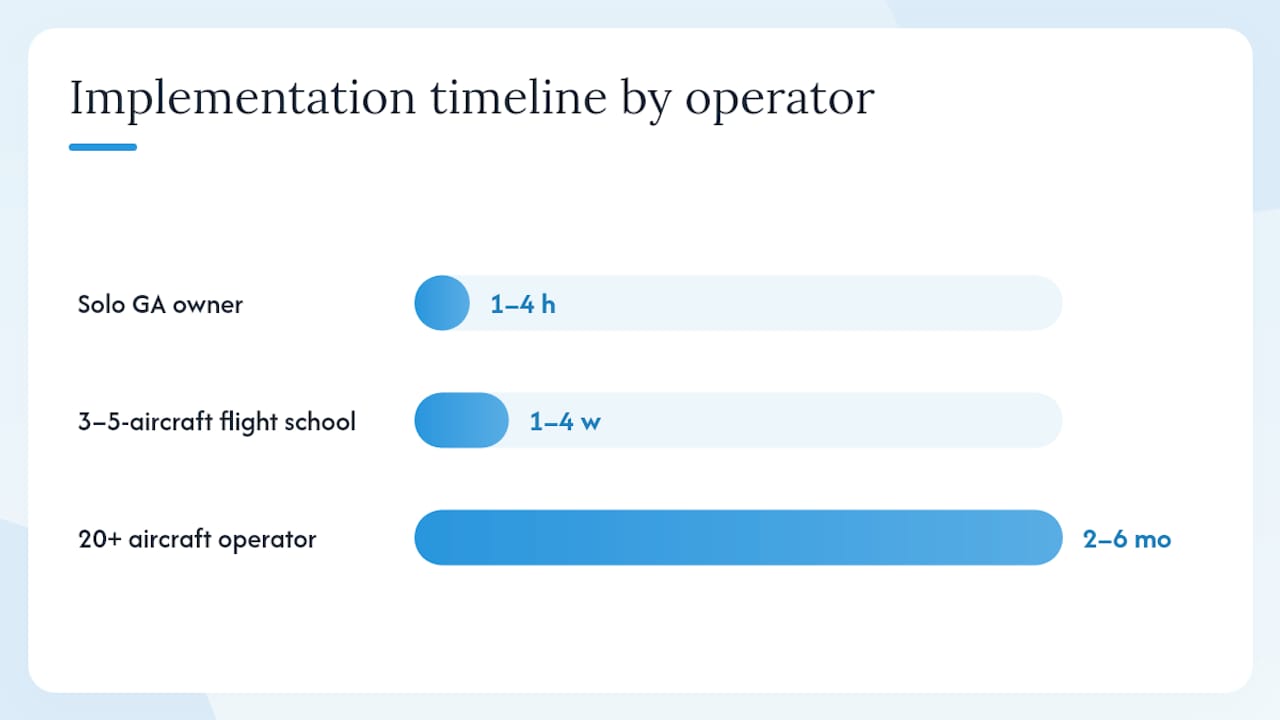
- Solo GA owner: Self-service setup, 1–4 hours; no formal implementation phase for most GA-focused SaaS tools
- 3–5-aircraft flight school: Guided onboarding, 1–4 weeks; includes user setup, scheduling configuration, and initial AD tracking setup
- 20+ aircraft operator: Phased implementation, 2–6 months; includes data migration, API integration, parallel-run period, and staff training
Migration cost items vendors sometimes quote separately:
- Data cleaning and reformatting of legacy records
- API development for third-party connections
- Parallel-run support (running old and new systems simultaneously)
- Custom workflow configuration
- Historical logbook scanning and OCR processing
Contract clauses to check before signing:
- Data portability: Can you export all records in a standard format (CSV, PDF) at any time, or only at termination?
- Renewal pricing steps: Does the contract cap annual price increases, or can the vendor raise rates freely at renewal?
- Termination and exit fees: Is there a fee to close the account or export data? How long does the vendor retain your data after termination?
- Support SLA: What is the guaranteed response time, and does it change after the first year?
- Module access: Are all current features locked in at your contract price, or can the vendor move features to a higher tier?
Timeline checklist to request in writing from any vendor:
- Kickoff call and access provisioning: Day 1–3
- Data migration scope confirmed: Week 1
- Initial configuration complete: Week 2–4
- User training completed: Week 3–6
- Go-live and parallel run: Week 4–8
- Post-go-live support window: 30–90 days
Getting these milestones in writing protects you if the vendor’s timeline slips and your operation is left running on two systems longer than planned.
How do flight-data import, AD tracking, and logbook digitization affect your total cost?
These three features sit at the intersection of compliance and operational efficiency, and they are the add-ons most likely to change both your annual cost and your ROI calculation.
What each feature does and why it matters:
- Automatic flight-data import (ADS-B): Pulls tach hours, Hobbs time, and flight records directly from ADS-B data without manual entry. Squawkfree’s Flight Intelligence feature does this automatically, eliminating a common source of logbook errors and saving meaningful admin time per aircraft per month.
- FAA AD tracking: Matches your aircraft’s make, model, and installed equipment against the FAA’s AD database and flags applicable directives. This is the feature that most directly reduces compliance risk and audit prep time.
- OCR logbook digitization: Converts paper maintenance logs into searchable digital records using optical character recognition plus human verification. This is typically a one-time cost at onboarding, priced per log page or per logbook volume.
How these features typically price:
- Flight-data import: per-aircraft add-on, billed monthly or annually
- AD tracking: often bundled in mid-tier plans; sometimes a separate module at the entry tier
- Logbook digitization: transaction-based (per page or per logbook), or a flat one-time fee at onboarding
ROI framing for add-on spend:
Conservative ROI estimate: A GA owner who spends 30 minutes per month on manual logbook entry and AD cross-referencing saves roughly 6 hours per year by automating those tasks. At a conservative $75/hour value of time, that is $450/year in recovered time, often exceeding the annual cost of the add-on itself.
Predictive maintenance analytics tied to flight-data import can also reduce unplanned maintenance events, which carry costs well beyond the repair itself: grounded aircraft, rescheduled students, and missed revenue. The ROI case for paying for data features strengthens considerably when you account for those downstream costs, not just the admin time saved.
Integration notes: Connecting a flight-data feed to your maintenance platform typically requires either a native ADS-B integration (as Squawkfree offers) or API work with a third-party data provider. For flight schools, linking scheduling software to maintenance records so that dispatch blocks aircraft with open squawks is a high-value integration that also affects implementation scope and cost.
What most buyers get wrong about aircraft maintenance software pricing
Most buyers focus on the monthly subscription fee and treat everything else as a detail to sort out later. That approach consistently produces budget overruns and vendor disputes.
The real mistake is treating aircraft maintenance software as a commodity purchase rather than a five-year operational commitment. The platforms that look cheapest at the proposal stage often carry the highest switching costs: proprietary data formats, export fees, and module-locking clauses that make it expensive to leave. A platform with a higher sticker price but clean data portability, transparent renewal terms, and a strong SLA can easily deliver lower TCO over five years.
For GA owners and flight schools specifically, the most underrated cost factor is the time spent on manual compliance tasks that a well-configured platform eliminates. AD tracking misses and logbook errors are not just compliance risks; they are real costs when they ground an aircraft or trigger an FAA inquiry. Budgeting for the features that prevent those events is not a luxury spend. It is the part of the TCO calculation that most buyers skip because it does not appear on a vendor invoice.
Ask for the sample invoice. Build the five-year model. And weight the compliance and audit-readiness features as heavily as the subscription price when you compare proposals.
Squawkfree keeps GA maintenance costs predictable from day one
For GA owners and flight schools that want transparent pricing without enterprise-level complexity, Squawkfree delivers a subscription SaaS model where the core compliance workflows, AD tracking, and maintenance log management are accessible without module-locking. Per-aircraft add-ons for Flight Intelligence auto-import let you pay for automated flight logging only on the aircraft where it adds value, keeping the base cost lean.
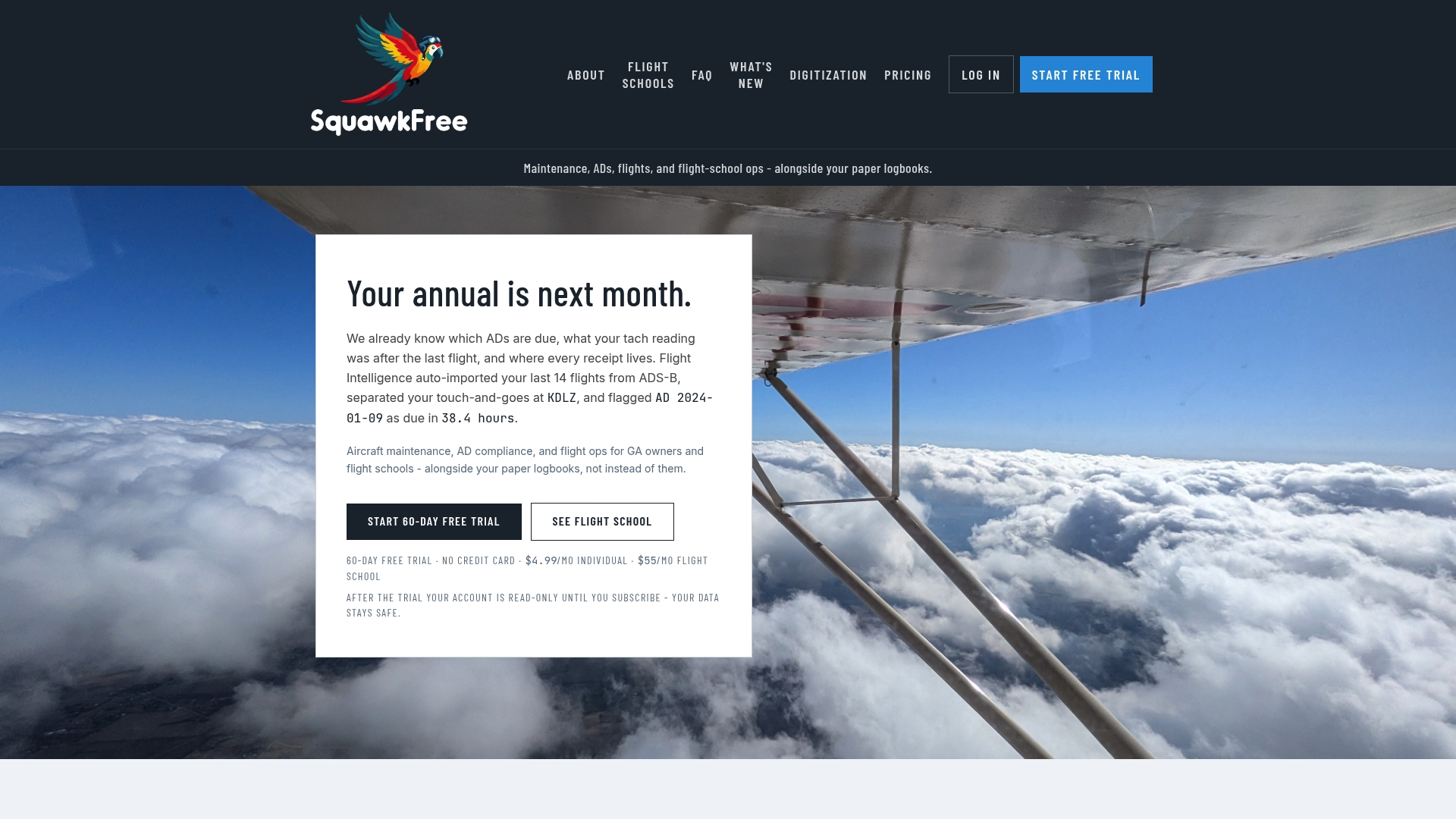
The 60-day free trial gives you enough time to configure your fleet, import your records, and run a real compliance check before committing to a paid plan. Logbook digitization services are available as a one-time add-on at onboarding, so you can convert paper records without a separate vendor contract. For flight schools, scheduling integration and dispatch tools are built into the platform rather than priced as a separate module.
Start your 60-day free trial today and see exactly what Squawkfree costs for your fleet size before you sign anything.
Sources
The following resources were used to build this guide and are worth bookmarking for your own vendor research:
- Best Aviation Maintenance Software 2026 | Capterra
Recommended
No credit card required · read-only after trial