
Component Time Tracking for GA Owners and Flight Schools

Component Time Tracking for GA Owners and Flight Schools
Component time tracking is the practice of recording each aircraft part’s accumulated hours, cycles, and calendar life so it can be legally operated, retired on schedule, and transferred with a complete airworthiness history. 14 CFR §91.417 requires owners to maintain total time in service for the airframe, each engine, propeller, and rotor, plus the current status of every life-limited part. Miss an update, and you risk grounding the aircraft or rendering a removed part unsellable.
Start here — your immediate compliance checklist:
- Confirm which parts on your aircraft carry mandatory life limits (check the TCDS, applicable ADs, and the AFM Limitations section).
- Standardize your time-in-service measurement as lift-off to touchdown, consistently applied across every flight.
- Open or reconcile a single source-of-truth component record for the airframe, engine, propeller, and each life-limited part.
- Attach a tag or written life-status record to any part the moment it leaves the aircraft.
- Verify every entry carries a date, total time at entry, and the identity of the person making it.
Paper records are legal, but a single source-of-truth digital log reduces the risk of mismatched entries between pilot logbooks and maintenance records.
Table of Contents
- What does “time in service” actually mean for component tracking?
- Which components require tracking, and where are the limits published?
- What exactly should you record for each component?
- How should your daily workflow look for owners, co-owners, and flight schools?
- How do you audit component records and avoid grounding risks?
- When should you move to a digital maintenance platform?
- Worked examples and templates for common scenarios
- Key Takeaways
- Why the record update on removal matters more than most owners realize
- Squawkfree keeps your component records audit-ready
- Authoritative sources to bookmark for audits
What does “time in service” actually mean for component tracking?
The FAA defines time in service as the period from when an aircraft leaves the surface of the earth until it touches down at the next point of landing. That definition is the foundation of nearly every component interval calculation you will make.
Three measurement types appear in component records:
- Hours (time in service): Accumulated flight hours from lift-off to touchdown. This is the most common limit expression for engines and propellers.
- Cycles: A single takeoff-and-landing sequence, or an operationally defined cycle where a specific AD or manufacturer document specifies otherwise. Turbine components and pressurized airframes often carry cycle limits.
- Calendar time: A fixed date-based retirement regardless of hours or cycles flown. Some hoses, seals, and emergency equipment fall here.
Tachometer, Hobbs, or automated import?
A tachometer records engine RPM-adjusted time, which can undercount actual flight time at cruise power settings. A Hobbs meter runs on engine oil pressure or master switch, so its reading depends on when it starts. Neither is inherently wrong, but the FAA expects consistency. Whichever method you use, document it in the aircraft record and apply it the same way every flight.

Pro Tip: Record your chosen measurement method directly in the aircraft logbook or your digital maintenance platform. An auditor who sees “Hobbs, oil-pressure start” written once in the record can verify every subsequent entry without guessing.
Which components require tracking, and where are the limits published?
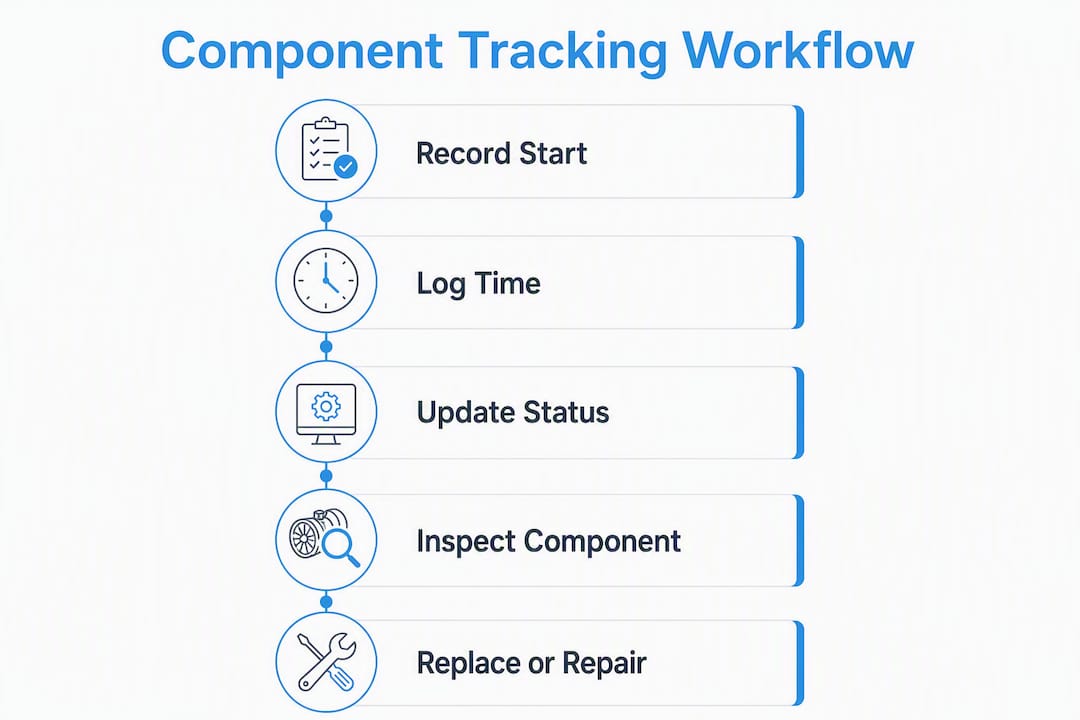
Under §91.417, you must track total time in service for the airframe, each engine, each propeller, and each rotor. Beyond those, any component carrying a mandatory replacement limit defined in the type design, Instructions for Continued Airworthiness, or an AD requires individual life-limited parts tracking.
Component classes and their authoritative limit sources:
| Component category | Typical limit expression | Authoritative source |
|---|---|---|
| Airframe | Hours, calendar | TCDS, AFM Limitations |
| Reciprocating engine | Hours (TBO) | TCDS, manufacturer ICA |
| Turbine engine | Hours, cycles | TCDS, ADs, ICA |
| Propeller | Hours, calendar | TCDS, AD, manufacturer manual |
| Life-limited parts (blades, discs, hubs) | Hours, cycles, calendar | TCDS, ADs, AFM Limitations |
| AD-controlled appliances | Hours, cycles, calendar | Applicable AD |
| Emergency equipment (ELTs, O2) | Calendar | AFM, manufacturer data |
One important distinction: life-limited parts have hard retirement limits that no on-condition inspection can extend. Once the limit is reached, the part must be replaced. This is not the same as a TBO recommendation, which some operators treat as advisory under Part 91.
For modular engines, §91.417 requires module-level records if you want to take advantage of the modular design during overhaul. A single combined engine record will not support partial module replacement without ambiguity.
What exactly should you record for each component?
Every component entry needs enough information to reconstruct the part’s complete life history. Part 43 requires a description of work performed, date of completion, and the signature and certificate number of the person approving return to service.
Mandatory fields for each component record entry:
- Part name and part number
- Serial number (TSN tracking and TSO tracking both depend on this)
- Date of entry
- Total time in service at entry
- Time since overhaul (TSO) at entry
- Cycles accumulated (if applicable)
- Source of time (e.g., “Hobbs, oil-pressure start” or “Flight Intelligence ADS-B import”)
- Work performed or reason for entry
- Signature and certificate number of the approving person
For AD-controlled items, add a “method used to comply” field that references the specific AD number and paragraph.
Sample component record entry (copyable template):
| Field | Entry |
|---|---|
| Part name | Left magneto |
| Part number | 10-357200-1 |
| Serial number | A12345 |
| Date | March 14, 2025 |
| Total time in service | 1,247 hrs |
| Time since overhaul | 247 hrs |
| Source of time | Hobbs, oil-pressure start |
| Work performed | inspection per AD |
| Approved by | J. Smith, A&P IA |
Pro Tip: When a part is removed, update its life status in the record before the part leaves the shop. A removed life-limited part with no updated life status cannot be legally reinstalled and loses resale value immediately.
How should your daily workflow look for owners, co-owners, and flight schools?
The goal is a record that any authorized person can pick up and immediately understand the component’s current life status.
Single owner, weekend flyer:
- Before flight, confirm no component has reached or exceeded its published limit.
- Log Hobbs start time.
- After landing, record Hobbs end time and calculate flight time.
- Update the engine and airframe running totals in the logbook.
- Note any squawks or observations.
Co-owner workflow:
- Designate one person as the record custodian, or use a shared digital platform where all entries are timestamped and attributed.
- Notify all co-owners when a component approaches a limit threshold.
- Never allow two separate logbooks to run in parallel without a scheduled reconciliation.
10-aircraft flight school daily cycle:
- Dispatcher opens the aircraft record at check-out and confirms component status.
- Instructor or student logs Hobbs start.
- After each flight, automated flight data import (via ADS-B integration) captures flight time without manual entry.
- Maintenance staff reconcile imported flight data against Hobbs entries at the end of each operating day.
- Weekly: review all components approaching limits and flag for scheduled maintenance.
The FAA has noted that automating recurring AD and time-limited component tracking materially reduces the risk of missed actions in multi-aircraft operations. For a school running 10 aircraft with multiple daily flights, manual paper reconciliation is where errors accumulate.
How do you audit component records and avoid grounding risks?
Most audit findings trace back to a small set of recordkeeping failures. Knowing them in advance lets you build a record that survives any ramp check or annual inspection.
Audit checklist:
- Verify total time in service entries are continuous, with no unexplained gaps.
- Confirm current life status for every life-limited part is recorded and within limits.
- Check that every recurring AD action shows the next-due time or date.
- Confirm each maintenance entry carries a signature and certificate number.
- Verify that removed parts have updated life-status records and appropriate tags or markings per Part 43.10 disposition rules.
- Cross-check pilot logbook flight times against maintenance record totals for the same period.
Common failures that cause findings:
- Decentralized paper records spread across multiple binders with no reconciliation
- Missing life-status updates when a part was pulled for bench maintenance
- Using tach time for component tracking without documenting that choice
- Pilot logbook totals that don’t match maintenance record totals
If a component has exceeded its published limit: Ground the aircraft immediately. Do not fly until the part is replaced or the discrepancy is resolved with a certificated mechanic. For life-limited parts, no extension is permitted under any on-condition program. Document the finding, the corrective action, and the return-to-service entry per Part 43.
When should you move to a digital maintenance platform?
Paper works for a single-owner aircraft with simple component records. The calculus shifts when you add co-owners, recurring ADs, or a fleet of any size.
Decision triggers for going digital:
- Two or more co-owners accessing the same aircraft records
- Three or more recurring ADs requiring interval tracking
- Any component with both hour and cycle limits
- A flight school or club with more than two aircraft
- An upcoming annual inspection where the auditor will want exportable records
Core features to require in any platform:
- Persistent timestamped entries that cannot be edited without a logged revision
- Part-level records with serial number, TSN, and TSO fields
- Removal and installation tagging with life-status update prompts
- AD tracking with recurring action intervals and next-due calculations
- Automated flight data import from ADS-B (eliminating manual Hobbs transcription)
- Role-based access so instructors, owners, and mechanics each see what they need
- Exportable audit trail in a format an FAA inspector can read
Setup typically takes a few days for a single aircraft and one to two weeks for a school fleet, depending on how much historical data needs to be digitized. Squawkfree offers a logbook digitization service using OCR and human verification, which handles the backlog without requiring you to re-enter years of records manually.
Worked examples and templates for common scenarios
Example 1: Logging a TBO reset after engine overhaul
After overhaul, create a new engine record entry showing:
- Date of overhaul completion
- Total airframe time at overhaul
- Engine time since new (TSN) reset to zero or carried forward per the overhaul shop’s documentation
- TSO reset to zero
- Overhaul shop name, certificate number, and return-to-service signature
Keep the pre-overhaul record. §91.417 requires that records showing current life status transfer with the aircraft, and a buyer will want the complete history.
Example 2: Removing a life-limited part for bench maintenance
- Record the part’s current life status (hours, cycles, calendar date) before removal.
- Attach a tag showing part number, serial number, and current life status.
- Store the part separately from serviceable stock.
- On reinstallation, create a new entry showing the same life status carried forward, plus the date and reason for removal.
Per Part 43.10, acceptable control methods include tagging, marking, segregation, or a record-keeping system. Any transfer of the part must include the tag or record unless the part is mutilated before transfer.
Example 3: Reconciling pilot Hobbs vs. automated import
If your platform shows a 0.2-hour discrepancy between a pilot’s logged Hobbs time and an ADS-B-imported flight time, investigate before closing the record. Common causes: Hobbs started before takeoff roll, or the import captured wheels-up to wheels-down only. Document which value you use and why, then apply that same rule going forward.
Transferring records with a sold or shipped part: Include the complete component record or a certified copy. The receiving party needs the life status to legally install the part.
Key Takeaways
Accurate component time tracking requires a single source-of-truth record, consistent time-in-service measurement from lift-off to touchdown, and a life-status update every time a part is removed.
| Point | Details |
|---|---|
| Use the FAA’s time-in-service definition | Count only lift-off to touchdown; document your measurement method in the aircraft record. |
| Update life status on every removal | A removed part with no updated life status cannot be legally reinstalled and loses resale value. |
| Hard limits cannot be extended | Life-limited parts have mandatory retirement limits; no on-condition inspection overrides them. |
| Audit with §91.417 and Part 43 | Verify continuous time entries, AD next-due dates, signatures, and disposition tags at every inspection. |
| Squawkfree automates the workflow | Flight Intelligence auto-imports flight data, and part-level records with timestamped entries keep you audit-ready. |
Why the record update on removal matters more than most owners realize
Most audit findings I see discussed in FAA guidance and industry commentary don’t come from owners who ignored the rules. They come from owners who updated the logbook at the end of the year instead of at the end of each removal. That gap, even a few weeks, is where a life-limited part can get reinstalled on a different aircraft without anyone catching that it was already close to its limit.
The removal-tagging requirement in Part 43.10 exists precisely because parts move between aircraft, shops, and owners. A tag with a current life status is the only thing standing between a serviceable part and an inadvertent limit exceedance on a different airframe.
Automated flight import changes the risk profile for schools and co-owners significantly. When flight time flows directly from ADS-B data into a timestamped record, the reconciliation step becomes a verification rather than a reconstruction. That distinction matters for any operation running more than a handful of flights per week.
The practical recommendation: set a rule that no part leaves the aircraft without a life-status update in the record, and no flight closes without a time entry. Simple rules, consistently applied, prevent the vast majority of findings.
Squawkfree keeps your component records audit-ready
Manually reconciling Hobbs entries, paper tags, and separate binders for each component is manageable for one aircraft. Add co-owners, a recurring AD, or a school fleet, and the error risk compounds with every flight.
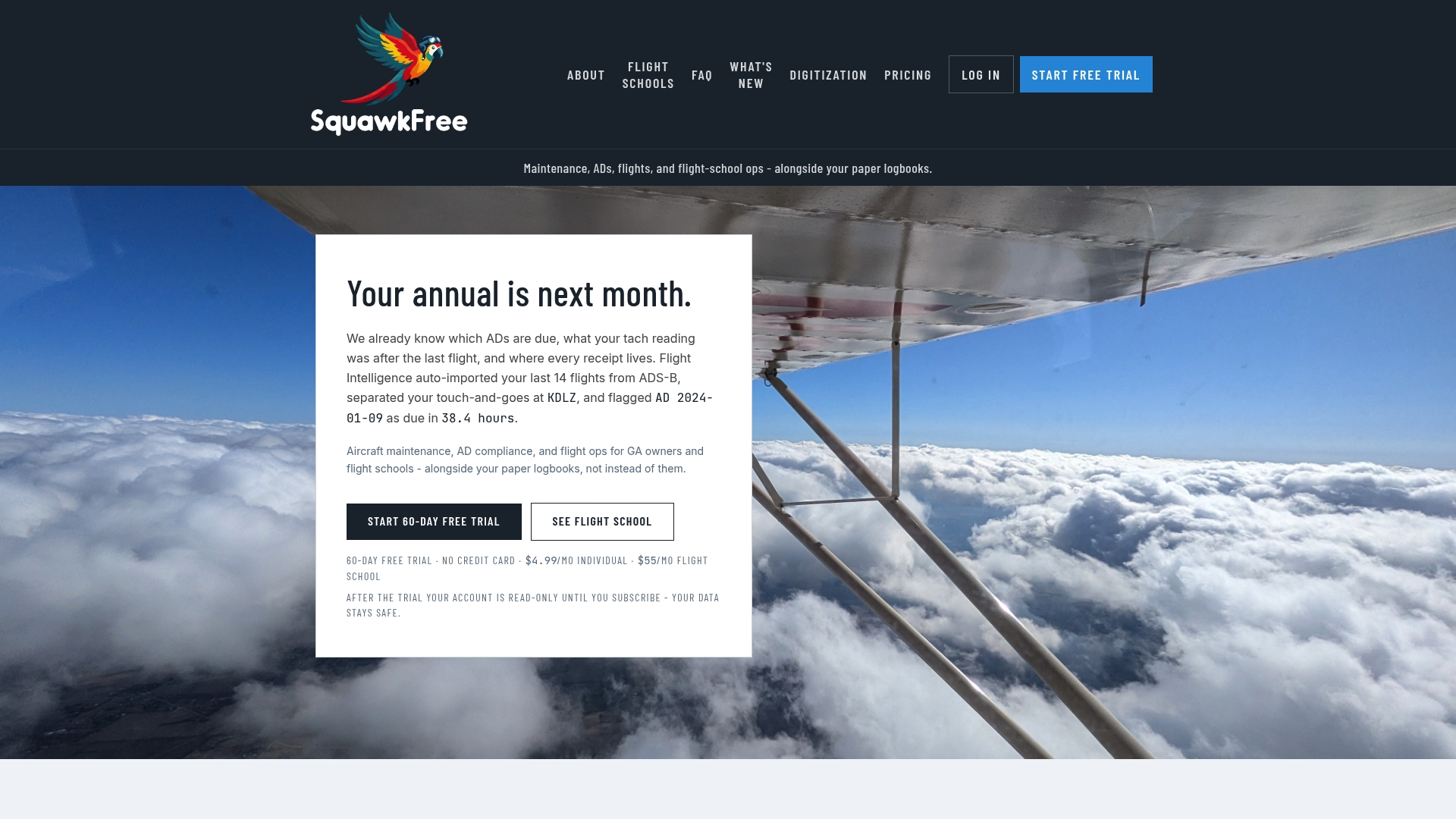
Squawkfree handles the full workflow: Flight Intelligence auto-imports flight data from ADS-B so time entries are timestamped and attributed without manual transcription. Part-level records carry serial numbers, TSN, TSO, and cycle fields. AD tracking calculates next-due intervals automatically, and exportable audit trails give an FAA inspector exactly what they need. Logbook digitization via OCR and human verification brings your historical records into the platform without manual re-entry.
A 60-day free trial gives you time to migrate existing records, set up component entries, and run a full reconciliation before committing. Start your free trial at Squawkfree and see how long your first audit-ready component report takes to generate.
Authoritative sources to bookmark for audits
Every limit, interval, and record requirement you will ever need traces back to a small set of primary sources. Keep these accessible.
| Source | What to look for |
|---|---|
| 14 CFR §91.417 | Retention periods, transfer requirements, required record content |
| 14 CFR §43.10 | Disposition methods for life-limited parts, tagging and transfer rules |
| Part 43 | Required maintenance entry content, signature requirements |
| AC 43-9C CHG 1 | Time-in-service definition, life-status update guidance, acceptable control methods |
| AC 120-113 CHG 1 | Hard retirement limits, on-condition program exclusions for life-limited parts |
| FAA TCDS database | Part retirement limits, modular engine requirements |
| FAA AD search | Recurring action intervals, compliance methods, next-due calculations |
- For §91.417: Confirm which records must transfer with the aircraft at sale and which are retained for one year.
- For §43.10: Verify acceptable tagging and disposition methods before transferring a removed part.
- For ADs: Always read the “method of compliance” and “recurring” paragraphs, not just the subject line.
- For TCDS: Cross-reference part retirement limits against your component records at every annual inspection.
Recommended
No credit card required · read-only after trial