
Deferred Maintenance Tracking for GA Owners & Flight Schools

Deferred Maintenance Tracking for GA Owners & Flight Schools
Start your deferred maintenance tracking system today by recording every postponed item in a single, consistent log the moment it is discovered. The industry term for this practice is “deferred maintenance tracking,” though you may also see it called a discrepancy log or open-item record in FAA advisory materials. Each entry must capture, at minimum:
- Short defect description (system, symptom, and location)
- Part number and serial number of the affected component
- Aircraft total time and Hobbs/tach hours at discovery
- AD number, method of compliance, and compliance date (if an AD applies)
- MEL proviso reference and repair-interval category (if MEL deferral is used)
- Name and certificate number of the person authorizing deferral
- Expected repair deadline (proviso-defined, next inspection, or date certain)
- Record location (logbook page, work-order number, or digital record ID)
Per 14 CFR §91.417 and AC 91-67A, a means of recording discrepancies and corrective actions must be available to the PIC at all times. Keep a copy of the relevant maintenance-record extract or a dedicated discrepancy log onboard every flight.
Key Takeaways
Consistent, component-level deferred maintenance tracking, covering part numbers, AD methods, MEL provisos, and repair deadlines, is the single most effective way to protect airworthiness, pass inspections, and preserve aircraft value.
| Point | Details |
|---|---|
| Record component-level detail | Capture part number, serial number, and work-order reference for every deferred item to avoid annual-inspection delays. |
| AD precedence is absolute | ADs override MEL deferrals unless an FAA-approved AMOC exists; document the method and next-due date for every applicable AD. |
| Two-tier retention rules | Temporary entries: 1 year or until superseded. Permanent records (AD status, life-limited parts, Form 337s): life of aircraft, transferred at sale. |
| Assign a repair deadline | Every open item needs a proviso-defined or inspection-based deadline and a named responsible party before the next flight. |
| Squawkfree automates the workflow | AD auto-search, Flight Intelligence data import, and role-based signoffs replace manual lookups and reduce documentation gaps across single aircraft and fleets. |
Table of Contents
- What do FAA regulations require you to record for deferred items?
- How do you log a deferred maintenance item correctly?
- How should you prioritize deferred items and set repair deadlines?
- Where do you store deferred-item records, and what transfers at sale?
- How do roles and approvals work for co-owned aircraft and training fleets?
- What should you look for in a deferred maintenance tracking system?
- Ready-to-use templates for deferred maintenance logs and AD records
- Why granular deferred-item records save you time, money, and liability exposure
- Squawkfree puts your deferred maintenance tracking on autopilot
- Sources
What do FAA regulations require you to record for deferred items?
The regulatory floor for deferred maintenance documentation spans three CFR sections and two advisory circulars. Understanding each one prevents the gaps that trigger FAA enforcement or kill an aircraft sale.
14 CFR §43.9 requires every maintenance record entry to include a description of work performed (or a reference to acceptable data), the date of completion, the name of the person performing the work when different from the approver, and the approver’s signature and certificate number when returning the aircraft to service.
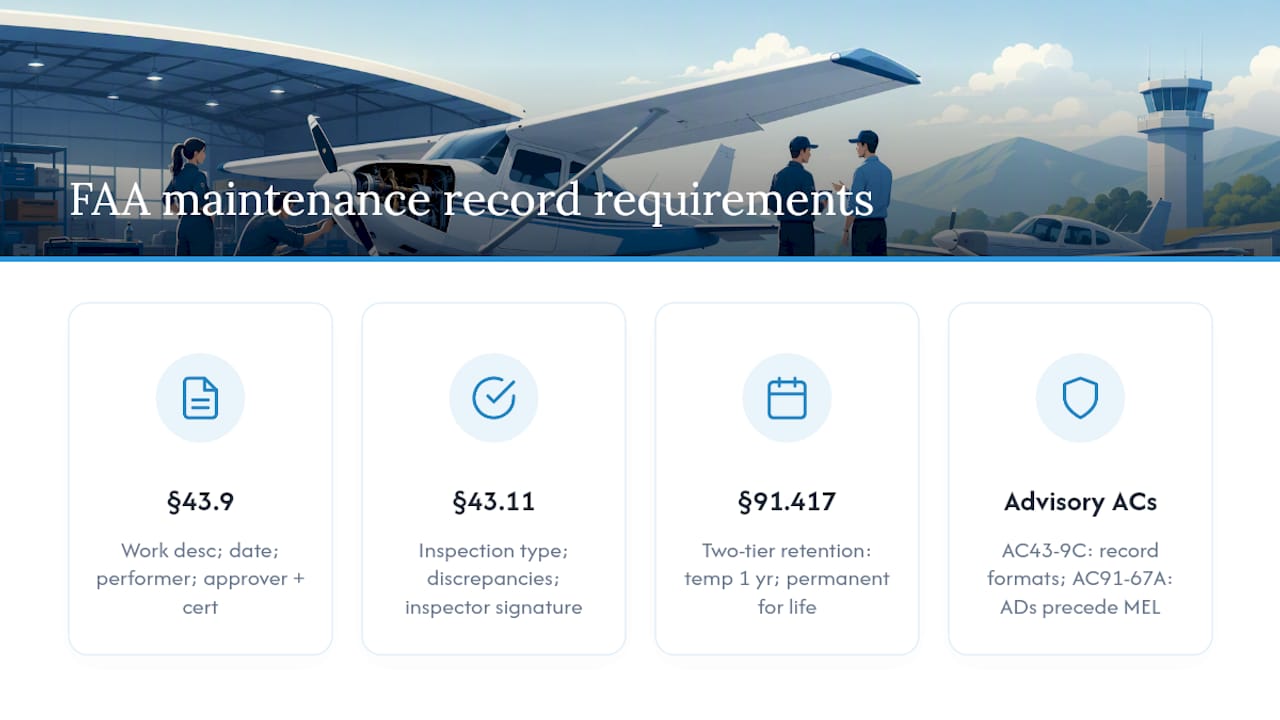
14 CFR §43.11 adds specific requirements for inspection entries, including the type of inspection, a list of discrepancies and unairworthy items, and the inspector’s signature.
14 CFR §91.417 creates a two-tier system. Temporary records (routine maintenance entries) must be retained until superseded or for one year, whichever comes first. Permanent records, including total time in service, life-limited part status, AD compliance status, and FAA Form 337s for major repairs and alterations, must be retained for the life of the aircraft and transferred to the buyer at sale.
AC 43-9C describes acceptable recordkeeping formats and explains how to structure entries so they satisfy both §43.9 and §91.417 simultaneously.
MEL and AD precedence: AC 91-67A is explicit: applicable ADs take precedence over MEL deferrals. If an AD covers the inoperative item, you cannot defer it under the MEL unless the FAA has approved an Alternative Method of Compliance (AMOC). The MEL also does not override a life-limit or mandatory replacement interval.
Under §91.403, the owner or operator bears ultimate responsibility for maintaining the aircraft in an airworthy condition, regardless of who performs or documents the work.
How do you log a deferred maintenance item correctly?
The fields below satisfy §43.9’s descriptive requirements and address the component-level detail gaps that AOPA safety experts identify as the leading cause of annual-inspection delays and sale complications.
Required fields for every deferred item:
- Discovery date, flight leg, and aircraft total time at discovery
- Defect description: system, symptom, location (specific and unambiguous)
- Affected part number and serial number
- AD number, revision, and method of compliance (if an AD applies)
- MEL item number, proviso category (A/B/C/D), and repair interval
- (M) or (O) procedure reference where applicable
- Deferral authorization: PIC name or A&P/IA certificate number and signature
- Repair deadline: proviso-defined interval or date of next required inspection
- Cross-reference: work-order number, shop invoice, or service bulletin number
Sample audit-ready logbook entry:
2026-03-14 | N12345 | TT: aircraft total time at discovery | Hobbs: 1,847.2 hrs Defect: Left landing light inoperative. Lamp P/N 4596, S/N N/A. No applicable AD. MEL item 33-40-01, Category C, repair within a short, defined calendar interval. (O) procedure completed by PIC. Deferral authorized by PIC J. Smith. Repair deadline: 2026-03-17. Ref: Discrepancy Log entry #DL-2026-031.
Pro Tip: Cross-reference external documents by work-order number rather than copying their full text into the logbook. A one-line reference (“See W/O #2026-0314-01 on file”) keeps the log concise while preserving a complete audit trail. Store the source document with the aircraft records.
For major repairs or alterations, the certifying mechanic must also complete FAA Form 337, provide a copy to the owner, and forward the original to the FAA Aircraft Registration Branch within 48 hours of returning the aircraft to service.
How should you prioritize deferred items and set repair deadlines?
Not every deferred item carries the same urgency. A structured prioritization framework keeps your aircraft flying legally while protecting safety.
Risk-based tiers:
- Safety-critical: Any item affecting primary flight controls, powerplant, or structural integrity. Ground the aircraft immediately. No deferral.
- AD-controlled: Any item covered by an applicable AD. Compliance is mandatory on the AD’s schedule unless an AMOC is approved. MEL deferral does not override an AD.
- MEL-deferred with proviso: Items deferred under a valid MEL/LOA. The proviso category sets the deadline: Category A items may have a zero-day interval (no deferral), while Categories B, C, and D allow 3, 10, and 120 calendar days respectively.
- Mission-critical but not MEL-controlled: Items that limit dispatch capability or increase crew workload. Schedule repair at the earliest available maintenance slot.
- Cosmetic or convenience: Items with no safety or operational impact. Repair at next scheduled maintenance visit.
Converting provisos to concrete deadlines:
- Record the proviso category and count from the date of discovery, not the date of entry.
- If the proviso specifies a flight-leg or cycle limit, calculate the projected calendar date based on your typical utilization and set the repair deadline to that date.
- If no proviso applies, default to “repair by next required inspection” and document that decision.
For flight schools, aircraft downtime tracking requires one additional step: flag each deferred item in the dispatch system so instructors and students see the open discrepancy before accepting the aircraft. An item that is legal to fly does not mean every pilot in the fleet is aware of it.
NBAA guidance on inoperative instruments and equipment distinguishes items required for the specific flight (IFR vs. VFR, day vs. night) from items that can be deferred under the MEL, a Configuration Deviation List (CDL), or the “no MEL” rule under §91.213. Review that distinction before authorizing any deferral.
Where do you store deferred-item records, and what transfers at sale?
Two separate documents govern deferred items: the onboard discrepancy log and the aircraft maintenance record.
The onboard discrepancy log is a running list of open items available to the PIC before each flight. It does not need to be a formal logbook, but it must be accessible in the cockpit. Many operators use a dedicated section of the aircraft’s journey log or a digital checklist tied to the aircraft profile.
The aircraft maintenance record (logbook or equivalent) is the permanent repository. Once a deferred item is repaired and signed off, the repair entry goes into the maintenance record and the discrepancy log entry is closed with a cross-reference to the repair entry.
Retention summary:
- Routine entries: retain for 1 year or until superseded
- AD compliance records, life-limited part records, total time, and Form 337s: retain for the life of the aircraft and transfer to the buyer at sale
- Scanned originals of Form 337s and shop work orders: store with the AD tracker entry they support
Digital records with audit trails and cross-referenced work orders reduce the risk of missing evidence at sale or inspection. Scanning and storing Form 337s alongside the corresponding AD tracker entry is a recognized best practice.
Pro Tip: Build a “buyer packet” before listing the aircraft: a single PDF or folder containing the AD compliance table (AD number, method, sign-off date, next due), the life-limited parts log, all Form 337s, and the most recent annual inspection entry. Buyers and pre-purchase inspectors will ask for exactly this, and having it ready shortens the transaction by days.
How do roles and approvals work for co-owned aircraft and training fleets?
Single-aircraft ownership is straightforward: one owner, one A&P, one logbook. Co-ownership and flight schools introduce handoff risk at every shift change.
Core roles and decisions:
- PIC: Authorizes MEL deferral in the cockpit, completes (O) procedures, and enters the discrepancy in the onboard log before the next flight.
- A&P/IA: Performs and certifies maintenance, signs off repair entries with certificate number, and closes deferred items in the maintenance record.
- Fleet manager/chief of maintenance: Assigns repair priority, schedules maintenance slots, and monitors open-item age against proviso deadlines.
- Dispatcher: Confirms open discrepancies are within their deferral limits before releasing the aircraft for a flight.
- Owner/lessee: Holds ultimate airworthiness responsibility under §91.403 and approves expenditures for repair.
Flight school handoff workflow:
- Student or instructor discovers discrepancy during preflight or flight.
- PIC enters item in the onboard discrepancy log before the next departure.
- Dispatcher reviews the log at aircraft return and flags the item in the scheduling system.
- Fleet ops creates a maintenance work order and assigns it to an A&P.
- A&P repairs and certifies; dispatcher verifies closure before releasing the aircraft.
Every open deferred item must be visible to the next crew before they accept the aircraft. A discrepancy that lives only in a paper log tucked in the seat pocket is a handoff failure waiting to happen.
Pro Tip: When an engine or component is moved between aircraft, transfer its component-level records (part number, serial number, install date, hours/cycles at install) to the receiving aircraft’s logbook immediately. A broken time chain is one of the most expensive documentation problems to reconstruct after the fact.
For fleets using predictive maintenance analytics, flagging deferred items in the same system that tracks flight hours lets you calculate remaining proviso time automatically rather than manually.

What should you look for in a deferred maintenance tracking system?
Spreadsheets can work for a single aircraft with a short open-item list. They break down quickly when you add multiple aircraft, recurring ADs, and multi-user access.
Must-have features for any digital system:
- AD auto-search and tracking with next-due calculation
- MEL/proviso fields with repair-interval category and deadline date
- Per-item part number and serial number fields
- Timestamped change history and traceable signatures
- Role-based access (PIC, A&P, dispatcher, fleet manager)
- On-the-fly discrepancy entry for cockpit use
- Form 337 and supporting document storage
- Audit-ready report export (PDF or structured data)
Entry-level field apps (basic digital logs and generic maintenance apps) handle single-aircraft discrepancy lists adequately but typically lack AD auto-search, role-based approvals, and audit-export features. They require manual AD lookups and offer no automated next-due calculation.
Fleet-grade platforms add multi-aircraft dashboards, automated AD compliance alerts, dispatch integration, and structured report generation. The tradeoff is higher cost and a longer setup process.
What to migrate first when switching systems:
- Open deferred-item list with all current proviso deadlines
- AD registry with method of compliance, sign-off date, and next due for every applicable AD
- Life-limited parts table with part number, serial number, install date, and hours/cycles at install
For a deeper feature comparison, the best aircraft maintenance software guide covers the evaluation criteria in detail.
Ready-to-use templates for deferred maintenance logs and AD records
Two templates cover the full deferred-item lifecycle: a compact cockpit log for discovery and a structured AD compliance tracker for the maintenance record.
Template 1: Deferred-item log (cockpit and maintenance record)
| Field | Cockpit entry (brief) | Maintenance record entry (full) |
|---|---|---|
| Discovery date/time | 2026-03-14 | 2026-03-14 |
| Aircraft total time | aircraft total time at discovery | aircraft total time at discovery |
| Defect description | Left landing light inop | Left landing light inoperative. Lamp P/N 4596, S/N N/A |
| AD reference | None | No applicable AD confirmed |
| MEL item / category | 33-40-01 / Cat C | MEL 33-40-01, Cat C, 3-cal-day interval |
| Deferral authority | PIC J. Smith | PIC J. Smith, cert. N/A (PIC auth.) |
| Repair deadline | 2026-03-17 | 2026-03-17 |
| Cross-reference | DL-2026-031 | Discrepancy Log #DL-2026-031; W/O #2026-0314-01 |
Template 2: AD compliance tracker
Track every applicable AD in a single table. Each row covers one AD:
- AD number and revision (e.g., AD 2022-14-07 R1)
- Applicability (aircraft make/model/serial)
- Method of compliance (e.g., SB 2022-27-01, one-time inspection)
- Compliance date and aircraft total time at compliance
- Certifying A&P/IA name and certificate number
- Next-due date or interval (recurring ADs only)
- Supporting document reference (Form 337, work order, or service bulletin on file)
An AD compliance table that shows method, sign-off, and next due for every applicable directive is the single document most likely to be requested at annual inspection, during a pre-purchase inspection, or in an FAA enforcement inquiry. Build it once and keep it current.
Missing or incomplete AD compliance documentation is among the most consequential record defects for buyers and during inspections. Cross-referencing each AD tracker row to a scanned Form 337 or work order closes that gap before it becomes a problem.
For a practical walkthrough of the FAA AD search process and how to document results, the FAA AD search guide on the Squawkfree blog covers the steps in detail.
Why granular deferred-item records save you time, money, and liability exposure
The most expensive maintenance documentation mistake is not a missing logbook page. It is a missing part number.
AOPA safety experts are consistent on this point: failing to record component-level details, specifically part numbers, serial numbers, and work-order references, is the leading cause of delays at annual inspections and aircraft sales. An A&P who cannot verify which exact component was installed, when, and under what authority has to treat the item as unverified. That means additional inspection time, possible parts replacement, and a delayed return to service.
Consider a scenario that plays out regularly in the GA community: an owner lists an aircraft for sale, the pre-purchase inspector finds three ADs with no documented method of compliance, and the sale stalls for three weeks while the owner reconstructs records from shop invoices and old emails. The records existed. They just were not organized in a way that anyone could verify quickly. Granular, cross-referenced records would have made that a 30-minute review instead of a three-week delay.
The liability dimension is equally direct. Under §91.403, the owner is responsible for airworthiness. An open deferred item with no documented repair deadline and no assigned owner is not just an administrative gap. It is evidence that the owner did not have a system for managing the aircraft’s condition. That matters in an insurance claim and in an FAA enforcement proceeding.
The fix is not complicated. It is consistent: record the part number, the serial number, the AD method, and the repair deadline every time, from day one.
Squawkfree puts your deferred maintenance tracking on autopilot
Squawkfree is built specifically for GA owners, co-owners, and flight schools who need a faster path from “item discovered” to “item closed and documented.” Where a spreadsheet requires manual AD lookups and offers no deadline alerts, Squawkfree’s automated AD tracking searches the FAA database and calculates next-due dates for every applicable directive on your aircraft.

Flight Intelligence auto-imports flight data from ADS-B, so your aircraft total time and Hobbs hours update without manual entry. Role-based signoffs let PICs log discrepancies in the cockpit, dispatchers review open items before release, and A&Ps certify repairs with a traceable digital signature. OCR-verified logbook import means your historical records are searchable from day one. For flight schools, dispatch integration and fleet-level dashboards give your chief of maintenance a real-time view of every open item across the entire fleet.
Start a 60-day free trial at Squawkfree and migrate your open deferred-item list, AD registry, and life-limited parts table in your first session.
Sources
The regulations and advisory circulars below are the primary references for every claim in this guide. Retain copies of the relevant ACs and CFR extracts in your maintenance records.
- Aircraft maintenance: Managing airworthiness directives | AOPA
- AC 91-67A: Minimum Equipment Lists (MELs) and deferral guidance | FAA
- 14 CFR § 43.9 — Content, form, and disposition of maintenance records | GOVINFO
- What Aircraft Records Must a Part 91 Operator Keep? The Complete Recordkeeping Guide | FileFlo
For deeper implementation guidance, the Squawkfree blog covers FAA AD compliance, aircraft maintenance logs, and recordkeeping requirements in detail. Retain copies of the CFR sections and advisory circulars referenced above alongside your aircraft’s maintenance records for quick reference during inspections.
Recommended
No credit card required · read-only after trial