Document Version Control in Aviation: A Compliance Guide

Document Version Control in Aviation: A Compliance Guide
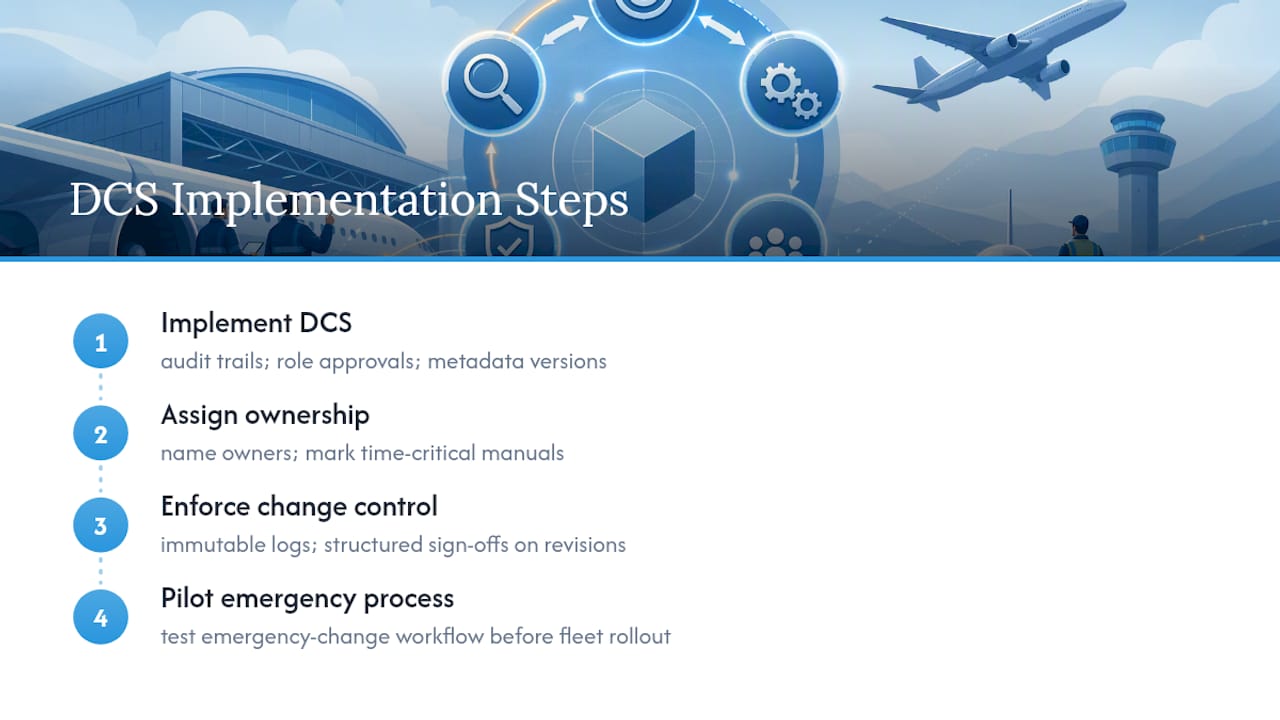
Adopt a fit-for-purpose document control system (DCS) that enforces immutable audit trails, role-based approvals, metadata-driven versioning, and clear separation of quick-reference material from time-critical content. Three moves get you there: 1) identify your time-critical manuals and assign named owners. 2) require immutable change logs and structured sign-off workflows on every revision. 3) run a pilot with a tested emergency-change process before rolling out fleet-wide. Standards from ICAO and IATA shape what auditors expect, and platforms like SquawkFree already build toward those expectations for general aviation operators.
Key Takeaways
A compliant aviation document control program requires immutable audit trails, defined ownership, and evidence exportable on demand for IOSA and FAA review.
| Point | Details |
|---|---|
| Prioritize by criticality | Put time-critical and frequently used content in quick-reference guides, not buried in full manuals. |
| Require immutable audit trails | Every revision needs a locked change log showing who approved what and when. |
| Build evidence auditors expect | Maintain exportable version history, Lists of Effective Pages, and signed approvals continuously. |
| Pilot before full rollout | Test one or two time-critical manuals in a phased pilot before fleet-wide migration. |
| Choose a fit-for-purpose platform | SquawkFree ties document control, AD tracking, and maintenance logs together for general aviation operators. |
Table of Contents
- What Does Document Version Control Mean in Aviation?
- What Capabilities Should a Compliant DCS Have?
- What Do Auditors Expect Your DCS to Prove?
- What Best Practices Should Govern Document Review and Control?
- What Are the Most Common Document Control Non-Conformities?
- How Long Does It Take to Implement a Compliant System?
- How Does SquawkFree Support Aviation Document Control?
- Why Most Aviation Teams Get Document Control Backward
- Get Audit-Ready With SquawkFree
- Frequently Asked Questions
- Sources
What Does Document Version Control Mean in Aviation?
Document version control in aviation is the controlled lifecycle of a document from creation through review, approval, distribution, and eventual obsolescence, with full traceability at every step. That’s a more precise term than most people use, but it’s the one auditors and IOSA assessors actually look for.
The scope is wide. A functioning program has to manage:
- Operations manuals and maintenance control manuals
- MEL and QRH revisions
- EFB content and app-based reference material
- Safety procedures and SMS documentation
- Training records and currency logs
- Flight crew SOPs
- Technical records tied to specific aircraft
Safety-critical documents behave differently than a typical corporate file. A checklist revision might depend on three other manuals updating in lockstep, and a missed cross-reference can put outdated guidance in a cockpit. That’s why ICAO’s guidance material treats time-critical placement and cross-document dependency as core design requirements, not nice-to-haves.
What Capabilities Should a Compliant DCS Have?
A document control system that can survive an IOSA audit needs a specific set of technical guardrails. Skipping any one of these tends to be exactly where auditors find gaps.
- An immutable audit trail that records every revision, who made it, and when
- Defined roles and approval gates before any document goes live
- Enforced metadata and naming conventions, not optional fields
- Document linking so a change in one manual flags dependent documents
- Distribution and obsolescence controls that pull outdated copies out of circulation
- Lists of Effective Pages and Summaries of Change for every revision cycle
- Read-and-sign workflows, ideally published through EFB
- Role-based access with offline availability for crew in the field
Quick-reference guides deserve special attention. ICAO recommends sorting content by how urgently it’s needed, meaning time-critical and frequently used information belongs in a dedicated quick-reference format, not buried in a 200-page manual a pilot has to search under pressure.
Pro Tip: When you pilot a new DCS, start with your time-critical and highest-use documents first. Validate the read-and-sign workflow and offline access on those before touching anything lower-priority. That’s where a broken process actually costs you.
What Do Auditors Expect Your DCS to Prove?
IOSA and SMS audits don’t take your word for it. They want documented evidence, and that evidence has to be exportable on demand. Build your DCS around producing this checklist automatically, not scrambling for it before an audit window opens:
- Full version history and an immutable change log per document
- Documented review and approval records with named reviewers
- Clear owner and reviewer assignments for every controlled document
- Documented review cycles and the SOPs that govern them
- Distribution lists paired with proof that obsolete copies were removed
- Training and read-and-sign records tied to each revision
- Direct linkage between documents and the regulations they satisfy
IATA’s position on Document Control Systems frames a fit-for-purpose DCS as foundational to IOSA readiness, not a bolt-on. Skybrary’s guidance on safety documentation adds that every document must reference applicable regulations, carry a timestamp at revision, and get obsolete versions secured against unintended use. Evidence should take the form of exportable revision logs, current Lists of Effective Pages, Summaries of Change, and signed approval records, not screenshots pulled together the night before an audit.
What Best Practices Should Govern Document Review and Control?
Formalize these into your SOPs rather than treating them as informal habits:
- Assign a named owner to every controlled document, not a department.
- Standardize metadata and naming conventions across the fleet or organization.
- Set review cycles based on document risk and usage frequency, not a blanket annual schedule.
- Require staged review and sign-off before any revision goes active.
- Maintain current Lists of Effective Pages and Summaries of Change for every manual.
- Tie every document change to a training update or crew communication.
- Keep a tested emergency change and rollback procedure on hand.
Pro Tip: Your emergency change workflow should force three things automatically: rapid validation of the change, a cross-document impact check, and immediate broadcast to every affected operational unit. If any of those steps require someone to remember to do it manually, it will eventually get skipped.
None of this works in isolation. Document revisions need to stay aligned with maintenance tracking, AD compliance records, and scheduling systems, since a manual update that isn’t reflected in maintenance logs creates exactly the kind of inconsistency auditors flag.

What Are the Most Common Document Control Non-Conformities?
Auditors tend to find the same handful of problems repeatedly:
- Obsolete documents still in circulation → fix with a single source of truth and enforced obsolescence controls.
- Missing approvals → fix with an enforced approval workflow that produces exportable sign-off records.
- Inconsistent formatting or terminology → fix with a corporate style guide and standardized templates.
- Limited accessibility → fix with role-based access and offline sync for field crews.
- Undocumented review cycles → fix with scheduled reminders and a live dashboard.
When you present corrective actions to an auditor, structure them the same way every time: documented root cause, the corrective plan itself, and validation evidence proving it worked. Auditors respond better to that sequence than to a vague promise that it “won’t happen again.”
How Long Does It Take to Implement a Compliant System?
Plan on a phased rollout rather than a single cutover weekend.
- Scoping and gap analysis (2 to 4 weeks): inventory existing documents and identify where your current process breaks down.
- Pilot (30 to 60 days): focus on one or two time-critical manuals only.
- System validation: test under conditions that resemble real operations, not a demo environment. ICAO guidance specifically recommends validating under realistic conditions before full deployment.
- Full rollout and migration (3 to 6 months depending on fleet and organization size).
- Ongoing monitoring and continuous improvement.
During migration, map every existing document version and its metadata, preserve an immutable record of legacy versions for audit history, and convert Lists of Effective Pages automatically wherever your tooling allows. Capture read-and-sign evidence as you train users, not after the fact.
How Does SquawkFree Support Aviation Document Control?
For general aviation owners and flight schools, the DCS requirements above translate directly into features you can check off:
- Immutable audit trail → SquawkFree records maintenance and compliance changes with exportable history for FAA inspectors.
- AD tracking tied to manuals → airworthiness directive tracking stays linked to the maintenance actions and revisions it triggers.
- Role-based access → cloud document storage with permissions matched to owner, mechanic, or instructor roles.
- Read-and-sign and training evidence → captured directly in the platform rather than on paper forms that go missing.
For flight schools specifically, that means maintenance logs and document control stay in the same system, which simplifies audit exports considerably.
Pro Tip: If you’re a flight school preparing for an inspection, pull your AD compliance history and document revision log from the same platform. Auditors notice immediately when those two records don’t match.
Why Most Aviation Teams Get Document Control Backward
Most compliance teams treat document control as a software purchase decision. Buy the platform, migrate the files, check the box. That’s backward, and it’s why so many IOSA findings trace back to documentation even after a system upgrade.
The real work is governance: who owns which manual, how a change cascades to dependent documents, and what happens in the 48 hours after an emergency revision needs to go out. A DCS can enforce those rules, but it can’t invent them for you. Teams that skip the ownership and workflow design step end up with a well-organized system full of the same inconsistencies they had on paper.
The other overrated idea is treating the pilot phase as a formality. A 30-day pilot on your least critical manual tells you nothing. Pilot with the document your crews touch every day, because that’s where a broken read-and-sign workflow or a missing offline sync will actually surface before it becomes an audit finding. Integrating scheduling and communication tools into that pilot matters more than most rollout plans admit.
Start with governance and ownership. The software follows.
Get Audit-Ready With SquawkFree
If you’re running general aviation aircraft or managing a flight school fleet, SquawkFree gives you one place to keep maintenance records, AD tracking, and document history aligned instead of managing them across separate spreadsheets and binders.
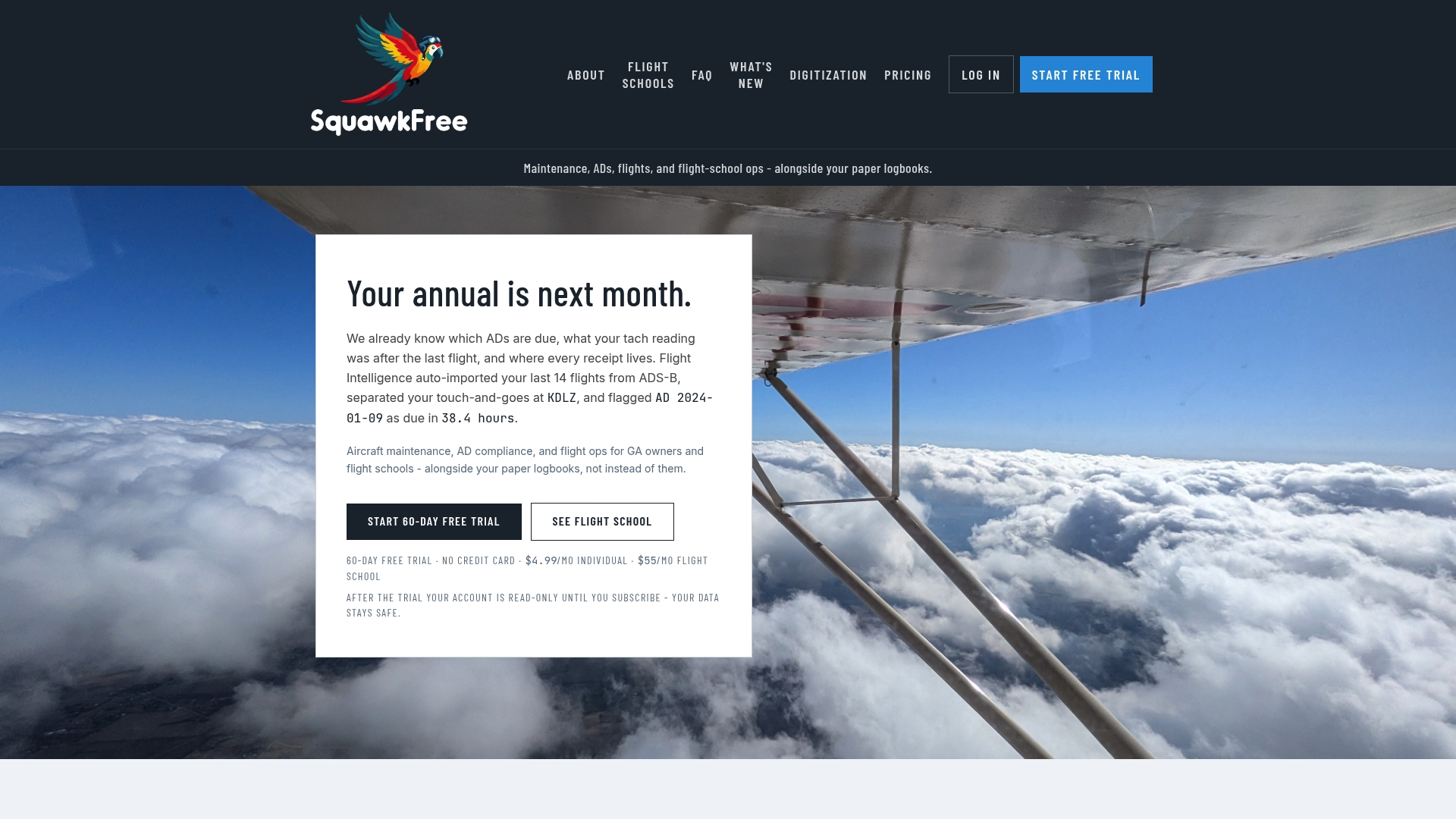
Unlike a standalone document repository, SquawkFree ties your revision history directly to the maintenance and AD data an inspector actually asks for, so you’re not reconciling two systems the night before an audit. It fits general aviation owners, co-owners, and flight schools that need audit-ready recordkeeping without hiring a dedicated compliance department. For teams weighing broader compliance platforms, resources like this compliance software guide cover evaluation criteria worth checking against any option you consider, SquawkFree included.
Start a trial at SquawkFree and see how your maintenance logs, AD compliance, and document history line up in one export.
Frequently Asked Questions
What’s the difference between document control and document management in aviation? Document management covers storage and retrieval. Document control adds the enforced lifecycle, meaning version history, approvals, and obsolescence tracking, that IOSA and FAA audits specifically require.
Do small flight schools need the same level of document control as major carriers? The scale differs, but the underlying requirements don’t. A flight school still needs immutable version history, defined ownership, and removal of obsolete manuals to pass FAA scrutiny, just across a smaller document set.
How often should aviation manuals go through review? Review frequency should match risk and usage, not a fixed annual calendar. High-use documents like checklists warrant more frequent review cycles than reference material accessed rarely.
What happens if an outdated manual is found during an audit? It typically becomes a non-conformity requiring a documented root cause, a corrective action plan, and evidence the fix was validated, exactly the sequence auditors expect to see.
Sources
- ICAO safety management guidance material
- IATA — Document Control Systems
- Safety documentation | SKYbrary Aviation Safety
Recommended
- FAA AD Compliance for Aircraft Owners and Operators | SquawkFree Blog
- Aircraft Recordkeeping Requirements: An Owner’s Compliance Guide | SquawkFree Blog
- Aircraft Maintenance Logs: FAA Compliance Guide for 2026 | SquawkFree Blog
- Airworthiness Directives Explained for Aviation Professionals | SquawkFree Blog
No credit card required · read-only after trial