
ELT Inspection Requirements for U.S. Aircraft Owners

ELT Inspection Requirements for U.S. Aircraft Owners
Under 14 CFR §91.207(d), every ELT required by §91.207(a) must receive a documented inspection within a year of the last inspection. If your logbook shows an inspection date older than 12 months, your aircraft is not in compliance and should not be flown until the inspection is completed and signed off.
The regulation specifies four elements that inspection must cover:
- Proper installation: The ELT is correctly mounted, secured, and positioned per the manufacturer’s Instructions for Continued Airworthiness (ICA).
- Battery corrosion: The battery compartment shows no corrosion, and the battery meets serviceability criteria.
- Controls and crash sensor operation: The g-switch, remote control, and arming mechanism all function correctly.
- Sufficient radiated signal: The unit transmits at the required power level on the correct frequency.
Three immediate actions to take right now: pull the logbook and confirm the ELT inspection date, verify your 406 MHz registration with NOAA/Cospas-Sarsat if your unit operates on 406 MHz, and schedule a certificated mechanic if the inspection is overdue or coming due within 30 days.
Table of Contents
- Your ELT compliance checklist before the mechanic arrives
- What does 14 CFR §91.207 actually require?
- What does the annual ELT inspection actually cover?
- How do you test an ELT without triggering a SAR response?
- Battery service life, replacement, and disposal
- Who can perform and sign off the annual ELT inspection?
- Recordkeeping and 406 MHz registration: what to document and where
- What to do when an ELT activates unexpectedly
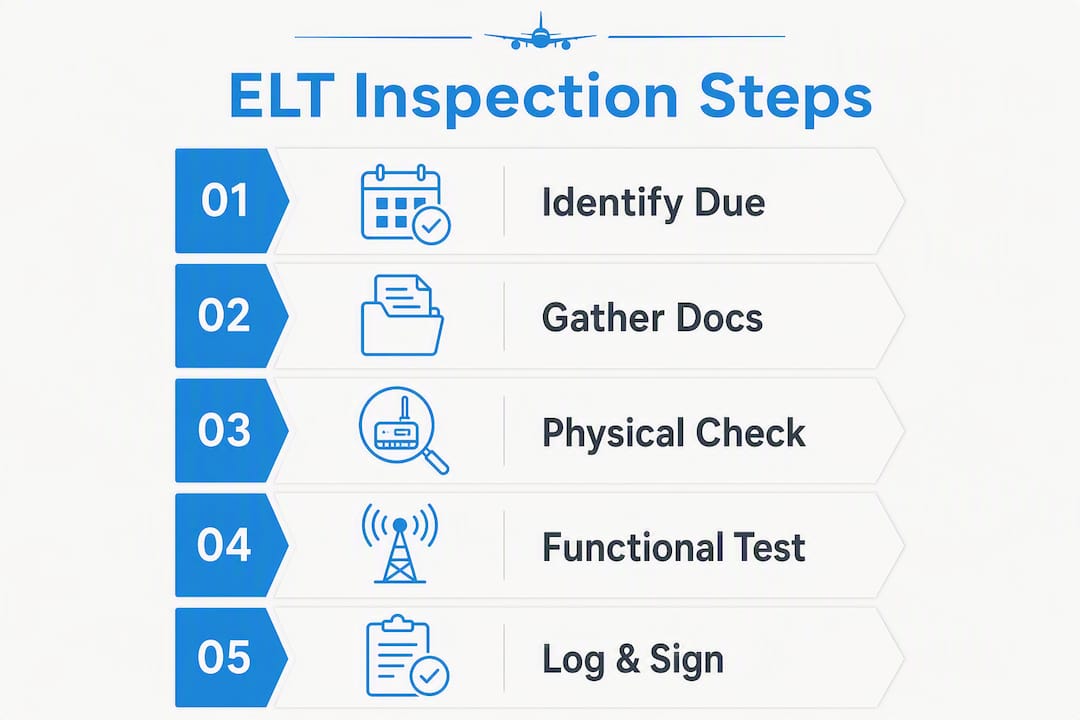
- A practical workflow for staying current on ELT compliance
- Key Takeaways
- The compliance gap most owners don’t see until it’s too late
- Squawkfree keeps your ELT inspection record current and audit-ready
- Useful sources to bookmark
Your ELT compliance checklist before the mechanic arrives
Use this table to confirm your status on every compliance item before the inspection appointment. Gathering this information in advance saves time and reduces the chance of a failed sign-off.

| Compliance Item | What to Check | Status |
|---|---|---|
| Next inspection due date | Logbook entry date plus about a year | ☐ Confirmed |
| Battery expiration / half-life | Manufacturer label on battery or ICA schedule | ☐ Confirmed |
| 406 MHz registration | NOAA beacon registration database (beaconregistration.noaa.gov) | ☐ Current |
| Antenna and cabling condition | Visual check for chafing, corrosion, or loose connectors | ☐ No defects |
| G-switch / crash sensor | Functional check per manufacturer procedure | ☐ Operable |
| Remote control function | Arm/disarm and test-mode operation verified | ☐ Operable |
| Logbook entry present | Prior inspection entry includes date, signature, and certificate number | ☐ Present |
Before the mechanic arrives, gather the ELT manufacturer’s ICA or maintenance manual, the aircraft logbook showing the last ELT inspection entry, and your 406 MHz registration confirmation. If the battery is approaching its replacement date, purchase the correct replacement battery in advance so the mechanic can swap it during the same visit.
Pro Tip: Coordinate battery replacement with the annual ELT inspection whenever the manufacturer’s expiration date falls within six months of the inspection due date. Replacing the battery at the same appointment avoids a second logbook entry, a second mechanic visit, and the risk of flying with a battery that expires mid-year.
What does 14 CFR §91.207 actually require?
The regulation and its primary advisory circular translate into five concrete obligations for U.S.-registered civil aircraft operators.
-
Annual inspection on a 12-month calendar interval. 14 CFR §91.207(d) requires the inspection within 12 calendar months after the last inspection. “Calendar months” means the same date in the month, 12 months later, not 365 days. An inspection performed in March is due by the end of March of the following year.
-
Compliance with FAA Advisory Circular AC 91-44A. AC 91-44A provides the FAA’s accepted means of compliance for ELT installation and inspection. It specifies test methods, signal-strength verification procedures, battery serviceability criteria, and the use of dummy loads during testing. Following AC 91-44A is not legally mandatory, but it is the standard against which FAA inspectors measure compliance.
-
Technical standard conformance. ELTs installed on U.S.-registered aircraft must meet either TSO-C91 (older 121.5/243.0 MHz units) or TSO-C126 (406 MHz units). TSO-C126 units transmit a digitally encoded distress signal that includes a unique hex identification code, enabling NOAA/Cospas-Sarsat to verify the alert against the registration database before dispatching search-and-rescue resources.
-
406 MHz registration with NOAA/Cospas-Sarsat. If your aircraft carries a TSO-C126 406 MHz ELT, federal guidance requires registration of the unit’s hex ID with the NOAA/Cospas-Sarsat beacon registry. Unregistered 406 MHz beacons still trigger satellite alerts, but responders cannot verify the owner or contact next of kin, which delays confirmation and increases the risk of a full SAR deployment for a false alert.
-
Logbook documentation after every inspection. The inspection is not complete until a certificated mechanic signs the logbook entry with the required elements. No entry means no compliance, regardless of whether the physical inspection was performed.
What does the annual ELT inspection actually cover?
A thorough annual ELT inspection goes well beyond a quick visual check. The table below lists the specific tasks a mechanic should perform and verify, drawn from AC 91-44A and manufacturer ICA requirements.
| Inspection Task | What the Mechanic Verifies |
|---|---|
| Installation and mounting | Unit is secured per ICA torque values; mounting bracket shows no cracks or corrosion; unit is oriented correctly for g-switch activation |
| Antenna and cabling | Antenna is undamaged and properly connected; coaxial cable shows no chafing, kinking, or connector corrosion along its full routed length |
| Battery compartment | No corrosion present; battery is within manufacturer’s expiration date and has not accumulated more than one cumulative hour of activation |
| Controls and remote operation | Arm/disarm switch, remote control panel, and test mode all function per manufacturer specification |
| G-switch / crash sensor | Sensor responds correctly during functional check; no evidence of prior impact damage or sensor drift |
| Hex ID verification (406 MHz) | Transmitted hex ID matches the registration record in the NOAA beacon database |
One point that owners often overlook: manufacturer ICA requirements frequently specify inspection items and torque values that go beyond the general FAA checklist. A mechanic who works only from the four-item statutory list in §91.207(d) without consulting the ICA may miss a mounting bracket torque check or a cable routing inspection that the manufacturer requires. That gap can create a non-compliance finding during a ramp check even when the logbook entry looks complete.
How do you test an ELT without triggering a SAR response?
Testing rules differ between 121.5 MHz and 406 MHz units, and the consequences of getting it wrong range from a warning call from ATC to a full search-and-rescue deployment.
- 121.5 MHz operational tests are permitted during the first five minutes after the hour only, and the test must not exceed three audio sweeps. Outside that window, any test requires prior coordination with ATC or the nearest FAA facility. The AIM notes that satellite monitoring of 121.5/243.0 MHz ceased in 2009, so a 121.5 test will not trigger a satellite alert, but it can still be heard by overflying aircraft and ground stations, which may generate an ATC inquiry.
- 406 MHz self-test mode is the correct method for routine functional checks. The manufacturer’s self-test transmits a reduced-power, coded test signal that the unit’s internal logic recognizes as a test. Do not activate the unit in full-power transmit mode to “test” it. That transmits a live distress signal to the Cospas-Sarsat satellite network.
- Bench testing with a test set is the method used during the annual inspection to verify radiated power output. AC 91-44A recommends using a shielded enclosure or a calibrated dummy load to prevent the signal from reaching the satellite network during bench tests. The mechanic should also decode the transmitted hex ID during the bench test to confirm it matches the NOAA registration record.
- Airborne testing is not permitted. Never activate an ELT in flight as a test. Even a brief airborne transmission on 406 MHz will be detected by the satellite network and may trigger a SAR response before you can notify ATC.
Battery service life, replacement, and disposal
Battery replacement is where the annual inspection and the manufacturer’s maintenance schedule intersect most directly. AC 91-44A defines a battery as unserviceable if it has accumulated more than one cumulative hour of activation time or if it has exceeded 50% of its useful life for rechargeable types. The manufacturer’s expiration date printed on the battery label is the other hard limit: an expired battery must be replaced regardless of how little activation time it has logged.
- Manufacturer expiration dates drive the replacement schedule. Most lithium ELT batteries carry a five-year or six-year service life from the date of manufacture, not the date of installation. Check the label, not the installation date.
- Coordinate replacement with the annual inspection. AOPA guidance recommends scheduling battery replacement to coincide with the annual ELT inspection whenever practical. This avoids a separate maintenance event and keeps the logbook clean.
- Who may replace the battery? Under 14 CFR Part 43, a certificated pilot-owner may replace certain ELT batteries as preventive maintenance, but only if the battery is a plug-in or snap-in type that requires no soldering or special tools. If the replacement requires opening the unit’s sealed housing or involves wiring, a certificated mechanic must perform the work.
- Logbook entry required after every battery replacement. Whether the owner or a mechanic replaces the battery, a logbook entry is required. The entry must describe the work performed, identify the new battery by part number and expiration date, and include the signature and certificate number of the person approving the aircraft for return to service.
- Disposal. Lithium ELT batteries are classified as hazardous materials. Do not discard them in regular trash. Return them to the battery manufacturer, a certified hazardous-waste facility, or a participating aviation parts supplier. Document the disposal in your maintenance records.
Pro Tip: Write the battery’s expiration date on a piece of tape and affix it to the inside of the battery compartment door. Your mechanic will see it immediately during the next inspection, and you will catch an approaching expiration date during any routine preflight that includes opening the ELT compartment.
Who can perform and sign off the annual ELT inspection?
The annual ELT inspection must be performed and signed off by a certificated airframe mechanic (A&P) or an appropriately rated repair station. The mechanic’s signature on the logbook entry is a return-to-service endorsement, meaning they are certifying that the ELT is airworthy and the aircraft may return to service.
-
Certificated A&P mechanic. An A&P with airframe rating may perform the inspection, complete all required checks per §91.207(d) and AC 91-44A, and sign the logbook entry. The entry must include the mechanic’s certificate number.
-
FAA-certificated repair station. A repair station with the appropriate rating may also perform and sign off the inspection. The entry will carry the repair station’s certificate number rather than an individual mechanic’s number.
-
Pilot-owner preventive maintenance. A certificated pilot who is the registered owner of a non-commercially operated aircraft may replace a plug-in ELT battery under preventive maintenance. This does not substitute for the mechanic’s annual inspection. AOPA and FAA guidance both flag the confusion between these two activities as a common source of enforcement findings during ramp checks.
-
Required logbook entry elements. Every annual ELT inspection entry must include:
- The item inspected (ELT, including make, model, and serial number)
- Date of inspection
- Description of work performed and findings
- A statement that the ELT is approved for return to service
- Signature of the approving mechanic or repair station
- Certificate number of the approving person or repair station
An entry that omits the certificate number or the return-to-service statement is incomplete and will not satisfy an FAA inspector.
Recordkeeping and 406 MHz registration: what to document and where
Accurate records serve two purposes: they prove compliance to an FAA inspector, and they give search-and-rescue coordinators the information they need to respond correctly to a real alert.
| Record Element | Where It Lives | What to Include |
|---|---|---|
| Annual inspection entry | Aircraft maintenance logbook | Date, ELT make/model/serial, inspection findings, return-to-service statement, mechanic signature and certificate number |
| 406 MHz hex ID | Logbook and NOAA registration | Hex code printed on the ELT label; must match NOAA registry |
| Battery replacement entry | Aircraft maintenance logbook | Battery part number, expiration date, date of replacement, signature and certificate number |
| ELT removal entry (if removed) | Aircraft maintenance logbook | Date removed, reason, “ELT not installed” placard confirmation, expected return date |
| NOAA registration record | beaconregistration.noaa.gov | Owner name, address, phone, aircraft N-number, ELT make/model/serial, hex ID |
Keeping the NOAA registration current is not optional. When a 406 MHz alert reaches the Cospas-Sarsat network, coordinators query the registry immediately. Stale contact information, a wrong phone number, or a previous owner’s name means coordinators cannot verify whether the alert is real, which can trigger a full SAR deployment that costs tens of thousands of dollars and diverts resources from genuine emergencies.
- Verify your NOAA registration annually, at minimum at the time of the ELT inspection.
- Update the registry within 60 days of any change to owner name, address, phone number, or aircraft registration.
- Store a printed or digital copy of your NOAA registration confirmation with the aircraft documents.
For aircraft recordkeeping requirements beyond the ELT, the same principle applies: complete, current records protect you during ramp checks and support accurate SAR responses.
What to do when an ELT activates unexpectedly
Inadvertent ELT activations are more common than most operators expect. AC 91-44A identifies false alerts as a significant burden on SAR resources and stresses that disciplined testing and accurate registration are the primary defenses.
- Step 3: Notify ATC or the nearest facility immediately — Contact ATC on the frequency in use or 121.5 MHz. Provide your aircraft N-number, ELT hex ID (for 406 MHz units), location, and the approximate start time and duration of the activation. If on the ground, call the nearest FAA FSDO or the Air Force Rescue Coordination Center.
- Step 5: Check for ADs and service notices. Some inadvertent activations are caused by known defects addressed by FAA Airworthiness Directives or manufacturer service bulletins. Search the FAA AD database for your ELT make and model. Tracking ELT-related ADs is part of maintaining airworthiness, not just an annual checkbox.
- Step 6: Monitor SARSAT safety notices. The NOAA SARSAT safety notices page publishes alerts about specific ELT models with known false-alert issues, battery defects, or registration problems. Bookmark it and check it when you receive any service bulletin from your ELT manufacturer.
A practical workflow for staying current on ELT compliance
Staying compliant is straightforward when you treat the ELT inspection as a scheduled event rather than something you check reactively. The workflow below integrates the inspection, battery lifecycle, and recordkeeping into a single repeatable process.
| Step | Action | Timing |
|---|---|---|
| 1. Identify due date | Pull the last logbook entry; calculate the 12-month calendar deadline | Immediately after each inspection |
| 2. Set a reminder | Enter the due date in your maintenance tracking system with a 60-day advance alert | Same day as step 1 |
| 3. Check battery expiration | Compare battery label date to inspection due date; order replacement if within six months | At the 60-day reminder |
| 4. Verify NOAA registration | Log in to beaconregistration.noaa.gov and confirm all fields are current | At the 60-day reminder |
| 5. Schedule the mechanic | Book the inspection appointment; confirm mechanic has the ICA for your ELT model | 30 days before due date |
| 6. Perform bench tests | Mechanic verifies radiated signal per AC 91-44A using shielded test set or dummy load | During inspection appointment |
| 7. Logbook entry | Mechanic signs entry with all required elements; owner retains copy | Day of inspection |
| — | Scan or photograph the logbook entry and upload to your maintenance tracking platform | Within hours of inspection |
Squawkfree’s maintenance scheduling and AD tracking features support every step in this workflow. The platform lets you set inspection due dates, receive automated reminders, log battery expiration dates alongside the inspection record, and store scanned logbook entries in the cloud. When an FAA inspector asks for your ELT inspection history, you can pull the complete record in seconds rather than searching through paper logbooks.
Key Takeaways
Every ELT on a U.S.-registered civil aircraft must receive a documented inspection within 12 calendar months, signed off by a certificated A&P mechanic with a return-to-service statement, and backed by a current NOAA/Cospas-Sarsat registration for 406 MHz units.
| Point | Details |
|---|---|
| 12-month inspection interval | 14 CFR §91.207(d) requires inspection within 12 calendar months; the clock runs from the last logbook entry date. |
| Four statutory inspection elements | Proper installation, battery corrosion check, controls/crash sensor operation, and sufficient radiated signal must all be verified. |
| Battery replacement coordination | Replace batteries at the annual inspection when expiration falls within six months; log the replacement with part number and expiration date. |
| 406 MHz registration is mandatory | Keep NOAA/Cospas-Sarsat registration current; stale contact info can trigger a full SAR deployment for a false alert. |
| Squawkfree for compliance tracking | Squawkfree automates inspection reminders, AD tracking, and logbook recordkeeping to keep your ELT compliance audit-ready year-round. |
The compliance gap most owners don’t see until it’s too late
Most ELT compliance failures don’t happen because owners ignore the regulation. They happen because owners assume the annual aircraft inspection and the annual ELT inspection are the same event. They are not. The aircraft’s airworthiness inspection and the ELT’s 12-month inspection can be performed together, but the ELT inspection has its own regulatory clock, its own logbook entry, and its own sign-off requirements. If your A&P performs the airworthiness inspection without explicitly completing the four-element ELT check and logging it separately, you have a gap.
The second failure mode is subtler: treating the annual inspection as a paperwork exercise rather than a physical verification. Antenna cable chafing, mounting bracket corrosion, and g-switch drift are not visible from the cockpit. A mechanic who checks the logbook date and activates the self-test without routing the antenna cable or torquing the mounting hardware to ICA specifications has not completed a compliant inspection, even if the entry looks correct. The practical standard from AC 91-44A is clear: the inspection must include a physical check of the antenna route and mounting hardware, not just a functional test.
The third pitfall is the battery swap. Owners who replace a plug-in battery under preventive maintenance sometimes believe they have reset the inspection clock. They have not. The battery replacement is a separate maintenance action with its own logbook entry. The 12-month inspection interval continues to run from the last mechanic-signed inspection entry, regardless of how recently the battery was replaced.
Getting all three right, on schedule, with complete logbook entries, is what separates an aircraft that passes a ramp check from one that doesn’t.
Squawkfree keeps your ELT inspection record current and audit-ready
Missed ELT inspection dates are one of the most preventable compliance failures in general aviation, and they almost always come down to one thing: no system tracking the due date. Squawkfree gives you a single platform to schedule the 12-month inspection, log battery expiration dates, store scanned logbook entries, and receive automated reminders before the deadline arrives.

The platform’s AD tracking integration means you will also see any FAA Airworthiness Directive affecting your specific ELT model, with the compliance deadline and required action clearly displayed. When your mechanic completes the inspection, you can upload the signed logbook entry directly to the aircraft’s digital record, giving you an audit trail that is accessible from any device. For operators who need to bring historical paper logbooks into the system, Squawkfree’s logbook digitization service uses human-verified OCR to import past ELT inspection entries accurately.
Start your 60-day free trial at Squawkfree and set up your ELT inspection schedule today.
Useful sources to bookmark
The documents below are the primary regulatory and guidance references for ELT inspection compliance in the United States. Primary regulatory sources carry legal authority; advisory circulars and operational notices provide accepted means of compliance and best-practice guidance.
- 14 CFR §91.207 — Emergency Locator Transmitters (Primary regulatory source) — The statutory requirement for ELT carriage, inspection intervals, and the four inspection elements. This is the controlling legal text for U.S.-registered civil aircraft.
- FAA Advisory Circular AC 91-44A (CHG 1) (Advisory/accepted means of compliance) — Installation and inspection procedures, test methods, signal-strength criteria, and battery serviceability standards. The practical reference for mechanics performing the annual inspection.
- Aeronautical Information Manual (AIM), Chapter 6, Section 2 (Operational guidance) — Testing windows, false-alert consequences, and 406 MHz registration guidance for pilots and operators.
- AOPA — Emergency Locator Transmitters (Practical guidance) — Plain-language explanation of pilot vs. mechanic responsibilities, battery coordination, and common compliance pitfalls.
- NOAA SARSAT Safety Notices (Operational notices) — Model-specific safety alerts, recall notices, and false-alert advisories published by the U.S. SARSAT program office.
Recommended
No credit card required · read-only after trial