
Part 91 Maintenance: What Owners and Operators Must Know
Part 91 Maintenance: What Owners and Operators Must Know
As the registered owner or operator, you’re the one legally responsible for keeping your aircraft’s maintenance records current and its inspections on schedule, no matter who turns the wrenches. Three rules anchor every Part 91 maintenance program: an annual inspection every 12 calendar months, an inspection every 100 hours of operation if the aircraft is used for hire or flight instruction for hire (with an allowance to reach a shop), and airtight records tracking every Airworthiness Directive by number, method of compliance, and next due date.
Miss any one of these and you’re flying an aircraft that isn’t legally airworthy, whether or not the engine runs fine.
Here’s the compliance floor every Part 91 operator needs to clear:
- Annual inspection: required every 12 calendar months under 14 CFR § 91.409, regardless of hours flown.
- inspection every 100 hours: mandatory only for aircraft used for hire or for flight instruction for hire, with a limited allowance to reach an inspection facility.
- AD and maintenance records: must show the AD number, method of compliance, date of compliance, and be transferred to the new owner at sale, per 14 CFR § 91.417.
Pro Tip: If you’re a co-owner or club member, put in writing who is responsible for tracking the annual due date. “Someone else has it” is the single most common reason inspections lapse.
Key Takeaways
Part 91 compliance rests on three pillars: a current annual inspection, correct application of the 100-hour rule when applicable, and maintenance records that clearly link every AD to the work that resolved it.
| Point | Details |
|---|---|
| Annual inspection is universal | Required every 12 calendar months for all Part 91 aircraft, regardless of hours flown. |
| 100-hour rule is conditional | Applies only to aircraft used for hire or instruction for hire, with a 10-hour ferry allowance. |
| Records need specific fields | Every entry requires AD number, method of compliance, date, and signature where applicable. |
| Some records are permanent | Total time, AD status, and inspection status must transfer to the new owner at sale. |
| Squawkfree closes the linkage gap | Automated AD tracking and timestamped entries connect each directive to its compliance record for audit-ready exports. |
Table of Contents
- Who Is Responsible for Part 91 Maintenance Compliance
- Inspection Intervals: Annual, 100-Hour, and Progressive Programs
- Preventive Maintenance: What You Can Legally Do Yourself
- Maintenance Records: What to Keep and What Transfers at Sale
- Airworthiness Directives: Recording Compliance the Right Way
- Returning to Service After Maintenance, Rebuilding, or Alteration
- Audit-Ready Recordkeeping: Where Compliance Actually Breaks Down
- A Weekend Compliance Checklist for Part 91 Owners
- Stay Ahead of Every Inspection and AD With Squawkfree
- Frequently Asked Questions
- Sources
Who Is Responsible for Part 91 Maintenance Compliance
The registered owner or operator carries legal responsibility for airworthiness under Part 91, full stop. That obligation doesn’t transfer to your mechanic, your flight school, or whoever last flew the airplane. Section 91.417 places the record-keeping duty squarely on the owner or operator, which means you need to know what’s been done to your aircraft even when someone else does the wrench work.
That doesn’t mean you’re expected to perform annual inspections yourself. It means you’re accountable for verifying they happened, on schedule, and that the paperwork proves it.
Certificated mechanics (A&Ps) and certificated repairmen hold the privilege to approve aircraft for return to service after maintenance, repairs, or alterations. Certificated pilots hold a narrower privilege: performing specific preventive maintenance tasks on aircraft they own or operate, which we’ll cover in detail below. Neither privilege relieves you of the underlying responsibility to confirm the work got logged correctly.
For flight schools, clubs, and multi-owner arrangements, this responsibility gets murky fast unless someone writes it down. A management agreement or flight department procedure should spell out:
- Who schedules and tracks the annual inspection due date
- Who monitors 100-hour intervals for aircraft used in instruction for hire
- Who owns the AD compliance log and updates it after each maintenance event
- How delegated work gets documented so the owner can verify it without chasing down a mechanic’s personal notes
A single-owner Cessna 172 has a simple answer: it’s you. A flight school with six aircraft and rotating instructors needs a documented chain of custody, or the compliance gaps show up exactly when an inspector asks to see them.
Inspection Intervals: Annual, 100-Hour, and Progressive Programs
Every U.S.-registered civil aircraft operating under Part 91 needs an annual inspection every 12 calendar months, full stop, regardless of how many hours it flew that year. The inspection must be signed off by an A&P mechanic holding inspection authorization, or performed at a certificated repair station, and it covers the aircraft, engine, and appliances against the manufacturer’s inspection checklist or an equivalent FAA-approved program.
The 100-hour inspection requirement applies only when the aircraft is used to carry passengers for hire or flight instruction for hire, per 14 CFR § 91.409. A privately flown aircraft never used for hire doesn’t need one. If your aircraft does fall under this rule and the 100-hour interval is about to expire mid-trip, the regulation gives you a limited allowance to reach a maintenance facility, so long as you land at the nearest suitable location once the inspection becomes due.
Here’s how the three inspection paths break down in practice:
- Annual only: Personal-use aircraft, never rented or used for instruction for hire. One inspection cycle to track.
- Annual plus 100-hour: Flight school aircraft, rental fleet airplanes, and anything used for compensated instruction. Two clocks running simultaneously, and the 100-hour typically hits first on active trainers.
- Progressive inspection program: An FAA-approved alternative that breaks the full annual-equivalent inspection into smaller segments performed on a rolling schedule, rather than pulling the aircraft out of service for one large block.
Progressive programs appeal to flight schools and commercial operators who can’t tolerate an aircraft sitting grounded for a multi-day annual. The trade-off is documentation discipline: your maintenance records need to demonstrate the progressive schedule is genuinely equivalent to a standard annual, item for item, because that’s exactly what an inspector will check first.
Pro Tip: If your training aircraft flies 700+ hours a year, run the math on 100-hour intervals against your annual. Many operators find the inspection every 100 hours effectively absorbs most annual inspection items anyway, which is worth discussing with your maintenance shop when setting the schedule.
Preventive Maintenance: What You Can Legally Do Yourself
Part 91 lets a certificated pilot who owns or operates an aircraft perform specific preventive maintenance tasks without an A&P certificate, provided the aircraft isn’t used in air carrier service. FAA guidance lists concrete examples:
- Certain tasks such as replacing safety belts and shoulder harnesses
- Servicing landing gear wheel bearings
- Replacing bulbs, reflectors, and lenses on position and landing lights
- Changing tires and tubes
- Servicing spark plugs, cleaning, and setting gap clearance
- Replenishing hydraulic fluid, oil, and other approved fluids
Anything beyond this defined list, engine work, structural repairs, avionics installation, falls to a certificated mechanic or repair station. The line matters because performing work outside your preventive maintenance privilege and logging it yourself creates a record an inspector can invalidate.
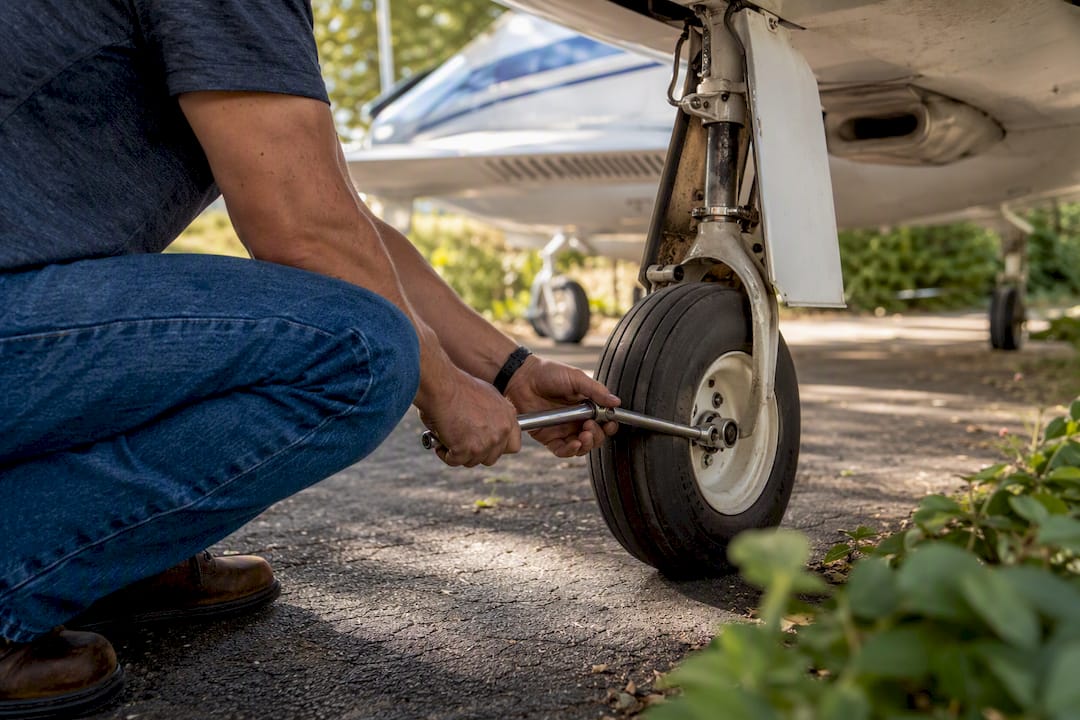
Every preventive maintenance action still requires a logbook entry, and a vague entry doesn’t satisfy anyone reviewing your records later. A usable entry connects four things: the aircraft or component, the specific work performed, the date, and your certificate number and signature. “Replaced nose tire, serial N12345, [date], [certificate number]” holds up. “Fixed tire” does not, especially if you’re trying to sell the aircraft two years later and the buyer’s mechanic wants to trace the work history.
Maintenance Records: What to Keep and What Transfers at Sale
Section 91.417 spells out exactly what records you’re required to maintain, and the list is longer than most owners expect. You need records covering maintenance, preventive maintenance, alterations, and every inspection performed, whether that’s a 100-hour, an annual, or a progressive inspection segment, along with the associated engine, propeller, and appliance data tied to each event.
Each entry needs specific fields to count as compliant:
- Description of the work performed, detailed enough that a future mechanic can understand exactly what was done
- Date the work was completed
- Aircraft total time in service at the time of the work
- The name, signature, and certificate number of the person approving the aircraft for return to service (when applicable)
- AD number, method of compliance, and date of compliance for any Airworthiness Directive addressed
Retention rules trip up more owners than any other part of 91.417. Routine maintenance and preventive maintenance records only need to be kept until the work is repeated or superseded, or for a limited retention period, whichever comes first. But certain records carry a permanent retention requirement that follows the aircraft for its entire life: the total time in service, current inspection status, and current AD compliance status, and a list of major alterations and repairs made using FAA Form 337.
Those permanent records must transfer to the new owner at the time of sale. This is where a surprising number of transactions run into trouble. A buyer’s pre-purchase inspection routinely turns up gaps between what the aircraft’s logbooks show and what the AD compliance status actually requires, because the seller kept incomplete records or never consolidated years of maintenance shop invoices into a coherent AD log.
14 CFR § 91.417 also requires that these records be made available for inspection by the FAA Administrator or an authorized NTSB representative, which means “I’ll have to dig through some boxes” is not an acceptable response during a ramp check. A compliant logbook entry written clearly the first time saves hours of reconstruction later, especially when the aircraft changes hands and the new owner’s mechanic needs a clean audit trail from day one.
Airworthiness Directives: Recording Compliance the Right Way
An AD entry that just says “AD complied with” tells an inspector nothing and satisfies no one. Every AD compliance record needs three elements: the AD number itself, the specific method of compliance, whether that’s a parts replacement, an inspection, or a repair, and, for recurring ADs, the next required action date or interval.
Consider the difference between these two entries. “AD 2015-19-07 complied with” leaves an inspector guessing whether the compliance was a one-time fix or the start of a recurring inspection cycle. “AD 2015-19-07, complied with via inspection of fuel pump per AD instructions, next inspection due at 3,847.5 hours TT or 12 calendar months” gives a complete picture that any mechanic can act on without calling around for context.
A searchable AD status log separate from your general maintenance logbook makes recurring ADs far easier to manage, because you’re not flipping through years of unrelated entries to find the last compliance date on a single directive. Each maintenance entry addressing an AD should cross-reference the AD log, so a mechanic reviewing either document can trace the connection instantly. That link between the AD action and the specific logbook entry that satisfied it is exactly what inspectors look for first, and it’s exactly what tends to be missing when an aircraft fails a records review.
Returning to Service After Maintenance, Rebuilding, or Alteration
14 CFR § 91.407 prohibits operating an aircraft that’s had maintenance, preventive maintenance, rebuilding, or alteration performed until it’s been approved for return to service and the maintenance record entry has been made. This isn’t a formality. It’s a legal gate that stands between a completed work order and the next flight.
For major repairs or major alterations, that approval typically comes through FAA Form 337, filed by the mechanic or repair station and describing exactly what was done. A copy of Form 337 must be kept with the aircraft when the alteration affects a limitation or condition referenced on its airworthiness certificate.
Before your next flight after any significant maintenance event, verify:
- The logbook entry approving return to service is complete and signed
- Form 337 was filed if the work qualifies as a major repair or alteration
- Any required operational check or test flight referenced in the work order was actually flown
- Weight and balance data was updated if the alteration changed empty weight or CG
Skipping the verification step because “the shop said it’s fine” is how owners end up flying on an incomplete paper trail.
Audit-Ready Recordkeeping: Where Compliance Actually Breaks Down
The most common Part 91 audit failure isn’t missing maintenance. It’s missing the connective tissue between the maintenance and the requirement it satisfied. An owner can have every AD complied with and every inspection current, and still fail a ramp check because the paperwork doesn’t clearly link one to the other.
During a ramp inspection, the inspector isn’t just checking whether work happened. They’re tracing an audit trail: dated entries, signatures, AD numbers, and method-of-compliance notes that connect cleanly from one document to the next. Without that linkage, an aircraft can get grounded even when the actual maintenance was done correctly, because the owner can’t prove it fast enough.
Three failure patterns show up repeatedly:
- Orphaned AD entries with no reference to the maintenance log entry that addressed them, or vice versa.
- Unsourced approvals, where a return-to-service signature exists but the underlying work description is vague or missing.
- Retrieval failure under time pressure, where the records exist somewhere but can’t be located during the window an inspector is standing on the ramp.
A disciplined workflow closes these gaps: a central AD log cross-referenced to every maintenance entry, timestamped records that can’t be backdated or lost, role-based access so a flight school’s instructors and dispatchers see what they need without touching compliance data they shouldn’t edit, and a clean export package ready the moment an aircraft changes hands.
Digital, timestamped records that tie AD compliance directly to the maintenance entry that satisfied it eliminate the scramble that turns a routine ramp check into a grounding. The paper fire drill is almost always a documentation problem, not a maintenance problem.
This is precisely the gap Squawkfree was built to close. Automated flight-data import through Flight Intelligence removes manual logging errors, AD search and tracking keeps every directive linked to the maintenance action that resolved it, and audit-ready export packages mean a sale transfer or a ramp inspection never turns into a document hunt.
Pro Tip: Before your next annual, pull your AD log and cross-check it against your logbook entries one line at a time. If you can’t find the linkage in under two minutes, an inspector won’t find it any faster.
A Weekend Compliance Checklist for Part 91 Owners
- Audit what you have: pull recent inspection and AD entries, confirm your annual and any applicable 100-hour due dates.
- Fix what’s overdue: prioritize lapsed ADs or inspections first, and book A&P time now if anything needs correcting.
- Build the packet: compile a digital, searchable export, PDFs included, so you’re ready for a sale or a ramp check without scrambling.
A practitioner’s note on audit readiness
The owners who pass ramp checks without stress are the ones who treat records as a living document, not year-end paperwork. Get ahead of the AD log now, and check Squawkfree’s resources for deeper how-tos.
Stay Ahead of Every Inspection and AD With Squawkfree
Squawkfree replaces the spreadsheet-and-shoebox approach most GA owners use with a system built specifically for Part 91 compliance. Flight Intelligence auto-imports flight data so your total time in service updates without manual entry, while the AD tracking tool searches directives against your aircraft and flags what’s due before it becomes a ramp-check surprise.
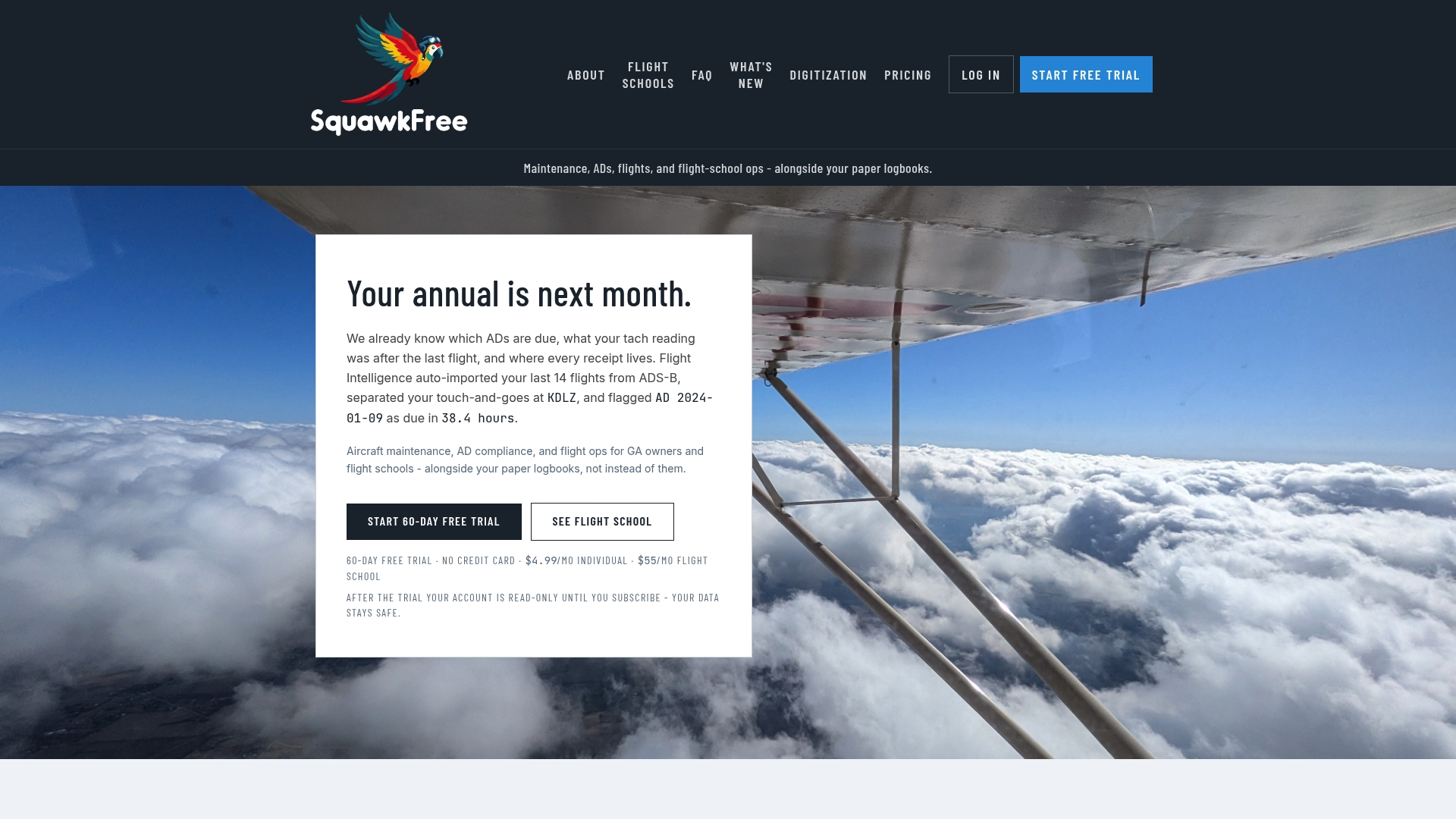
Picture the difference: instead of manually cross-referencing a new AD against your logbook and hoping you remembered every prior entry, Squawkfree links the directive directly to the maintenance record that satisfies it and surfaces the next action date automatically. For flight schools, role-based access lets instructors and dispatchers see scheduling and squawk data without touching compliance records they shouldn’t edit. When it’s time to sell, a transfer-ready export hands the new owner exactly what 91.417 requires, instead of a box of invoices.
Start a trial on the Squawkfree platform and see how much time an automated AD log and timestamped maintenance record actually save on your next annual.
Frequently Asked Questions
Do I need a inspection every 100 hours if I only fly my aircraft for personal use? No. The inspection every 100 hours under 14 CFR § 91.409 applies only to aircraft used for hire or for flight instruction for hire. Personal use requires only the annual inspection.
How long do I need to keep aircraft maintenance records? Routine maintenance and preventive maintenance entries need to be kept only until the work is repeated or for a limited period, whichever comes first. Records showing total time in service, current AD status, and current inspection status must be retained permanently and transferred at sale, per 14 CFR § 91.417.
Can I perform my own oil changes or tire replacements under Part 91? Yes, if you’re a certificated pilot who owns or operates the aircraft, these fall under preventive maintenance privileges. You still need to log the work with the date, description, and your certificate number.
What happens if I can’t produce maintenance records during a ramp check? The FAA Administrator has the authority to require records be made available for inspection. If you can’t produce them, or if the AD compliance status can’t be clearly demonstrated, the aircraft can be grounded until the documentation is sorted out.
When is FAA Form 337 required? Form 337 is required for major repairs and major alterations. A copy must be carried aboard the aircraft if the alteration affects a limitation or condition listed on the airworthiness certificate.
Sources
- 14 CFR § 91.409 - Inspections
- 14 CFR Part 91 Subpart E – Maintenance, Preventive Maintenance, and Alterations
Recommended
No credit card required · read-only after trial