
Tens of Meters ADS-B Accuracy: Verification for Operators & Developers

Tens of Meters ADS-B Accuracy: Verification for Operators & Developers
ADS-B position reports are typically accurate to tens of meters under good GNSS conditions, but the protocol carries no built-in authentication, so treat every report as advisory rather than gospel. Standards like RTCA DO-260B define how quality indicators (NIC, NACp) should flag uncertainty, and independent checks like MLAT and TDOA exist precisely because ADS-B alone can’t prove itself.
TL;DR:
- ADS-B position reports are accurate to tens of meters under good GNSS conditions but lack built-in authentication, requiring independent verification for reliability.
- Position quality indicators like NIC and NACp provide estimates of horizontal accuracy and integrity, which should be decoded and checked before trusting ADS-B data.
- Most ADS-B errors stem from latency, GNSS faults, radio interference, or spoofing, with latency being the primary factor in positional deviations during actual flight.
- Ground-based multilateration (MLAT) can independently verify aircraft positions and identify spoofed or erroneous signals, especially when latency exceeds acceptable thresholds.
- Automated verification methods, including filtering by quality indicators and reasonableness tests, enable reliable flight logging without manual input or external equipment.
Table of Contents
- Understanding ADS-B Data Accuracy: What’s in the Message
- What Actually Causes ADS-B Errors
- Measuring Real-World ADS-B Signal Quality
- Verifying and Mitigating ADS-B Errors
- How SquawkFree Verifies ADS-B Before It Touches Your Logbook
- When ADS-B Alone Is Enough, and When It Isn’t
- Get Verified Flight Data Without the Manual Entry
- Sources
- FAQ
Understanding ADS-B Data Accuracy: What’s in the Message
Every ADS-B extended squitter carries more than a latitude and longitude. It bundles velocity, altitude, and a set of quality flags that tell you how much to trust the position itself. These flags matter more than most pilots and data engineers realize, because two ADS-B messages can report the exact same coordinates with wildly different confidence behind them.
Position data gets encoded using Compact Position Reporting (CPR), a scheme that compresses latitude and longitude into fewer bits by splitting broadcasts into even and odd frames. Decoders need both frames within a set time window to resolve an unambiguous global position. This is also where a lot of ADS-B signal quality problems start: a dropped frame or a stale pairing produces a decoding error before the aircraft’s own position error even enters the picture.
The integrity metadata is where real accuracy assessment happens:
- NACp (Navigation Accuracy Category for Position) estimates the 95% horizontal containment radius, called EPU, directly from the aircraft’s navigation source.
- NIC (Navigation Integrity Category) bounds the probability that the true position falls outside a defined radius, which matters for separation assurance.
- NUCp, used on older ADS-B version 0 equipment, is a coarser predecessor to NACp and NIC combined.
- NACv does the same job for velocity accuracy, and SIL (Source Integrity Level) rates the probability that the reported NIC bound is actually exceeded.
According to mode-s.org’s technical documentation on ADS-B uncertainty, these indicator values map directly to specific horizontal and vertical figure-of-merit numbers, which is why any system consuming raw ADS-B should decode NACp and NIC before doing anything else with a position report, not after.
What Actually Causes ADS-B Errors
Most anomalies in a raw ADS-B stream trace back to one of four sources, and recognizing the pattern tells you how to react.
- Latency and along-track drift. ADS-B reports a position calculated at the moment of the aircraft’s GNSS fix, not the moment you receive the message. Processing, transmission, and reception delays stack up, and a fast-moving aircraft can travel a meaningful distance in that gap. This shows up almost exclusively along the direction of travel, not sideways.
- GNSS and avionics faults. A degraded GPS constellation view, an aging navigation unit, or intermittent satellite dropout inflates NACp and NIC values even when the aircraft is flying straight and level. Transponder version differences compound this. Version 0 equipment lacks the NIC/NACp granularity that version 2 units broadcast, so two aircraft can report identical coordinates with very different confidence available to a decoder.
- Radio-layer interference. The 1090 MHz band gets congested near busy airports and dense traffic corridors. Message collisions, multipath reflections off terrain or structures, and poor receiver geometry all degrade decode reliability before accuracy even enters the conversation.
- Spoofing and erroneous transmissions. ADS-B has no built-in encryption or authentication. Anyone with the right hardware can broadcast a fabricated position, and a malfunctioning transponder can do the same thing by accident. Research on TDOA-based position verification exists specifically because the protocol offers no native way to confirm a broadcast position actually corresponds to a real aircraft’s location.
Measuring Real-World ADS-B Signal Quality
Ground truth is the hard part of any ADS-B accuracy study. Researchers can’t simply ask an aircraft where it “really” is, since even reference GNSS receivers carry their own uncertainty. The standard workaround is multilateration, or MLAT: multiple ground receivers time-stamp the same signal, and the differences between those timestamps (time difference of arrival, or TDOA) triangulate a position independent of what the aircraft itself is broadcasting.
A 2025 study using high-resolution MLAT comparisons against live ADS-B traffic found that latency, not GNSS error, is typically the dominant contributor to positional deviation, particularly along the aircraft’s flight path. Version 2 transponders generally performed within acceptable bounds when latency stayed within standard limits, but performance varied with avionics quality and local radio conditions, according to the comprehensive MLAT analysis published in 2025.
Typical accuracy in numbers: under good GNSS geometry and low-latency conditions, ADS-B horizontal accuracy generally lands on the order of tens of meters, matching what FAA guidance describes as a meaningful improvement over legacy radar. Cross-track error tends to stay tighter than along-track error, because along-track drift compounds every millisecond of transmission delay with the aircraft’s ground speed.
The caveat every study shares: results depend heavily on sample conditions. A dataset gathered near a busy MLAT-instrumented terminal area doesn’t necessarily represent accuracy in mountainous terrain with sparse receiver coverage. Treat any single figure as a snapshot of specific conditions, not a universal constant.
Verifying and Mitigating ADS-B Errors
You can catch most bad ADS-B data before it ever reaches a maintenance log or an analytics dashboard, if your ingestion pipeline is built to look for it.
- Filter or down-weight any message where NIC, NACp, or NACv fall below a threshold appropriate to your use case, and discard positions that fail CPR decoding outright.
- Run a CPR reasonableness test on every decoded position. ICAO’s SURICG-7 working paper documents this test catching a position jump well beyond typical thresholds for position jumps, proof that a simple sanity check flags real decoding failures.
- Cross-check suspicious tracks against an independent source. MLAT clusters or TDOA-based verification, the same technique described in peer-reviewed ADS-B position verification research, catch spoofed or erroneous positions that pass every onboard integrity check.
- Timestamp every incoming packet at the moment of reception, apply latency compensation to reproject the position to a common reference time, and smooth the resulting track with a Kalman filter rather than trusting each raw fix in isolation.
Pro Tip: Treat any position jump greater than a distance threshold for position jumps within a short time interval as automatically invalid before it reaches your database. That single rule, borrowed from the DO-260B reasonableness test logic, catches a surprising share of bad decodes without needing any external cross-check.
Aireon’s RefTrack methodology takes this further at the network level, combining clustering logic with Kalman filtering and TDOA updates to fill gaps and compensate for GNSS anomalies, as detailed in its white paper on independent position estimation.
How SquawkFree Verifies ADS-B Before It Touches Your Logbook
Automated flight logging only earns trust if the import pipeline behind it actually checks its work. Automated flight logging pulls ADS-B flight data automatically, but it doesn’t commit a flight to your maintenance record without running it through basic quality checks first, including timestamp verification and screening for the kind of position jumps that signal a bad decode rather than a real flight.
Before you lean on any auto-imported ADS-B flight for tach time or maintenance tracking, a few checks are worth running yourself:
- Confirm the flight’s NIC and NACp values were within a reasonable range for the equipment on board.
- Look for unexplained altitude or speed jumps that don’t match the aircraft’s known performance.
- Cross-reference total flight time against your own fuel or engine-monitor logs when the numbers matter for AD compliance.
A related blog walks through the setup and verification steps for ADS-B import in more detail if you’re configuring this for the first time.
When ADS-B Alone Is Enough, and When It Isn’t
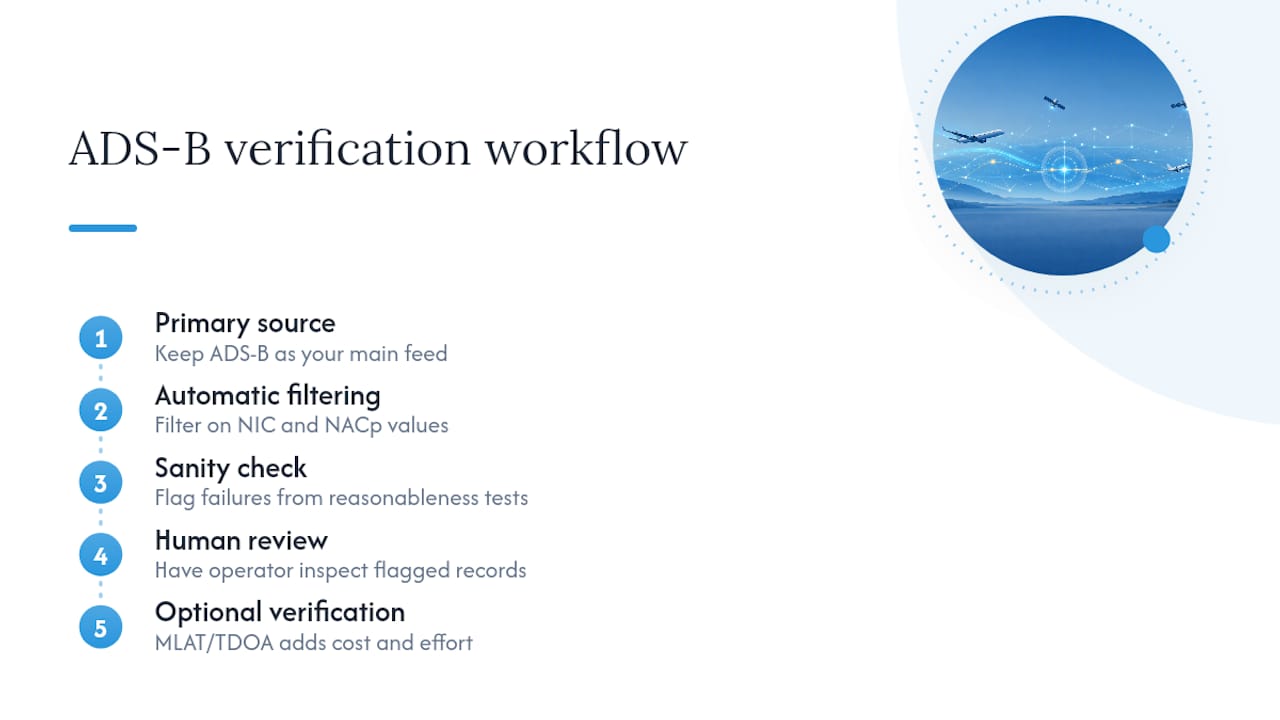
ADS-B is plenty reliable for casual flight tracking, rough tach estimates, or a flight school confirming a student actually flew the pattern they logged. It gets shakier the moment the data feeds a regulatory record, a warranty claim, or anything tied to airworthiness directive compliance, where a bad decode could quietly corrupt a maintenance interval.
Adding MLAT or TDOA verification costs engineering effort most owner-operators don’t need. The more practical default: keep ADS-B as your primary source, but filter on NIC and NACp automatically, and flag anything that fails a basic reasonableness test for a human to review. That single habit closes most of the gap without building a parallel verification network.
— Trent
Get Verified Flight Data Without the Manual Entry
Cross-checking NIC values and running reasonableness tests by hand on every flight isn’t realistic for a busy flight school or a GA owner juggling annuals and ADs. A Flight Intelligence feature handles that verification automatically, importing ADS-B flight data, screening it for the anomalies covered above, and turning it into an auditable maintenance record without you touching a keyboard.

That means fewer manual logbook entries, a cleaner audit trail when an FAA airworthiness directive comes due, and analytics you can actually trust because the import pipeline already filtered out the bad decodes. If you’re managing a fleet or just tired of reconciling flight logs by hand, see how the SquawkFree platform handles verified ADS-B import and start a trial to check it against your own aircraft data.
Sources
- Positive effect of CPR reasonableness test on ADS‑B security (SURICG-7 WP11)
- ADS‑B FAQ | Federal Aviation Administration
- Independent estimation of aircraft positions using space-based ADS‑B data for GNSS anomaly identification and investigation
FAQ
Where Does ADS-B Get Its Data?
ADS-B position data comes from the aircraft’s own onboard GNSS receiver, which the transponder broadcasts automatically along with altitude, velocity, and integrity metadata like NIC and NACp.
How Accurate Is ADS-B Data Compared to Radar?
ADS-B typically reports horizontal accuracy in the tens of meters under good conditions, which the FAA considers a meaningful improvement over conventional radar, though latency and GNSS quality can widen that margin.
Why Can’t Planes Fly Above 40,000 Feet?
Most commercial aircraft are certified with a service ceiling near 40,000 feet because thinner air above that altitude reduces engine efficiency and aerodynamic performance beyond safe operating margins, not because of any ADS-B or airspace limitation.
Why Do Pilots Say “Pan-Pan”?
Pilots use “pan-pan” to declare an urgent situation that isn’t yet a life-threatening emergency, alerting air traffic control to a problem without triggering the highest-priority “mayday” response.
What Is the 1/2/3 Rule in Aviation?
The 1/2/3 rule is a fuel-planning guideline for diversion decisions that varies depending on conditions, guiding pilots in estimating lateral distance and flight time needed to reach a diversion airport.
Recommended
No credit card required · read-only after trial