
Cut Verification Time in Aircraft Records Migration for Maintainers

Cut Verification Time in Aircraft Records Migration for Maintainers
The right approach to aircraft records migration is a phased pilot: map your data structure, validate it against a test aircraft or fleet segment, then cut over in controlled stages rather than all at once. A successful migration leaves you with one source of truth, an auditable history with no gaps, and minimal disruption to daily flight operations. Start now by scoping a pilot around two aircraft or a single base.
TL;DR:
- Mapping and validating records in small pilot groups prevents costly rework caused by inconsistent field definitions and poor-quality scans.
- Using structured, exportable data fields and open APIs in the destination system ensures smooth imports and future integrations.
- Prioritizing active operational records for migration while archiving older data reduces system bloat and maintains workflow speed.
- Running iterative, smaller batch imports with validation checkpoints improves accuracy and simplifies troubleshooting.
- Automating flight data import and AD tracking with tools like SquawkFree minimizes manual entry, improves accuracy, and speeds up the entire migration process.
Table of Contents
- What Does Aircraft Records Migration Actually Involve?
- Why Do Aircraft Records Migrations Fail?
- What Should Your Destination System Actually Require?
- What to Migrate Now vs. What to Archive
- How to Migrate Aircraft Records Step by Step
- How Do You Reconcile Records After Go-Live?
- How SquawkFree Reduces Migration Friction
- What I’ve Learned Watching These Projects Succeed or Stall
- Get Started With SquawkFree
- Sources
What Does Aircraft Records Migration Actually Involve?
Aircraft records migration means moving every category of technical documentation from paper logs or fragmented digital files into a single, structured system. That includes airframe logs, engine and component histories, airworthiness directive (AD) and service bulletin (SB) records, modification and repair approvals, bills of sale, ownership documents, and registration and ELT data.
Getting this right matters for two reasons. First, regulators expect traceability. Part 43 spells out what maintenance records must contain, and inspectors will ask for continuous documentation, not a patchwork with holes where the old system stopped and the new one started. Second, complete records protect resale value and simplify pre-buy inspections down the road.
A typical inventory for migration covers:
- Airframe, engine, and propeller logbooks
- Component histories with life limits and time-in-service
- AD and SB compliance records
- Major repairs, alterations, and Form 337 approvals
- Bills of sale and title/ownership documentation
- Registration and 406 MHz ELT registration data
Why Do Aircraft Records Migrations Fail?
Most failures trace back to a handful of predictable problems, not bad luck. Records built over decades rarely share a common structure, so fields that seem equivalent (say, “engine hours” and “tach hours since overhaul”) often mean different things across different logbooks.
Scanned images cause a second wave of trouble. Poor scan quality, faded handwriting, and missing signatures generate OCR errors that look clean on screen but fail an audit. A third risk shows up after the fact: repair and alteration approvals get separated from the work orders and engineering signoffs that justify them, especially when older paper archives are boxed up and migrated as an afterthought.
Common failure points to plan around:
- Inconsistent field definitions across logbooks and legacy systems
- Low-quality scans producing unreliable OCR text
- Missing or illegible signatures on maintenance entries
- Repair approvals disconnected from their supporting work orders
- Operational downtime during a rushed, all-at-once cutover
Statistic Callout: Guidance from maintenance software vendors consistently points to the same root cause behind rework: teams that skip structured inventorying, mapping, and iterative validation end up re-cleaning data after go-live instead of before it, turning a planned project into an open-ended one.
What Should Your Destination System Actually Require?
An integrated maintenance platform, whether it’s an MRO system, a CMMS, or ERP-style records software, gives you structure the paper world never had: defined fields, APIs, bulk import tools, centralized document storage, and audit trails that timestamp every change. But the system enforces rules going forward. It does not fix history for you.
That distinction shapes how you plan. The migration project has to correct historical errors, standardize field names, and resolve duplicate records before anything loads into the new platform. The software then keeps those standards in place.
When evaluating a destination system, require:
- Structured, exportable data fields (not locked PDFs or proprietary blobs)
- Open APIs for bulk import and future integrations
- Centralized, searchable document storage with version history
- Immutable audit trails showing who changed what and when
- Native or connected AD/SB tracking feeds
- Role-based authentication so mechanics, owners, and dispatchers see what they need
Flight-data import capability deserves its own line item. If your new system can pull hours and cycles automatically from ADS-B or onboard avionics, you eliminate one of the most error-prone manual tasks in the entire migration.
What to Migrate Now vs. What to Archive
Not every scrap of paper needs to land in your live system on day one. Draw a hard line between active operational records, the data mechanics and dispatchers touch weekly, and historical archives that exist for legal and audit purposes but rarely get opened.
A workable rule: pull the last 12 months of operational history into the live system for anything tied to a life-limited part, an open AD, or a recurring inspection interval. Everything older gets scanned, indexed, and stored as a read-only archive linked to the aircraft record, searchable but not part of daily workflow.
Prioritize by criticality, not chronology:
- Life-limited components and time-controlled items first
- Aircraft with open ADs or upcoming major inspections next
- Fleet aircraft with high utilization before low-utilization spares
- Complete historical files for any aircraft nearing a sale
Pro Tip: Don’t try to achieve perfect historical parity in the live system. A well-organized, searchable archive satisfies both auditors and buyers just as well as a bloated active database, and it keeps your day-to-day system fast.
How to Migrate Aircraft Records Step by Step
Treat this as a five-phase project, not a weekend data dump. Each phase produces a specific artifact you can point to if a question comes up later.
1. Govern the project before you touch a single file. Assign an owner for data accuracy, a signoff authority for disputed records, and pick a pilot group, ideally two aircraft or one base, small enough to fail cheaply and learn fast.
2. Inventory and map every field. Build a mapping table that connects every legacy field to a canonical field name in the new system. This is where inconsistent terminology gets resolved once, instead of repeatedly.
3. Cleanse and digitize. De-duplicate records, flag entries with missing signatures for manual review, and run OCR with human verification rather than trusting automated text extraction alone. Structured digitization at this stage prevents most post-load rework.
4. Test with real loads. Run a baseline import, then operate the new and old systems in parallel for a defined window, two weeks is a common benchmark, using a verification template that checks hours, cycles, and AD status against the paper source.
5. Cut over deliberately. Use a go/no-go checklist, confirm a rollback plan exists, and schedule the first week of post-go-live checks before you retire the paper system.
Additional artifacts to produce along the way:
- A signed data governance policy defining who owns corrections
- A canonical field list circulated to every records staffer
- A named retirement date for legacy paper files
Pro Tip: Run iterative loads instead of one massive import. Smaller batches with a validation checkpoint after each one make it far easier to isolate which source caused an error.
How Do You Reconcile Records After Go-Live?
Migration doesn’t end at cutover. The next few weeks determine whether the new system earns trust or gets quietly second-guessed by the mechanics who have to rely on it.
Start by reconciling every repair and alteration approval against its originating work order and engineering signoff. A repair record with no traceable authorization is a compliance flag waiting to surface at the worst possible time. Next, run counter and life-limit checks across every tracked component, comparing hours and cycles in the new system against the last known paper entries.

When you find a gap, decide on a rule ahead of time rather than improvising case by case: annotate it with a note explaining the discrepancy, escalate it to the records owner for a decision, or archive it with a controlled note if it’s clearly historical and non-critical.
Statistic Callout: Case studies on large-scale migrations show that iterative loads paired with dashboards tracking per-aircraft status cut verification time significantly compared to a single bulk load with manual spot-checks after the fact.
Set a recurring audit cadence, monthly for the first quarter, then quarterly, and track a small set of KPIs: open discrepancies, average time to resolve a flagged record, and percentage of components with verified life-limit data.
How SquawkFree Reduces Migration Friction
Several of the most error-prone migration tasks are exactly what SquawkFree automates. Flight Intelligence auto-imports flight data directly from ADS-B sources, which removes manual counter reconciliation, the step most likely to introduce hour and cycle errors during a records migration.
Where it removes manual work:
- AD tracking: Direct FAA AD integration replaces spreadsheet-based AD monitoring during cutover
- Digitization: OCR paired with human verification catches signature and legibility issues before they load into the live system
- Counter accuracy: Automated flight-data import keeps hours and cycles current without manual logbook entry
What I’ve Learned Watching These Projects Succeed or Stall
The projects that stall almost always share one mistake: trying to achieve perfect historical parity before going live, instead of accepting a solid archive and a clean operational baseline. Prioritize continuity over completeness, and lock in gains with short, mandatory training sessions the week of cutover, not a manual nobody reads.
— Trent
Get Started With SquawkFree
Every migration task covered here, flight-data import, AD tracking, logbook digitization, is exactly what SquawkFree was built to reduce.
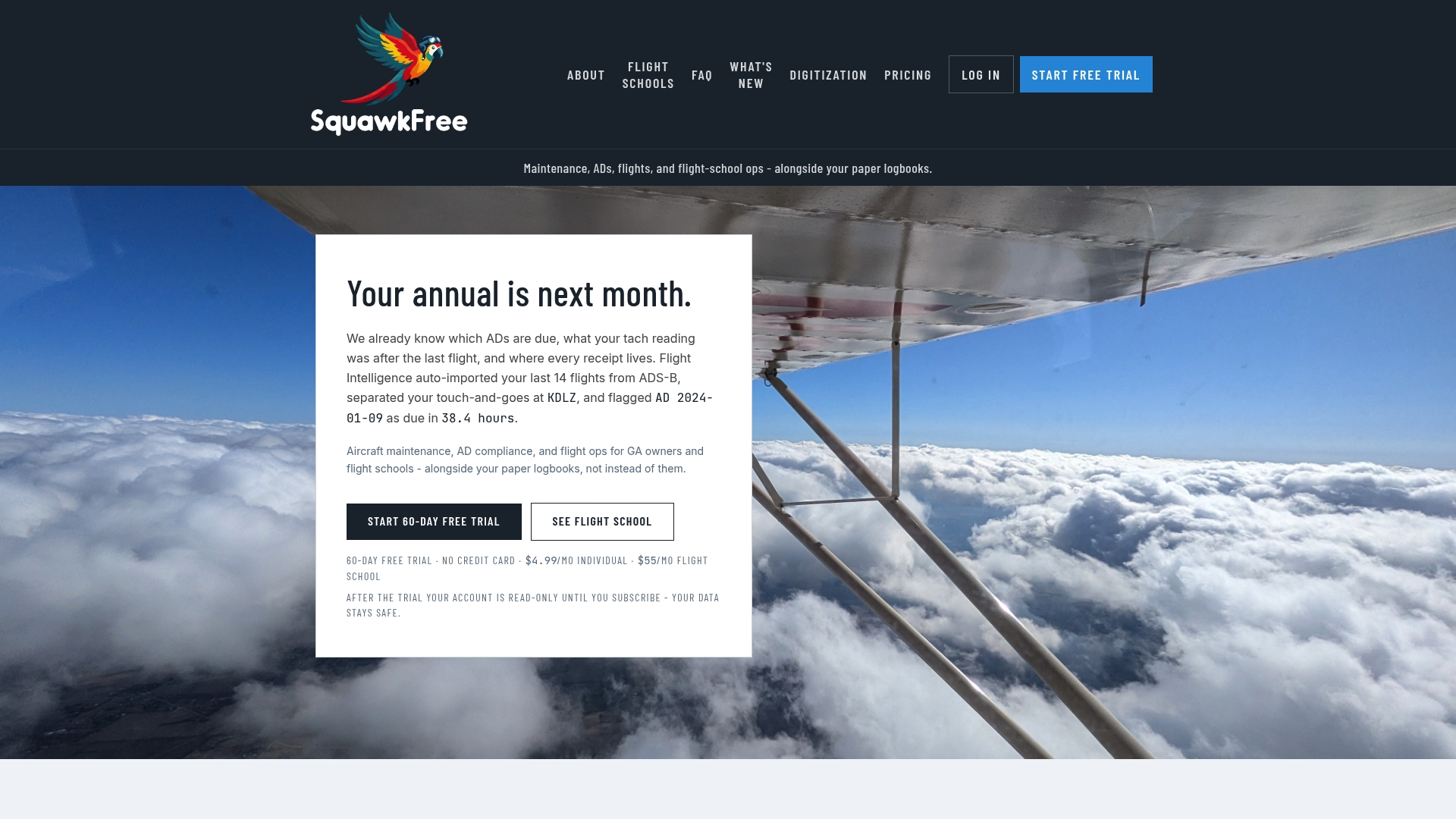
Instead of manually re-keying tach hours after every flight, Flight Intelligence pulls them in automatically. Instead of cross-checking AD compliance by hand during your parallel-ops window, integrated AD tracking flags open items the moment they load. And instead of your team scanning decades of logbooks with no verification step, SquawkFree’s digitization service pairs OCR with human review so records go in clean the first time. Owners and flight schools who lean on these tools during a migration typically report far less manual entry and faster AD resolution once the new system goes live. If you’re scoping a pilot project, start your migration with SquawkFree and see how much of this playbook your team can automate from day one.
Sources
- FAA — Register an aircraft
- eCFR — Part 43: Maintenance, preventive maintenance, rebuilding, and alteration
- Veryon — Best practices for data migration in aviation maintenance software
Recommended
No credit card required · read-only after trial