
Audit Ready Compliance Tracking: GA Owners' ADs Linked to Flight Data

Audit Ready Compliance Tracking: GA Owners’ ADs Linked to Flight Data
A compliance tracking process is the auditable system you use to prove your aircraft’s ADs, inspections, component hours, and maintenance history are current and defensible. It rests on records required under 14 CFR §91.417, tools like SquawkFree, and one habit above all others: documenting as you go. Your first move today is simple. Build a dated configuration record and an AD current-status log before you touch anything else.
TL;DR:
- Recurring ADs tied to flight hours require real data to prevent drift and should be fed automatically from flight data imports.
- Keep permanent records for the aircraft’s lifetime, including total hours and AD compliance, and transfer them at sale; temporary records are only kept for one year or until superseded.
- Ensure each compliance record includes exact specifications, applicable ADs, compliance methods, signatures, and an evidence reference point to withstand inspections or sales.
- Use digital tools with real-hours AD tracking, automatic flight data importing, and secure audit trails to improve accuracy and compliance efficiency.
- Missing serial numbers on life-limited parts or incomplete logbook entries can create legal and safety issues during inspections or transactions.
Table of Contents
- What Records Your Compliance Tracking Process Must Include
- The Step-by-Step Compliance Tracking Process for AD and Inspection Records
- Building an AD Current-Status Row Anyone Can Verify
- Which Digital Features Actually Improve Compliance Tracking
- Recordkeeping Mistakes That Cost You at Inspection or Sale
- Why Records Are the Asset Nobody Talks About
- How SquawkFree Puts This Process on Autopilot
- Sources
- FAQ
What Records Your Compliance Tracking Process Must Include
Section 91.417 splits your recordkeeping obligation into two tiers, and confusing them is where most owners get into trouble. Temporary records cover routine maintenance and 100-hour or annual inspections; you keep those until the work is superseded or for one year, whichever applies. Permanent records cover total time in service, current AD status, and life-limited part histories, and you keep those for the life of the airframe, transferring them at sale.
Assembling a defensible record set starts with a short checklist:
- Freeze a configuration record listing serial numbers, installed STCs, and appliance part numbers exactly as they exist today.
- Pull every applicable AD and note its next-due date, whether that’s a calendar interval or an hour count.
- Collect every FAA Form 337 and matching invoice for major alterations or repairs.
- Confirm every logbook entry carries a technician signature and certificate number as required under 14 CFR §43.9.
- Check that recurring AD intervals are cross-referenced to actual flight hours, not estimates.
That last point matters more than it looks. Recurring ADs tied to tach time or cycles drift out of sync fast when hours are logged by hand, and flight-data import closes that gap by feeding real time-in-service straight into your component-hour tracker.
The Step-by-Step Compliance Tracking Process for AD and Inspection Records
A repeatable process beats a memory-based one every time an inspector, buyer, or insurance adjuster asks for proof. Here’s the workflow that holds up.
- Build the configuration record first. List the airframe, engine(s), propeller(s), part and serial numbers, installed STCs, and appliances. Everything downstream depends on this being accurate, so date it and update it the moment anything changes.
- Search each item against the FAA AD database. For every product in your configuration record, capture the exact applicability language, the AD number, its revision date, and the compliance time or interval. AC 39-7D stresses that owners, not mechanics, carry the responsibility for ensuring every applicable AD gets found and recorded.
- Document the method of compliance. Reference the specific service instruction, repair, or inspection used, and make sure the entry carries a signature and certificate number per §43.9. Attach the evidence, whether that’s a work order, a photo of a placard, or a Form 337.
- Link flight hours to recurring intervals. Recurring ADs tied to hours or cycles need live data, not estimates from the last fuel receipt. Set a calendar or hour-based alert so the next-due trigger fires before it becomes a scramble.
- Retain and verify before every flight or ramp check. Temporary entries get retained until superseded or for a year; permanent records travel with the aircraft for life and transfer at sale. Before a flight, or before an FAA ramp check, a quick pass through your AD status log should confirm nothing has slipped past due.
Pro Tip: Subscribe directly to FAA AD email notifications for your make and model instead of relying on your mechanic to flag them at the next annual. AC 39-7D specifically recommends owners stay ahead of AD issuance rather than discovering one during a pre-buy inspection.
AC 43-9C includes a suggested AD compliance record format in its appendix, and building your own log around that structure means an inspector, a buyer, or your own memory six years from now will find exactly what’s expected in exactly the place it’s expected.
Building an AD Current-Status Row Anyone Can Verify
A defensible AD file answers four questions without guesswork: what’s installed, which ADs apply, what action established compliance, and what’s due next, according to The Flight Brief’s compliance guide. A single status row per AD, built around consistent fields, makes that answer instant instead of a research project.
| Field | What it captures |
|---|---|
| Product | Engine, prop, airframe, or appliance affected |
| Applicability | Exact model/serial range from the AD text |
| AD number & revision | Directive number plus current revision date |
| Compliance method | Inspection, repair, replacement, or modification performed |
| Last action & reference | Date and pointer to logbook page, work order, or Form 337 |
| Next-due trigger | Calendar date or hour/cycle count for recurring ADs |
| Terminating action | Whether a modification closes the AD permanently |
| Evidence location | Where the underlying document actually lives |
That evidence-location field does the real work. Every status row should point somewhere concrete, a specific logbook page, a Form 337 filed by date, an invoice number, or a photo of a placard, so an inspector can follow the trail without asking you to reconstruct it from memory.
Some ADs get complied with through an approved alternative method rather than the directive’s stated procedure. When you use an Alternative Method of Compliance, record the AMOC approval number and the FAA documentation authorizing it directly in that AD’s status row, right alongside the standard fields.
Which Digital Features Actually Improve Compliance Tracking
Auto-imported flight data solves a problem hand logging can’t: hours entered from memory or estimated from Hobbs readings drift from actual time in service, and that drift compounds against every recurring AD tied to an hour interval. SquawkFree’s Flight Intelligence pulls flight data automatically and feeds it straight into component-hour counters, which keeps recurring-AD triggers accurate without anyone re-typing numbers into a spreadsheet.
Whatever maintenance tracking software you evaluate, require these features before you commit:
- An AD tracker with next-due triggers tied to real hours, not manual entry
- Component-hour linking that updates automatically from flight data
- Storage for Form 337s and technician signatures tied to each entry
- An uneditable audit trail, since altered records raise red flags at inspection or sale
- One-click export for transfer, insurance, or a ramp check
- Multi-user roles for schools running multiple aircraft and instructors
Pro Tip: Ask any vendor how their system captures certificate numbers and signatures. If they can’t point to a specific field mapped to §43.9 requirements, the “digital record” you’re buying may not satisfy an inspector at all; for guidance on FAA certification and risk management, see FAA Certification and risk management for drone cleaning vendors.
Recordkeeping Mistakes That Cost You at Inspection or Sale
Missing part and serial numbers on life-limited components break the chain of custody entirely; without them, legal life limits can’t be verified, which can force grounding or replacement even when the part is airworthy. VREF’s analysis of common logbook errors lists this among the costliest recurring failures in pre-purchase inspections.
- Incomplete AD entries missing a method of compliance or a sign-off leave you defending a gap with no evidence.
- Relying on an inspection sticker alone won’t satisfy an inspector who’s going to ask for the underlying logbook entries behind it.
- Skipping backups means one lost binder erases years of history; keep paper and digital copies, and export snapshots regularly.
Why Records Are the Asset Nobody Talks About
Owners treat maintenance the way they treat insurance: necessary, but rarely something they think adds value. That’s backward. A clean AD-status log and an unbroken component-hour chain often move faster in a sale than a fresh paint job, and flight schools with role-separated dispatch and shared access avoid the compliance surprises that ground aircraft mid-semester. Disciplined records aren’t overhead. They’re the thing that keeps a $40,000 AD surprise from ever becoming your problem.
— Trent
How SquawkFree Puts This Process on Autopilot
Everything covered above, the configuration record, the AD status log, the component-hour links, gets tedious fast when it’s manual. Some digital maintenance tools automate parts of the compliance tracking process that eat the most time: automatic flight data import, AD trackers with next-due triggers tied to real hours, and component-hour linkage updates to prevent drifting out of sync.
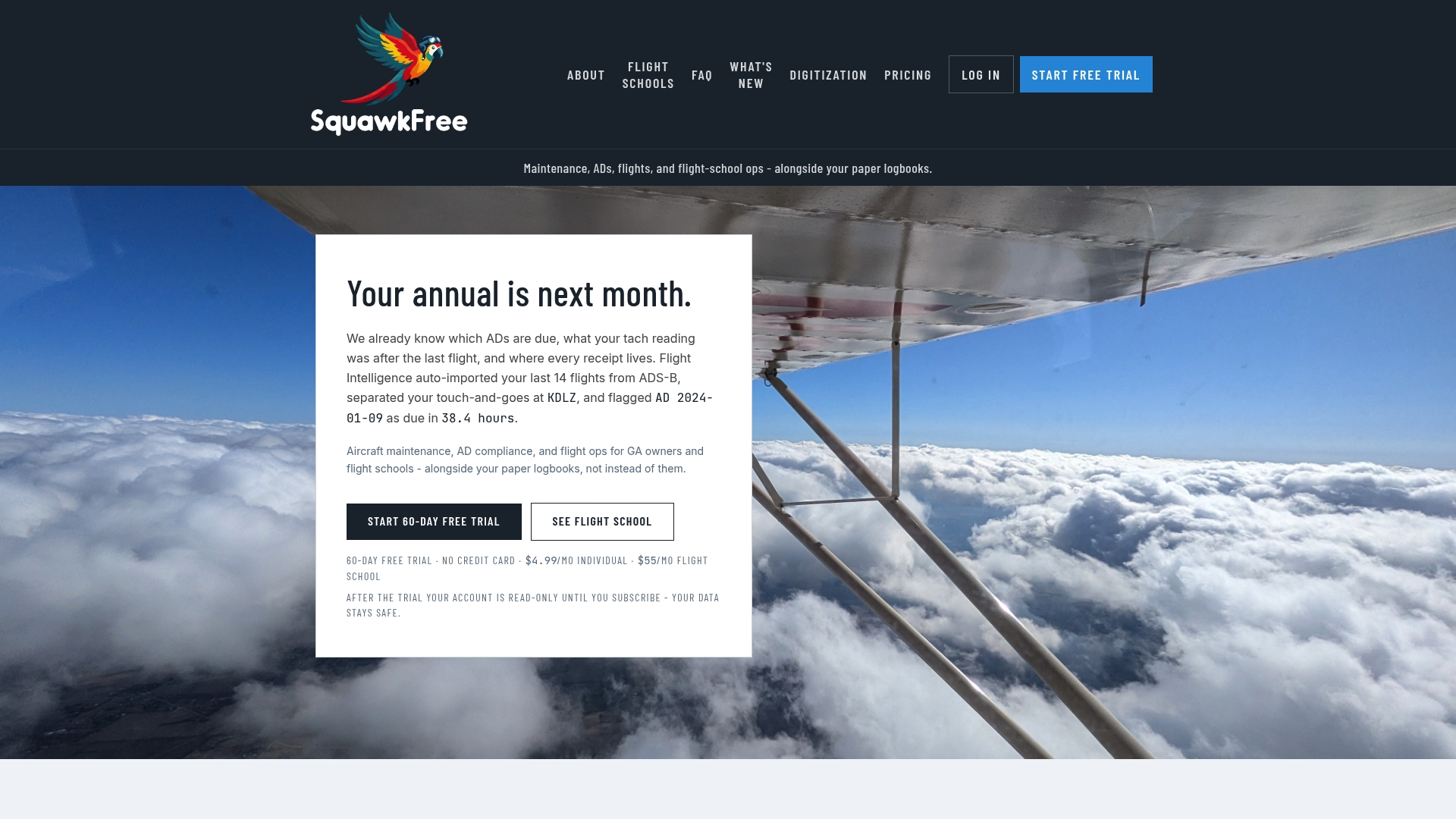
For records you’re still catching up on, SquawkFree’s logbook digitization service converts paper history into searchable digital entries using OCR plus human verification, so your permanent records are complete before your next annual. Flight schools get organizational plans built around shared access and role separation for instructors, dispatchers, and students, while individual owners can add per-aircraft Flight Intelligence to a standard subscription. Form 337s and signed maintenance entries store alongside each AD record, ready to export as one packet for a ramp check, a pre-buy inspection, or a sale. Start a trial at SquawkFree and get your configuration record and AD status log built the way an inspector expects to see them.
Sources
For the regulatory backbone of this process, keep 14 CFR §91.417, AC 43-9C, and AC 39-7D close at hand, alongside AOPA’s guidance on managing ADs.
FAQ
What Is a Compliance Tracking Process for Aircraft?
It’s the documented workflow, records, and next-due triggers you use to prove ADs, inspections, and component hours are current, grounded in the requirements of 14 CFR §91.417.
How Long Must I Keep Aircraft Maintenance Records?
Temporary records, like routine inspections, are kept until superseded or for one year; permanent records, including AD status and total time, are kept for the aircraft’s life and transferred at sale.
What Fields Belong in an AD Current-Status Log?
Product, applicability, AD number and revision date, compliance method, last action with a record reference, next-due trigger, terminating action, and where the underlying evidence is stored.
Can Digital Records Replace Paper Logbooks?
Yes, according to FAA guidance, as long as the system captures the same required content, signatures, and certificate numbers, and keeps an uneditable audit trail.
How Does Flight Data Import Improve AD Tracking?
Auto-imported flight data feeds real time-in-service directly into component-hour counters, which keeps recurring-AD triggers accurate instead of relying on manually estimated hours. Some tools handle this import automatically.
Recommended
No credit card required · read-only after trial