
Save on Flight School Software Cost with Maintenance First Platforms

Save on Flight School Software Cost with Maintenance First Platforms
Most flight schools pay a range of monthly fees per aircraft for core scheduling and billing, with tiered subscriptions increasing as you factor in student count and locations. Small single-fleet schools usually spend a few thousand dollars a year; mid-size operations with several aircraft typically spend more, and multi-location schools often have higher annual costs. The two biggest swing factors are which modules you add (LMS, billing automation, maintenance tracking) and what the vendor charges for onboarding.
TL;DR:
- The typical annual cost for small flight schools ranges from $1,000 to $4,000, mainly for scheduling and billing, excluding add-ons like maintenance or LMS.
- Costs escalate with school size, reaching over $20,000 annually for mid-size operations and exceeding $30,000 for multi-location enterprises, especially when including custom reports and onboarding.
- Pricing models vary, with per-aircraft fees suitable for fleets and per-seat licenses better for schools emphasizing training content; additional modules like maintenance tracking significantly increase total costs.
- Implementation, migration, and premium support fees often double the advertised subscription price in the first year, making detailed vendor negotiations essential.
- To understand true expenditure, build a total cost of ownership model factoring recurring fees, one-time setup costs, and anticipated savings from automation.
Table of Contents
- Flight School Software Pricing at a Glance
- What Are the Main Flight School Software Pricing Models?
- What Features Actually Drive Up Flight School Software Cost?
- Realistic Flight School Software Cost Ranges by School Size
- What Hidden Fees Should You Watch For in Flight School Software Contracts?
- How Do You Calculate Total Cost of Ownership for Flight School Software?
- What Should You Ask Vendors Before Signing a Contract?
- Why Maintenance-First Platforms Change the Cost Equation
- Get Maintenance-First Software That Pays for Itself
- Where to Verify These Flight School Software Numbers
- Sources
Flight School Software Pricing at a Glance
Before you get deep into vendor calls, it helps to have rough numbers in hand. Here’s what buyers commonly see when they start comparing quotes.
- Per-aircraft entry pricing: Some scheduling vendors publish rates around $20 to $29 per aircraft per month, often with unlimited user seats included.
- Seat-based LMS pricing: Training-content platforms frequently price per user, with published rates near $19.98 per user per month before onboarding fees.
- Annual spend, small school (1 to 4 aircraft): Roughly $1,000 to $4,000 a year for scheduling and billing alone.
- Annual spend, mid-size school (5 to 15 aircraft): Commonly $6,000 to $20,000 once maintenance tracking or LMS seats are added.
- Annual spend, multi-location or enterprise: Often $25,000 and up, driven by per-base dispatch tools and custom reporting.
Treat published per-aircraft or per-seat numbers as a floor, not a ceiling: implementation and add-on modules almost always push the real number higher.
What Are the Main Flight School Software Pricing Models?
Vendor quotes rarely use the same billing structure twice, which makes side-by-side comparison harder than it should be. Understanding the model behind the number matters as much as the number itself.
- Per-aircraft pricing charges you based on fleet size rather than staff or student count. It fits schools with a stable fleet and fluctuating enrollment, since your subscription cost tracks the assets, not the headcount. Vendor guides describe per-aircraft entry points as one of the most predictable structures for growing schools.
- Per-user or seat-based licensing charges by the number of logins, common in learning management systems. It scales cleanly for schools with heavy student turnover but can balloon quickly if instructors, dispatchers, and students all need separate seats.
- Resource-based pricing applies to simulators, classrooms, or briefing rooms tracked as bookable assets, layered on top of aircraft or seat fees.
- Flat tiers with modular add-ons bundle a base package (scheduling plus basic billing) and charge extra for maintenance tracking, LMS integration, or advanced reporting.
Per-aircraft models suit fleet-heavy operations; seat-based models suit schools prioritizing training content over dispatch complexity.
What Features Actually Drive Up Flight School Software Cost?
Not every module costs the same, and not every module returns the same value. Here’s what typically moves the price needle and why it’s worth paying for in some cases and skipping in others.
- Multi-base dispatch and complex scheduling cost more because they require conflict resolution across locations, not just a single calendar.
- Billing automation with itemized flight pricing adds cost but removes manual invoice errors, which matters more as flight volume grows.
- Maintenance and AD tracking integration carries a premium because it pulls regulatory data and squares it against your fleet in real time.
- LMS and recurrent training seat licensing scales with enrollment, so it’s often the fastest-growing line item on your invoice.
- APIs and custom integrations (payment processors, insurance systems, accounting software) frequently carry one-time development fees on top of the subscription.
- Analytics and multi-location reporting tend to be the last tier unlocked, reserved for schools running more than one campus.
Pro Tip: Don’t pay for multi-location reporting or advanced analytics until you actually operate more than one base. Vendors bundle these into premium tiers, and a single-location school rarely uses them.
Realistic Flight School Software Cost Ranges by School Size
Numbers mean more once they’re tied to a school’s actual size and operating model. Here’s how the budget typically breaks down.
- Small school (1 to 4 aircraft): Expect $80 to $300 a month for scheduling and basic billing, often $1,000 to $4,000 annually. This usually includes core dispatch and student records but excludes maintenance tracking and LMS seats.
- Mid-size school (5 to 15 aircraft): Budget $500 to $1,700 a month, or $6,000 to $20,000 a year, once you add maintenance integration or a learning management module for a growing student roster.
- Multi-location or enterprise operations: Costs often exceed $30,000 annually, with contract terms that include per-base licensing, custom reporting, and dedicated account support.
Headline prices on vendor pages almost never include onboarding, data migration, custom integrations, or premium support tiers, which is exactly where budgets get blown.
What Hidden Fees Should You Watch For in Flight School Software Contracts?
The subscription line is only part of the bill. Implementation, migration, and support fees frequently double the effective first-year cost compared to the advertised monthly rate.
- Implementation and onboarding fees commonly run from a few hundred to several thousand dollars, depending on fleet size and how much configuration the vendor handles for you.
- Data migration and validation costs extra when you’re moving years of maintenance logs or student records from spreadsheets or a legacy system.
- Customization and private-label branding for an LMS, including content licensing, adds recurring cost beyond the base seat price.
- Support tiers and SLA guarantees are often gated behind a premium plan, so “included support” may mean email-only response in 48 hours.
- Contract terms like minimum commitments, auto-renewal clauses, and per-feature add-on charges can lock you into costs you didn’t budget for.
Seat-based LMS pricing is the clearest example of this pattern. A rate like $19.98 per user per month looks inexpensive in isolation, but once onboarding and implementation fees are added, the first-year total can run well above the advertised monthly figure. Vendors selling all-inclusive seat-based bundles sometimes fold onboarding into the subscription itself, which is worth asking about directly before you sign.
How Do You Calculate Total Cost of Ownership for Flight School Software?
A vendor’s sticker price tells you almost nothing about what you’ll actually spend in year one. Building a simple total cost of ownership (TCO) model fixes that.
- List recurring subscription costs across every module you plan to use, multiplied by your actual aircraft or seat count.
- Add one-time implementation, migration, and hardware costs, including any tablets or kiosk devices required for check-in.
- Include annual support and integration maintenance fees, especially for connections to payment processors or accounting software.
- Estimate administrative time saved through billing automation, since reduced reconciliation work offsets part of the subscription cost.
- Total the first-year and three-year figures separately, since onboarding costs hit once but subscription and support fees repeat annually.
Modeling admin-time savings from billing automation, discussed further in this aircraft billing software guide, often shifts the calculation in favor of a slightly pricier platform that eliminates manual reconciliation work.
What Should You Ask Vendors Before Signing a Contract?
The demo is where vendors put their best foot forward. The RFP and contract review is where you find out what they didn’t mention on the call.
- Billing structure: Is pricing per-aircraft, per-seat, or tiered, and what triggers a tier upgrade?
- Implementation timeline: How long from contract signature to a fully migrated, functioning system?
- Data portability: Can you export maintenance logs, student records, and billing history if you switch vendors later?
- Integration scope: Does the price include API access to your existing accounting or payment tools, or is that a custom quote?
- Support SLA: What response time is guaranteed, and does it change at a higher tier?
Pro Tip: Ask every vendor for a written first-year total, not just the monthly rate. If they hesitate to put onboarding and support fees in writing, treat that as your red flag.
Watch for contracts with vague per-feature charges, multi-year minimum terms with automatic renewal, or limited data export rights. Reviewing scheduling-specific pricing patterns in this flight school scheduling software guide can help you spot when a quote is missing standard inclusions.
Why Maintenance-First Platforms Change the Cost Equation

Most cost comparisons stop at scheduling and billing, which misses where the real budget risk lives. Unplanned aircraft downtime from missed airworthiness directives costs far more than any software subscription, and the FAA’s ongoing modernization of training program guidance makes compliance tracking harder to handle manually every year.
Automated flight-data import removes the manual logbook entry that causes billing disputes and Hobbs-meter discrepancies. Tying maintenance status directly to your scheduling calendar means a grounded aircraft never gets booked by accident, which cuts the compliance-related downtime that erodes revenue far faster than a subscription fee does. Buyers who price software purely on scheduling features are underpricing the real cost of a missed AD.
— Trent
Get Maintenance-First Software That Pays for Itself
SquawkFree pairs flight school scheduling with automated AD tracking and Flight Intelligence, the feature that imports flight data straight from your aircraft without manual logbook entry.
If your current software handles dispatch but leaves maintenance compliance to spreadsheets and sticky notes, that gap is where unplanned downtime and billing errors creep in. SquawkFree connects maintenance history, pre-flight checks, and scheduling in one system, so a grounded aircraft never gets booked and every flight hour gets logged automatically for billing. Review the details on FAA AD compliance requirements to see how tracking integrates with your fleet records, then start a trial on the SquawkFree platform to see your actual fleet data imported and reconciled within a day.
Where to Verify These Flight School Software Numbers
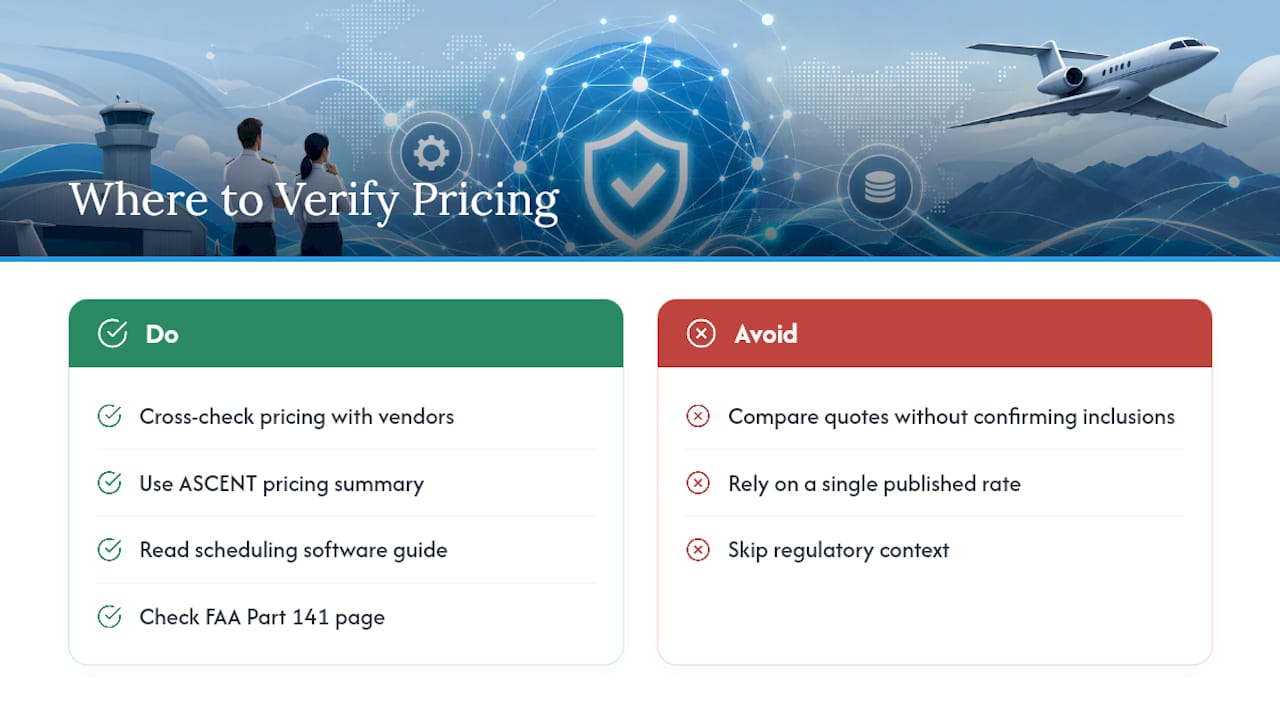
Cross-check pricing claims directly with vendors before budgeting. The ASCENT Aviation pricing summary and the flight school scheduling software guide both break down published rates in more detail. For regulatory context on training program requirements, see the FAA’s Part 141 modernization page. Always confirm what’s included before comparing quotes line by line.
Sources
- Pricing & Buying - ASCENT Aviation E-training system
- ASCENT Aviation pricing (ITQlick summary)
- Flight School Scheduling Software: A Complete Guide (2026)
- FAA — modernization of Part 141 initiative
Recommended
No credit card required · read-only after trial