
What Belongs in Your Flying Club Bylaws Document

What Belongs in Your Flying Club Bylaws Document
A complete set of flying club bylaws always names the club, defines membership classes and fees, assigns officer duties, sets meeting and voting rules, states financial controls, and defines amendment and discipline procedures. Just as important: it keeps stable governance separate from the operating rules that change every season.
Get these seven articles right and your club avoids the two most common failure modes — bylaws so vague that every dispute ends in argument, or bylaws so rigid that fixing a scheduling problem requires a full membership vote.
Here’s the required article list at a glance:
- Name, purpose, and legal structure
- Membership classes, eligibility, and fees
- Officers and board duties
- Meetings, quorum, and voting procedures
- Financial controls and dues structure
- Amendment and disciplinary procedures
- A clear statement that operating rules (checkout, currency, fuel minimums) live in a separate SOP document, not the bylaws
Pro Tip: Before you write a single clause, pull a sample document from the EAA Flying Club Resource Center. Editing a proven structure takes a weekend. Building one from scratch takes months and usually misses something a lawyer would catch on page one.
The checklist below expands each article into ready-to-adapt clause language, plus the governance mistakes that sink clubs three years after formation, not on day one.
TL;DR:
- Clear membership classes and fee structures prevent disputes by explicitly defining voting rights, equity shares, and flight privileges for each type of member.
- Separating governance bylaws from operational rules allows quick updates to scheduling or safety policies without requiring full membership votes, avoiding bureaucratic delays.
- Well-defined amendment procedures with majority or two-thirds thresholds ensure bylaws evolve appropriately, preventing stagnation or unmanageable rigidity.
- Precise financial policies including dues, hourly rates, and reserve funds reduce member distrust and enable transparent handling of large repairs or unexpected costs.
- Incorporating digital maintenance logs and automated compliance tracking meets recordkeeping requirements and promotes transparency, minimizing governance and operational conflicts.
Table of Contents
- Club Constitution and Legal Structure to State in Bylaws
- Membership Classes, Eligibility, and How Dues Actually Work
- Officers and Board: Roles, Duties, and Term Limits
- Meetings, Quorum, and How Votes Actually Get Decided
- Structuring Dues, Hourly Charges, and Reserves Without Drama
- Flight Rules vs. Bylaws: What Actually Belongs Where
- Scheduling, Maintenance Funding, and Insurance Clauses That Prevent Disputes
- Amendments, Discipline, and Avoiding the Governance Traps That Freeze Clubs
- A Practical Checklist and Clause Bank for Drafting Your Bylaws
- Where Flying Clubs Usually Get Bylaws Wrong
- How SquawkFree Supports the Recordkeeping Your Bylaws Require
- Key Takeaways
- Sources
Club Constitution and Legal Structure to State in Bylaws
Your name and purpose clause does more work than most founders expect. Write it too broadly (“to promote aviation”) and you invite mission creep, like a club slowly turning into an informal charter service. Write it precisely, and you give future officers a clear yardstick for what the club should and shouldn’t do.
A workable purpose clause states the club exists to provide its members with access to aircraft for personal, recreational, and training use on a cost-sharing basis, consistent with 14 CFR §61.113. That single reference does real work. It signals to every member, and to any regulator who ever asks, that the club understands the line between shared expenses and commercial carriage.
Next comes the entity decision, and this one has teeth:
- Nonprofit corporation: Offers liability protection for officers and members, requires state filing and (often) more formal recordkeeping, and suits clubs with real assets like owned aircraft.
- Unincorporated association: Faster and cheaper to set up, but officers and members can carry more personal exposure if something goes wrong.
- LLC structure: Some clubs use this for the entity that actually holds title to the aircraft, then govern member relations through separate bylaws.
Most established clubs choose incorporation once they own an aircraft outright, because the liability separation matters more than the extra paperwork.
Finally, add a compliance clause that ties the club’s operation to applicable FAA regulations and any state nonprofit statutes governing the entity. This clause doesn’t need to restate every regulation. It needs to state that the club operates in accordance with them and that officers are responsible for staying current.
Membership Classes, Eligibility, and How Dues Actually Work
Most disputes that end up dissolving flying clubs trace back to one thing: unclear rights tied to membership. Get the classes and money mechanics specific, and you remove the ambiguity that fuels resentment.
Start with membership classes. A typical structure includes:
Full/equity members — hold voting rights, flying privileges, and a share of club assets, usually acquired through an initiation buy-in. Associate/non-equity members — pay dues and flight-hour charges but hold no equity stake and often no vote on capital decisions. Student members — typically have restricted flying privileges and reduced dues. Honorary/inactive members — retained for historical or social reasons, without flying privileges or voting rights.
Each class needs its rights spelled out in the bylaws themselves, not left to informal understanding. A member who paid a $3,000 buy-in and finds out two years later that “member” meant something different than they assumed will not stay quiet about it.
On fees, the mechanics matter as much as the amounts. Initiation fees usually include an administrative fee covering onboarding costs and an equity buy-in granting a share of club assets. Bylaws should define a buy-out formula for departing members based on a consistent valuation method rather than discretionary board decisions.
Dues and flight-hour policy should specify:
- Monthly dues amount and what they cover (hangar, insurance base, reserve contribution).
- Hourly wet or dry rate and how it’s calculated.
- Minimum monthly usage or a “no-fly dues” provision if the club depends on flight-hour revenue to cover fixed costs.
- Grace period for late payment (commonly 15 to 30 days) before flying privileges are suspended.
- Point at which delinquency triggers termination, and what happens to that member’s equity share.
Pro Tip: Write the delinquency clause before you need it, not during a dispute. A club that suspends flying privileges after 30 days unpaid, with a written notice requirement, has a defensible process. A club that decides case-by-case invites accusations of favoritism, even when none exists.
Officers and Board: Roles, Duties, and Term Limits
Vague officer language is where accountability goes to die. If the bylaws say the treasurer “handles finances,” nobody can point to a failure when the books are three months behind. Specific duty language fixes that.
A standard officer roster includes:
- President — presides over meetings, represents the club externally, and has tie-breaking vote authority on the board.
- Vice President — assumes presidential duties when needed and typically oversees membership matters.
- Treasurer — maintains financial records, prepares the annual budget, and issues monthly financial statements to members.
- Secretary — records and distributes meeting minutes, maintains the membership roster, and handles official correspondence.
- Maintenance Officer — tracks inspection status, authorizes routine maintenance spending up to a defined limit, and holds authority to ground an aircraft pending inspection.
- Safety Officer — a role AOPA specifically recommends clubs separate from financial and administrative duties, so safety oversight never competes with budget pressure for attention. See AOPA’s guidance on officer roles.
Board size typically runs five to seven positions, with staggered one or two year terms so the whole board never turns over at once. Elections happen at the annual meeting, with vacancies filled by board appointment until the next election.
Every board needs a conflict-of-interest clause. If the maintenance officer’s shop bids on the club’s annual inspection, that officer must disclose the relationship and abstain from the vote. Bylaws that skip this clause tend to discover why it matters the hard way, usually through a member complaint that turns a routine maintenance decision into a governance crisis.
Authority limits matter too. Specify a dollar threshold above which the treasurer or maintenance officer needs board approval before spending club funds, and a separate, higher threshold requiring a membership vote. Committees (safety, social, maintenance) can be delegated authority within the bylaws, but the delegation language should state clearly what a committee can decide versus what it can only recommend.
Meetings, Quorum, and How Votes Actually Get Decided
An annual meeting is non-negotiable, and most clubs add quarterly or as-needed special meetings for time-sensitive decisions like emergency assessments or officer replacement. Notice requirements should be explicit: 10 to 14 days written notice for regular meetings, shorter (48 to 72 hours) for genuine emergencies.
Quorum sets the floor for a legitimate vote. A common standard is one-third of voting members present or represented by proxy. Set it too high and a single bad-weather Saturday can paralyze the club’s ability to conduct business. Set it too low and a small clique can make decisions the broader membership never agreed to.
Voting mechanics need equal specificity:
- Proxy voting allowed or not, and if allowed, whether proxies must be in writing and filed before the meeting.
- Secret ballot required for officer elections and disciplinary matters, to protect members from social pressure.
- Simple majority for routine business (approving the budget, electing officers).
- Two-thirds majority for structural changes (amending bylaws, dissolving the club, major asset purchases).
Recordkeeping closes the loop. Minutes should capture attendance, motions, vote counts, and action items, distributed to members within a defined window, commonly two weeks. Financial reports belong at every meeting where money changes hands in any meaningful way, and EAA’s own guidance identifies transparent, recurring financial reporting as one of the strongest predictors of whether a club survives past its first few years, because it starves distrust before it takes root. Retain minutes and financial records for a minimum of seven years, both for tax purposes and for resolving disputes about what was actually decided.
Structuring Dues, Hourly Charges, and Reserves Without Drama
Money problems sink more flying clubs than mechanical problems ever will, and the fix starts with precise language, not good intentions.
Start with the rate structure itself. Clubs generally choose between a “wet rate” that bundles fuel into the hourly charge, or a “dry rate” with fuel billed separately based on actual burn. Wet rates simplify billing and reduce disputes over fuel receipts; dry rates reward efficient pilots but require more bookkeeping. Either way, the bylaws should state which model the club uses and what the hourly rate is meant to cover: engine reserve, airframe reserve, insurance allocation, and hangar cost, at minimum.
Here’s a practical structure most clubs converge on:
- Initiation fee — one-time payment covering equity buy-in and administrative onboarding costs.
- Monthly dues — fixed charge covering insurance, hangar, and fixed overhead regardless of flying activity.
- Hourly rate — variable charge tied to tach or Hobbs time, funding fuel, engine reserve, and routine maintenance.
- Reserve fund contribution — a defined portion of the hourly rate, set aside specifically for engine overhaul and major airframe work, and never touched for operating expenses.
- Special assessment provision — a mechanism for extraordinary costs (an unexpected engine teardown, storm damage) that exceed reserves, with a defined vote threshold before members can be billed.
That last item matters more than most first-time drafters realize. Without a special assessment clause, a club facing a surprise $18,000 repair bill has no legitimate process for collecting it, just an officer sending an awkward email and hoping people pay. With the clause in place, the board calls a vote, members know the threshold that triggers a special assessment, and nobody feels ambushed.
Delinquency and billing cadence deserve their own short article. Monthly invoicing, a defined grace period, and escalating consequences (flying privilege suspension, then membership termination, then forfeiture or forced buy-out of equity) give the treasurer a process to follow instead of a judgment call to make every time someone falls behind. Some clubs also include lien language against a departing member’s equity distribution if they leave with an outstanding balance, which prevents the awkward scenario of paying out a buy-out check to someone who still owes the club money.
If your club occasionally structures cost-sharing for larger aircraft or considers time-sharing arrangements, know that NBAA’s guidance on Part 91 Subpart F lays out which charges are permissible and where federal excise tax may apply. Most flying clubs never need this, but it’s worth knowing the boundary exists before someone proposes an arrangement that crosses it.
Flight Rules vs. Bylaws: What Actually Belongs Where
Here’s the mistake that causes more club dysfunction than any financial dispute: burying operational details inside the bylaws themselves.
Checkout requirements, currency minimums, fuel reserve policy, and reservation windows all change as the club’s fleet, membership, and safety culture evolve. If those details live in the bylaws, updating them requires the same two-thirds vote and notice period as amending the club’s legal structure. That’s backwards. AOPA specifically recommends keeping bylaws stable and moving operational policy into a separate operating rules document the board can update without a full membership process.
The dividing line works like this:
- Bylaws, which require membership votes to change, cover governance structure, financial policies, officer roles, and amendment procedures.
- Operating rules or SOPs, which the board can amend directly, govern operational details such as checkout requirements, currency minimums, fuel reserves, scheduling, and safety policies.
Include a clear bylaws clause stating that “The board shall maintain and may amend a separate Operating Rules document covering flight operations, scheduling, and safety, provided these rules do not conflict with the bylaws,” to allow operational flexibility without extensive membership votes.
This split matters practically, not just administratively. A club that spots a scheduling abuse pattern, say, members holding reservations without flying, can fix it at the next board meeting if reservation limits live in operating rules. If that same limit sits inside the bylaws, the fix waits for the next general membership meeting, sometimes months away.
Scheduling, Maintenance Funding, and Insurance Clauses That Prevent Disputes
Reservation conflicts and maintenance funding gaps generate more member complaints than almost anything else in club operations, and both trace back to bylaws language that never got specific.
For scheduling, set concrete limits rather than trusting good faith alone:
- Maximum reservation length (commonly capped at three to five days for cross-country trips).
- A hold-time rule requiring pilots to release a reservation within a set window if they haven’t confirmed the flight.
- A no-show policy, since repeat no-shows waste availability for other members.
- A published booking window (30 to 60 days out) so no single member can lock up the schedule indefinitely.
Maintenance funding needs its own dedicated language, distinct from the routine dues discussion above. State clearly that the maintenance officer holds authority to ground any aircraft pending inspection, no matter how that decision affects the schedule, and that this authority cannot be overridden by any other officer or by the board short of a formal vote. Require immediate incident reporting for any hard landing, gear-up scare, or squawk that affects airworthiness, with a defined reporting window (commonly 24 hours).
A digital maintenance log accessible to all members does real work here. When every member can see the same maintenance history, disputes about “was this squawk actually fixed” or “when was the last annual” mostly disappear, because the record speaks for itself instead of relying on one officer’s memory or a paper logbook only they can access.

Insurance minimums belong in the bylaws as a floor, not a suggestion. State the minimum liability coverage the club must carry, hull coverage requirements if the club owns the aircraft outright, and a requirement that any member operating club aircraft carry renter’s insurance meeting a stated minimum. Clubs that skip this clause often discover the gap only after an incident, when it’s too late to fix.
Amendments, Discipline, and Avoiding the Governance Traps That Freeze Clubs
Two failure modes show up repeatedly in club bylaws: amendment thresholds so high that nothing ever changes, and disciplinary language so vague it invites a lawsuit every time someone gets suspended.
A workable amendment process includes submitting proposals in writing, reading them at two consecutive meetings before voting, passing routine changes by simple majority of members present at quorate meetings, requiring a two-thirds majority and sometimes advance notice for structural changes, and allowing the board to adopt temporary emergency amendments subject to later ratification. Disciplinary procedures should similarly follow clear steps: receive a written complaint, conduct a timely board investigation, suspend flying privileges temporarily if safety is at risk, hold a hearing for member response, and finalize decisions with documented votes. Skipping the hearing step, or leaving “conduct unbecoming a member” as the only disciplinary standard, is exactly the kind of vague language that turns a routine suspension into a legal fight.
The single most common drafting mistake AOPA flags is requiring unanimous consent for amendments. It sounds protective in theory. In practice, it means one disengaged member can block a change everyone else agrees on, and clubs with unanimity clauses often end up operating under bylaws nobody has updated in a decade.
A Practical Checklist and Clause Bank for Drafting Your Bylaws
Real club bylaws documents, whatever club wrote them, tend to converge on the same eight-article structure: name/purpose, membership, officers, meetings, dues, flight rules reference, amendments, and enforcement. Use that consistency as a shortcut, not a constraint.
Run through this before you call your bylaws finished:
- Name, purpose, and legal entity type stated clearly
- Membership classes defined with specific rights attached to each
- Initiation fees, dues, and hourly rates spelled out with a delinquency process
- Officer roles with concrete duty descriptions and authority limits
- Meeting cadence, quorum, and vote thresholds documented
- Financial reporting cadence and reserve fund policy stated
- Clear reference separating bylaws from the operating rules document
- Amendment process with a notice period and defined vote thresholds
- Disciplinary procedure with investigation, hearing, and appeal steps
A short clause bank to adapt directly:
Purpose: “The club exists to provide members with cost-shared access to aircraft for personal and recreational flying under 14 CFR §61.113, and shall not engage in the carriage of persons or property for compensation.”
Membership: “Full membership entitles the holder to one vote on all matters requiring membership approval, priority scheduling as defined in the Operating Rules, and a pro rata equity interest in club assets upon departure.”
Officers: “The Maintenance Officer shall have sole authority to ground any club aircraft pending inspection or repair, and this authority may not be overridden except by a two-thirds vote of the board.”
Amendments: “These bylaws may be amended by a two-thirds vote of members present at a meeting where quorum is met, provided the proposed amendment was read at the prior regular meeting.”
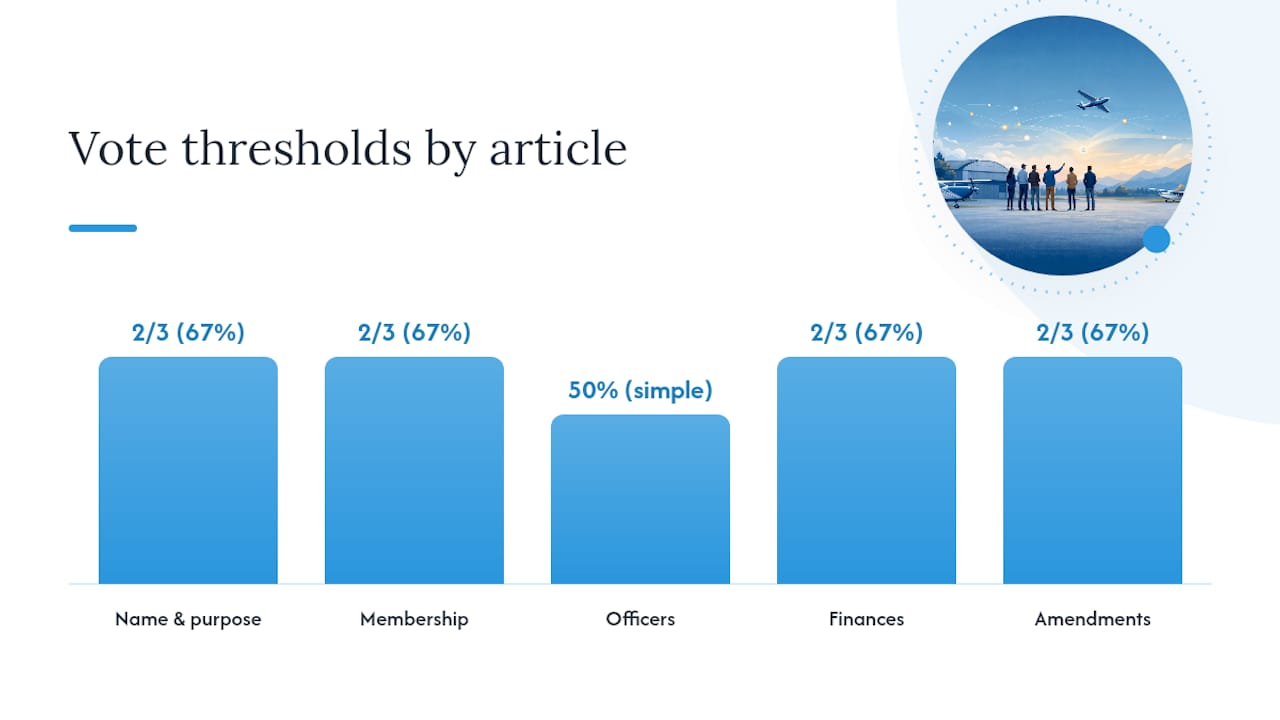
| Article | Governs | Amendment path |
|---|---|---|
| Name & purpose | Legal identity, mission scope | Two-thirds membership vote |
| Membership | Classes, fees, rights | Two-thirds membership vote |
| Officers | Roles, authority, terms | Simple majority |
| Finances | Dues, reserves, assessments | Two-thirds for structural changes |
| Amendments | Change process itself | Two-thirds membership vote |
Once the governance framework is set, the ongoing burden shifts to proving compliance with it, particularly the maintenance and financial transparency clauses. That’s where a maintenance tracking system earns its keep, turning “the maintenance officer says it’s fine” into a record every member can check themselves.
Where Flying Clubs Usually Get Bylaws Wrong
Three problems show up again and again when clubs run into trouble years after formation. First, frozen bylaws: a document written in 2008 that nobody has touched since, full of dues figures and rules that no longer reflect the club’s fleet or membership size. Second, dues mechanics that were never specific enough, leaving the treasurer to improvise delinquency handling case by case. Third, and most damaging, operational rules trapped inside the bylaws, so a scheduling fix that should take one board meeting instead waits for a full membership vote.
The fix for all three is the same: put a bylaws review on the calendar, annually, with a specific board member owning that agenda item. Clubs that treat governance as a living document rather than a founding artifact tend to catch problems while they’re still small.
Member friction drops fastest when the numbers are visible. Clubs that publish maintenance status and scheduling data openly generate far fewer disputes than clubs where that information lives in one person’s head or one filing cabinet.
— Trent
How SquawkFree Supports the Recordkeeping Your Bylaws Require
Bylaws that mandate maintenance transparency, financial reporting, and scheduling discipline are only as good as the system behind them. SquawkFree gives flying clubs the operational backbone those clauses actually need.

The platform’s Flight Intelligence feature auto-imports flight data so nobody has to reconcile a paper logbook against what actually happened in the air, and it tracks FAA airworthiness directive compliance automatically rather than leaving it to one maintenance officer’s memory. Role-based access lets treasurers, safety officers, and members each see exactly what your bylaws say they’re entitled to see, and scheduling tools with configurable reservation limits enforce the checkout and hold-time rules your operating rules document lays out. For clubs still working from a shoebox of paper logs, SquawkFree’s logbook digitization service converts that history into a searchable digital record.
If your bylaws call for maintenance history “accessible to all members,” a shared paper binder in the hangar doesn’t really satisfy that clause. A digital system does. Start a trial at SquawkFree and see how much of your bylaws’ recordkeeping language it handles automatically.
Key Takeaways
Flying club bylaws work when they separate stable governance from editable operating rules, spell out financial mechanics precisely, and give officers clearly bounded authority.
| Point | Details |
|---|---|
| Keep bylaws and SOPs separate | Store checkout, currency, and scheduling rules in a board-editable operating rules document, not the bylaws. |
| Define every membership class | Spell out voting rights, equity, and flying privileges for each class to prevent disputes at exit. |
| Set concrete amendment thresholds | Use simple majority for routine changes and two-thirds for structural changes, never unanimity. |
| Require financial transparency | Monthly statements and a defined reserve policy reduce member distrust and attrition. |
| Use SquawkFree for compliance records | Digital maintenance logs and automated AD tracking satisfy bylaws’ recordkeeping and audit-trail requirements. |
Sources
Drafting from scratch wastes time that a proven template already saves. Start with these before writing a single clause:
- Flying Club Resource Center | EAA
- AOPA flying club guidance — bylaws vs operating rules
- 14 CFR §61.113 — Private carriage and cost sharing
Recommended
No credit card required · read-only after trial