Tach Time Tracking: What It Means and How to Log It Right
Tach Time Tracking: What It Means and How to Log It Right
Tach time measures engine revolutions converted into an hours-equivalent figure, and it’s the most reliable proxy general aviation owners have for engine wear. Use tach time for engine and component tracking, and cross-check it against Hobbs time and flight time for pilot logbooks and billing. The two metrics rarely match exactly, and that’s normal, not a problem to solve.
The practical move is simple: capture your tach reading every time you fly, using whatever method takes the least effort, and reconcile your log weekly instead of letting entries pile up.
- Tach time: engine-based, best for wear and maintenance intervals
- Hobbs time: often elapsed run time, common for billing and ground operations
- Flight time: wheels-up to wheels-down, what goes in your pilot logbook
Pro Tip: Pick a rounding convention (nearest tenth of an hour is standard) and write it into your aircraft records once. Consistency matters more than precision here.
Key Takeaways
Tach time works best as an engine-wear proxy when it’s logged consistently and reconciled weekly against Hobbs and flight time records.
| Point | Details |
|---|---|
| Use tach for engine wear | Track oil changes and component life against tach hours, not clock time. |
| Cross-check three metrics | Compare tach, Hobbs, and flight time regularly to catch discrepancies early. |
| Capture at shutdown | Read and log the tach the moment the engine stops, before distractions set in. |
| Reconcile weekly | Compare manual entries to EDM or import data every week, not just before inspections. |
| Automate where possible | SquawkFree’s Flight Intelligence auto-imports flight data to remove transcription errors and speed up inspections. |
Table of Contents
- What Is Tach Time and How Is It Measured?
- Tach Time vs. Hobbs Time vs. Flight Time: What Goes Where?
- How to Track Tach Time Without Losing Data
- Tach Time and Maintenance Compliance: What to Record
- How SquawkFree’s Flight Intelligence Removes the Manual Work
- Common Tach Tracking Problems and How to Fix Them
- A Weekly Tach Tracking Routine You Can Actually Keep
- Why the Small Habit Matters More Than the Perfect System
- Let SquawkFree Handle the Logbook Busywork
- Sources
What Is Tach Time and How Is It Measured?
A tachometer doesn’t measure clock time. It measures engine RPM and converts that into a cumulative “tach hour” figure based on a reference RPM, usually the engine’s rated cruise speed. Run the engine above that reference RPM and tach time accumulates faster than clock time. Idle or taxi at low RPM and it accumulates slower. That’s why a two-hour flight might log 1.9 tach hours, or 2.1, depending on how much of it happened at high power.
Here’s the basic math most mechanical tachometers use, simplified:
- The tachometer samples engine RPM continuously through a mechanical or magnetic pickup on the engine.
- It compares that RPM against a fixed reference speed (often the engine’s rated maximum continuous RPM).
- It converts the ratio into a fraction of an hour and adds it to a running total displayed on the gauge face.
So if your engine’s reference RPM is 2,700 and you cruise at 2,400, you’re accumulating tach time at roughly 89% of clock speed during that segment. Over a one-hour flight with a mixed power profile (climb, cruise, descent, taxi), the tach might read 0.85 to 0.95 hours instead of a flat 1.0. That gap is exactly why tach time and flight time diverge, and why pulling a tach number off the gauge without context can mislead you.
Modern engine data monitors (EDMs) and ADS-B-linked flight-data systems capture RPM continuously and calculate tach-equivalent hours automatically, often alongside cylinder head temperature, fuel flow, and other engine parameters. These systems export a far more granular record than a mechanical gauge ever could, which matters when you’re trying to explain a discrepancy months later. The FAA’s guidance on time-in-service recordkeeping doesn’t mandate a specific meter technology, but it does expect the numbers you record to be consistent and documented.
Tach Time vs. Hobbs Time vs. Flight Time: What Goes Where?
These three numbers answer three different questions, and mixing them up is the single most common recordkeeping mistake general aviation owners make.
Flight time is defined for FAA purposes as the time from the moment an aircraft moves under its own power for takeoff until it comes to rest after landing, per the definitions in 14 CFR § 1.1. This is what goes in your pilot logbook and what determines currency and rating requirements.
Hobbs time typically starts when the master switch or oil pressure triggers the meter, which means it often includes taxi, runup, and ground operation time that flight time doesn’t. Installation varies by aircraft, and Hobbs meter behavior isn’t standardized the way you might assume. Flight schools and rental operations lean on Hobbs because it captures actual engine run time for billing purposes, regardless of whether the wheels ever left the ground.
Tach time, as covered above, tracks engine revolutions rather than elapsed time, and functions as the closest available proxy for engine wear since fatigue accumulates with revolutions and load, not clock minutes.
Here’s how that plays out in practice:
- Oil change scheduling: use tach time, since wear on internal components tracks with engine cycles, not calendar hours.
- 100-hour inspection planning: tach time is the standard trigger for Part 91 commercial operations and flight school aircraft.
- Logging PIC time: use flight time exclusively, since that’s what the regulation defines and what examiners check.
- Renter billing: Hobbs time, because it captures ground running that tach time may undercount at idle.
The FAA doesn’t require you to pick one metric and ignore the others. It requires that whatever you record is accurate and traceable, which means documenting all three when they’re available rather than defaulting to whichever number is most convenient that day.
How to Track Tach Time Without Losing Data
The gap between owners with clean logs and owners who scramble before every annual usually comes down to one thing: how much friction sits between flying the airplane and writing down the number.

Manual capture still works if you make it a fixed habit rather than an afterthought. Read the panel tach before engine start and again at shutdown, and write both numbers down immediately, not from memory an hour later. A single-line entry format works best: date, tach start, tach end, Hobbs (if installed), pilot name, and a one-word remarks field for anything unusual. Photographing the gauge at shutdown gives you a backup record if the written entry gets smudged or skipped.
Lower-friction digital methods close most of the gaps manual logging leaves open. Mobile logging apps that accept a photo of the tach face, paired with EDM data exports, remove the need to transcribe numbers by hand at all. Productivity research on time-tracking adoption consistently shows that capture methods requiring five seconds or less produce dramatically fewer missed or inaccurate entries than manual systems that require remembering to write something down later.
- Add tach capture to your printed or digital preflight checklist, right next to fuel and oil checks.
- Add tach capture to your postflight checklist, before you walk away from the airplane.
- Set a recurring weekly reminder to reconcile your written log against any EDM or auto-imported data.
- Flag and annotate any discrepancy immediately rather than letting it carry forward unexplained.
Pro Tip: Write your rounding convention (nearest tenth, nearest quarter-hour, whatever you choose) directly into your aircraft records folder. When a new mechanic or co-owner reviews the logs years later, that one sentence saves them from questioning every entry.
Tach Time and Maintenance Compliance: What to Record
Tach time drives most of the maintenance intervals general aviation owners deal with day to day, but it doesn’t replace official time-in-service (TIS) for every purpose. Oil changes, spark plug rotations, and many manufacturer-recommended service intervals use tach hours as the trigger. Airworthiness directive compliance and life-limited part replacement, on the other hand, frequently specify TIS explicitly, which the regulations define in terms of flight time, not tach time. Knowing which category a given requirement falls into matters more than most owners realize.
A logbook entry that survives inspection scrutiny typically includes:
- Tach reading at the time of the maintenance event
- Hobbs reading, if the aircraft has a separate meter
- The specific work performed and parts replaced
- Any discrepancy noted between tach and other time sources, with a brief explanation
Component tracking, meaning engines, propellers, and life-limited parts, works best when you annotate tach-derived hours against the actual service tag or invoice for that component at every inspection. AOPA’s guidance on engine overhauls recommends reconciling multiple time sources rather than trusting a single number in isolation, since a single transcription error can compound over years of records. Our component time tracking guide covers this in more depth if you’re managing an engine approaching TBO.
Discrepancies at annual or 100-hour inspections are common and rarely serious, as long as you can explain them. A reading that’s off by 15% or more usually points to a real mechanical or electrical issue worth investigating before it becomes a bigger problem.
How SquawkFree’s Flight Intelligence Removes the Manual Work
Every step described above still relies on a human remembering to write something down, and humans miss entries. That’s the gap Flight Intelligence closes for owners and flight schools already using SquawkFree.
- Auto-imports flight data directly, eliminating the transcription errors that creep into hand-written logs
- Links imported flight data to maintenance events automatically, so a tach reading connects to the oil change or inspection it triggered
- Tracks component hours (engine, propeller, life-limited parts) against imported data instead of relying on manual annotation
- Surfaces analytics that flag unusual patterns, like a tach reading that doesn’t match expected flight duration
The practical payoff shows up at inspection time. When your mechanic asks for engine hours since the last oil change, you’re pulling a clean number instead of reconstructing it from handwritten entries across three logbooks. Trent has written more on the mechanics of this in SquawkFree’s guide to aircraft maintenance tracking software, which walks through how automated import compares to manual methods in more detail.
Pro Tip: If you co-own an aircraft, auto-imported data settles disputes before they start. Nobody has to trust anyone else’s handwriting.
Common Tach Tracking Problems and How to Fix Them
Most tach discrepancies trace back to a handful of repeat offenders, and catching them early keeps small errors from becoming audit headaches.
- Meter drift: mechanical tachometers can drift out of calibration over years of vibration and wear, producing readings that quietly diverge from actual engine time.
- Power interruptions: electronic tachs tied to aircraft electrical systems can lose or reset accumulated time during a battery failure or avionics power cycle.
- EDM vs. mechanical mismatches: an engine data monitor and the panel-mounted tach can calculate slightly different totals if their reference RPM assumptions don’t match.
- Wrong reference RPM assumptions: a tach calibrated for a different engine variant will produce systematically skewed hours.
Catching these early means comparing your cockpit tach against Hobbs time, GPS-logged flight duration, and any EDM export on a regular basis rather than waiting for annual inspection to notice a gap. When numbers diverge beyond a small, explainable margin, annotate the log entry with your best explanation, loop in your A&P if the cause isn’t obvious, and schedule an instrument check if the mismatch persists across multiple flights.
A Weekly Tach Tracking Routine You Can Actually Keep
Consistency beats perfection here. A simple, repeatable routine keeps your records audit-ready without turning logging into a chore.
- Preflight: read the tach and jot down the starting number before you touch the checklist’s engine start items.
- Postflight: read the tach again at shutdown and write a single log line: tach start, tach end, Hobbs reading if applicable, and pilot name.
- Weekly: compare your manual entries against any EDM or auto-imported data, and correct or annotate anything that doesn’t line up.
- Monthly or before inspections: export or compile the full record package your mechanic will need, rather than assembling it under time pressure.
Time-tracking methodology research backs up the weekly cadence specifically: raw logs left unreviewed for weeks tend to accumulate errors that are much harder to trace back to their source than problems caught within days.
Pro Tip: Keep the weekly reconciliation to under ten minutes. If it takes longer than that, something in your capture method is too complicated and you’ll eventually stop doing it.
Why the Small Habit Matters More Than the Perfect System
I’ve seen more owners get burned by a skipped postflight entry than by any actual mechanical problem. The fix usually isn’t a better spreadsheet. It’s moving tach capture to the same moment every time, right at shutdown, before you’re distracted by tie-down or fuel arrangements.
Try the weekly reconciliation habit for 30 days before judging whether it’s worth keeping. Most pilots find the friction disappears faster than expected. For readers who want the fuller procedural breakdown, our Hobbs vs. tach comparison and maintenance logs compliance guide go deeper into the recordkeeping mechanics touched on here.
— Trent
Let SquawkFree Handle the Logbook Busywork
SquawkFree automates the flight-data import, component tracking, and AD compliance work that turns tach and Hobbs recordkeeping into a chore for most owners.
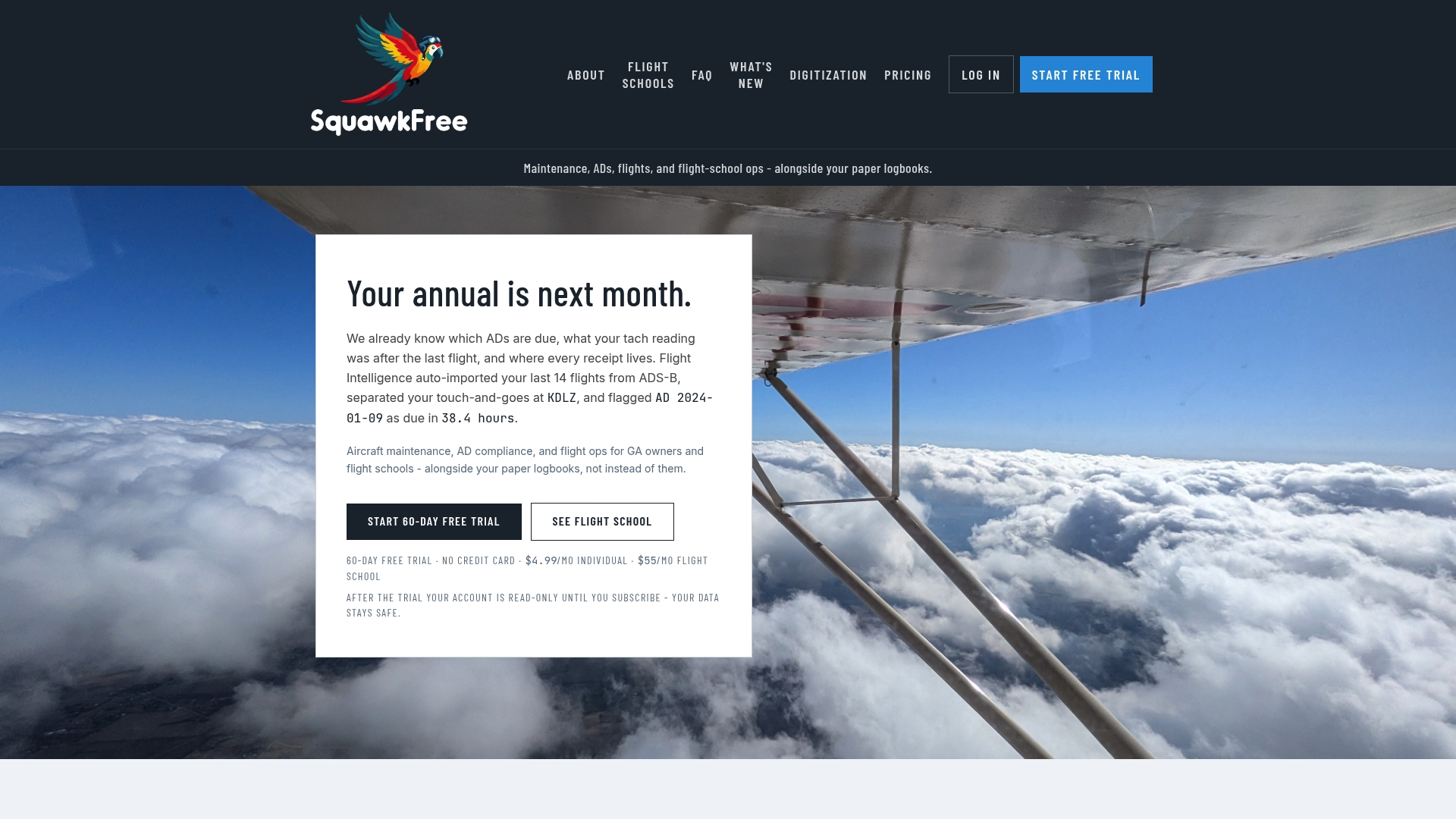
Instead of reconciling handwritten tach entries against EDM exports every week, Flight Intelligence pulls the data in automatically and links it straight to the maintenance events it affects. That means less time spent hunting for numbers before an inspection and a component history that’s already assembled when your mechanic asks for it. Flight schools managing a fleet get the same benefit multiplied across every tail number, without adding staff hours to the job.
Visit SquawkFree to see how automated tracking fits your aircraft or fleet, and start your trial to see your first flight import in minutes.
Sources
- FAA Advisory Circular (AC 20-106)
- Electronic Code of Federal Regulations (14 CFR § 1.1)
- AOPA — Engine overhauls and related time tracking
- How time tracking improves employee productivity — OnPay
- Hobbs Time vs. Tach Time — Aeroclass
Recommended
No credit card required · read-only after trial