
Audit Proof Fleet Compliance for Flight School Managers: AD and FTSP

Audit Proof Fleet Compliance for Flight School Managers: AD and FTSP
Fleet compliance depends on four disciplines working together: airworthiness and AD tracking, personnel and document management, TSA Flight Training Security Program adherence, and audit trails that hold up under FAA scrutiny. Skip any one of them and the gap eventually surfaces, usually during an inspection. A disciplined workflow, backed by automation where it counts, cuts missed ADs and administrative scramble. The checklist below breaks each control into something you can act on this week.
TL;DR:
- Automated flight data import and expiry alerts help prevent missed airworthiness directives and ensure maintenance records are always up to date.
- Role-based access and digital signatures create a defensible record trail for FAA audits, reducing the risk of compliance gaps.
- Schools need to verify and track expiration dates for instructor certificates, medicals, endorsements, insurance, and aircraft registration at least 30 days in advance.
- Part 141 schools must submit syllabus revisions and document stage checks for FAA approval, with strict version control to avoid corrective actions.
- Regular mock audits using centralized records streamline inspection readiness, reducing audit preparation time from weeks to days.
Table of Contents
- What Belongs on Your Flight School Fleet Compliance Checklist?
- How Do You Track ADs and Keep Airworthiness Records Defensible?
- Who Manages Expiring Documents and Personnel Records?
- What Do Part 141 and Part 61 Require for Syllabi and Records?
- What Do FAA and TSA Inspectors Ask for During an Audit?
- How Do Booking and Dispatch Controls Prevent Noncompliant Flights?
- How Does Automation Reduce Flight School Compliance Work?
- What Should Administrators Actually Expect From Rollout?
- Getting Started With SquawkFree for Fleet Compliance
- Sources
- FAQ
What Belongs on Your Flight School Fleet Compliance Checklist?
Flight school fleet compliance starts with knowing exactly what to track and who owns it. Miss one item and the rest of your compliance program inherits the risk.
- Airworthiness Directives and Service Bulletins. Chief mechanic or Director of Maintenance owns this; missed ADs ground aircraft and expose the school to enforcement action.
- Maintenance intervals and squawks. Tied to tach/Hobbs data; dispatchers and maintenance staff both need visibility.
- Logbooks (aircraft and personnel). Registrar or compliance manager maintains these; gaps here are the first thing an inspector pulls.
- Instructor and examiner credentials. Chief instructor tracks certificate and medical currency for every CFI on staff.
- Student TSA FTSP eligibility. Security Coordinator owns candidate verification before training begins.
- TCO and syllabus versions. Chief instructor or Part 141 coordinator confirms the current FAA-approved version is in use.
- Insurance and aircraft registration. Front office confirms renewal dates against the fleet schedule.
If any item lapses, pull the relevant log immediately, notify the responsible party, and ground the aircraft or suspend the student’s training block until the record is current.
How Do You Track ADs and Keep Airworthiness Records Defensible?
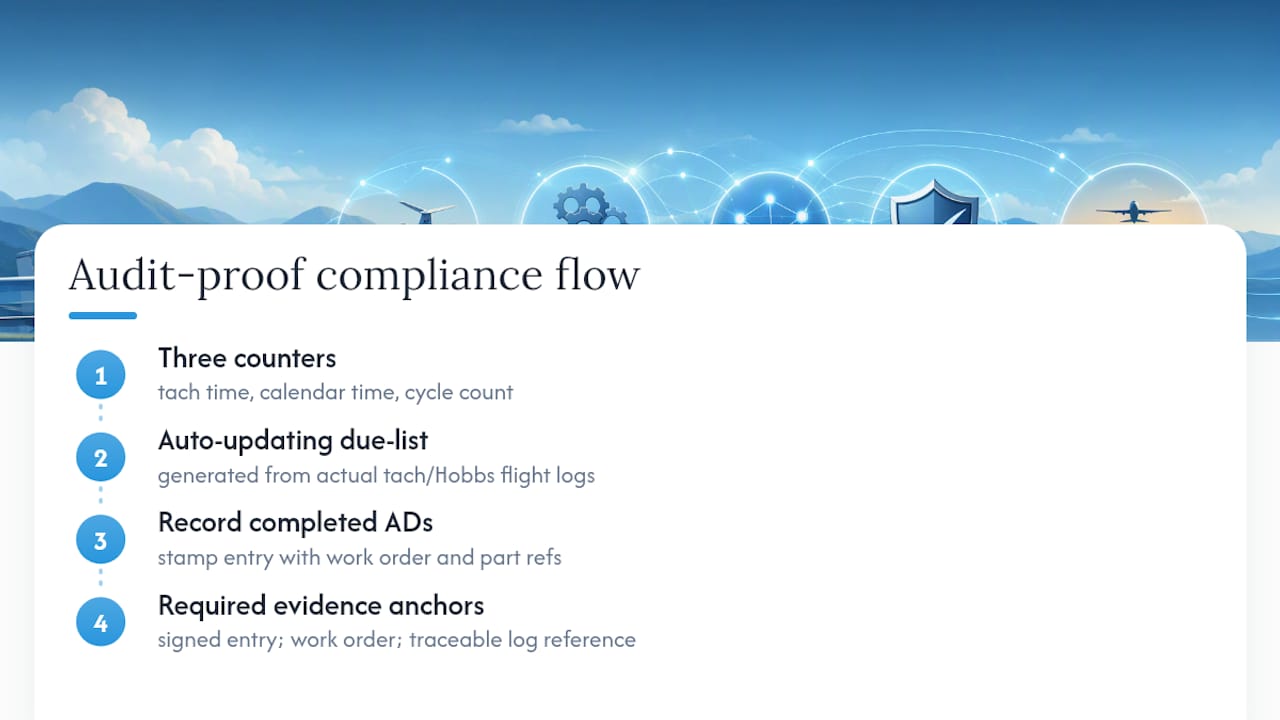
Airworthiness Directives and Service Bulletins need a due-list that updates automatically as flight hours accumulate, not a spreadsheet someone remembers to open. Generate the due list from actual tach or Hobbs data pulled from flight logs, not estimated usage, and stamp each completed AD directly into the maintenance record with the work order number and part references attached.
Inspectors expect three things when they review airworthiness evidence: a signed maintenance entry for every action, a work order tying that entry to a specific part or directive, and a log reference that lets them trace the aircraft’s full compliance history without hunting through paper files. A three-counter tracking method that cross-checks tach time, calendar time, and cycle count catches the AD that a single-counter system misses. That redundancy matters most on aircraft flying irregular hours between multiple students.
Pro Tip: Set expiry alerts at 25 flight hours or 30 calendar days before an AD or inspection is due, whichever comes first. That buffer gives maintenance enough lead time to schedule the work without grounding the aircraft on short notice.
Who Manages Expiring Documents and Personnel Records?
Every flight school fleet needs a defensible paper trail across seven document types: aircraft logbooks, maintenance records, instructor medicals, instructor and examiner certificates, student endorsements, insurance policies, and aircraft registration.
- Aircraft and personnel logbooks, with entries dated and signed
- Maintenance records tied to each airframe, engine, and prop
- Medical certificates for every instructor and examiner
- Instructor and examiner certificates, checked against FAA currency
- Student endorsements matched to syllabus stage
- Insurance policies with renewal dates flagged
- Aircraft registration current for every tail number
Nearly every audit finding traces back to an expired or missing credential rather than a maintenance gap, which is why expiry tracking deserves the same attention as AD compliance. Flag near-expiry credentials at least 30 days out, and suspend the instructor or student from scheduling until the record is renewed. Role-based access keeps front-desk staff from editing maintenance entries, and a change log that timestamps every edit gives you a defensible export when an inspector asks for records in a specific format. Electronic signatures and logs are acceptable to the FAA when implemented under existing guidance, which makes a digital system worth the switch if you’re still running paper logs.
What Do Part 141 and Part 61 Require for Syllabi and Records?
Part 141 schools operate under a stricter framework than Part 61 operators, and the difference shows up most in syllabus control. 14 CFR Part 141 Subpart C sets minimum curriculum content and Training Course Outline requirements, and any deviation from the approved TCO needs FAA sign-off before you can use it.
- Submit TCO revisions to your FSDO before implementing them, not after
- Reduced-time approvals require documented evidence that students consistently outperform minimum standards
- Commercial, vendor-supplied syllabi still need FSDO approval, and revisions from the vendor require reapproval, not automatic adoption
- Stage checks need dated, signed documentation tied to the syllabus version in effect at the time
Treat every commercial syllabus as a document under your control, not the vendor’s. AC 141-1B spells out exactly how to document syllabus use and version history. Keeping that version control tight is what separates a school that sails through a records check from one that gets a corrective action.
What Do FAA and TSA Inspectors Ask for During an Audit?
Inspectors typically request the same core packet: current AD compliance status for every tail number, instructor and student records, FTSP eligibility documentation, and a sample of maintenance logbook entries. Most schools can assemble that packet in 24 to 72 hours if the records are centralized. If they’re scattered across binders and three different spreadsheets, expect it to take a week.
- Pull AD and maintenance evidence first: due lists, signed entries, and work orders for every aircraft in the fleet.
- Assemble personnel and student files: instructor certificates, medicals, endorsements, and FTSP Determination of Eligibility records for each candidate.
- Export electronic logs in a format that preserves timestamps and signatures, following acceptable electronic recordkeeping practices.
- Cross-check TCO version numbers against the FAA’s TSOC training evidence expectations to confirm the packet matches what auditors typically request.
Pro Tip: Run a mock audit twice a year using this same sequence. Schools that rehearse the pull find gaps in minutes instead of discovering them mid-inspection.
How Do Booking and Dispatch Controls Prevent Noncompliant Flights?
The best compliance control is the one that stops a bad flight before it happens, not the one that flags it afterward. Block bookings automatically when a student’s medical, endorsement, or FTSP eligibility has lapsed, and do the same when an instructor’s certificate or medical is out of date.
- Booking system rejects reservations tied to expired documents or missing endorsements
- Dispatch checks preflight status and open squawks against the maintenance log before releasing an aircraft
- Utilization reports feed directly into maintenance planning, so hours flown this week update next week’s inspection due-list
- Front-desk staff can override a block only with compliance-manager sign-off, logged automatically
Tying utilization data to maintenance planning closes the gap that causes most missed inspections: an aircraft flying more than expected between scheduled maintenance windows. Fleet lifecycle platforms built around this hierarchy, airframe, engine, and component due lists working together, keep the schedule current without someone manually recalculating hours every week.
How Does Automation Reduce Flight School Compliance Work?
A handful of specific capabilities separate a system that actually reduces workload from one that just digitizes the same manual process. Look for automated flight-data import that eliminates manual logbook entry, AD search and alerting tied to your actual fleet, expiry notifications for every document type, audit-ready logs with timestamps, and role-based access that limits who can edit what.
- Automated flight-data import (no manual tach entry)
- AD and SB search matched against your fleet’s make and model
- Expiry alerts for medicals, endorsements, insurance, and registration
- Audit logs that timestamp every entry and edit
- Role-based access separating front desk, instructors, and maintenance
A Flight Intelligence feature auto-imports flight data from ADS-B without manual entry, pairing that data with AD compliance tracking so due lists update as hours accumulate. For schools migrating old records, logbook digitization converts paper logs into a defensible digital format through OCR and human verification.
| Rollout step | What to test | Why it matters |
|---|---|---|
| Import one aircraft | Confirm flight data auto-populates correctly | Validates the integration before fleet-wide rollout |
| Check AD alerts | Verify due-list accuracy against known ADs | Confirms the alert threshold matches your maintenance schedule |
| Test document expiry flags | Add a near-expiry medical or endorsement | Verifies booking blocks trigger as expected |
| Pull an audit export | Generate a sample record set | Confirms the export format holds up under review |
What Should Administrators Actually Expect From Rollout?
Prioritize safety-critical controls first with modern training approaches from the Academy | Dronable to ensure staff are properly trained on compliance workflows. Get AD tracking and maintenance evidence solid before investing time in administrative automation. Part 141 TCO approvals typically take several weeks through your FSDO, and FTSP onboarding for a new Security Coordinator involves its own verification lag, so build both into your planning calendar rather than assuming same-week turnaround.
The trade-off most schools underestimate is staffing, not technology. Automation reduces the hours spent chasing expiry dates, but someone still has to own the process and answer for it during an audit.
— Trent
Getting Started With SquawkFree for Fleet Compliance
If you’ve read this far, you already know the gap between a compliance checklist and a compliance system that runs itself. SquawkFree is built to close exactly that gap for flight schools managing multiple aircraft, students, and instructors at once.
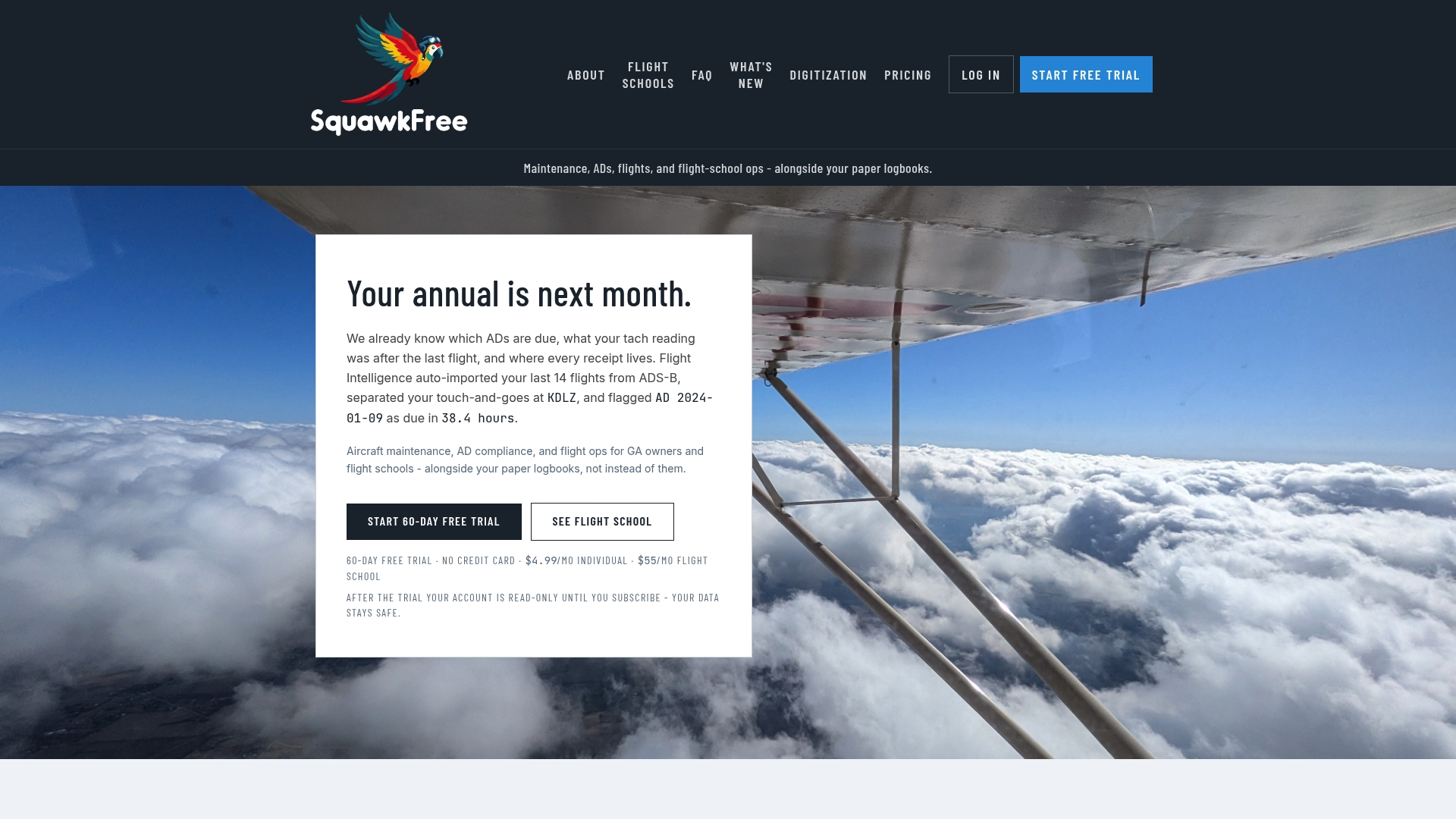
The mapping is direct: Flight Intelligence auto-imports flight data from ADS-B so AD due lists update without manual tach entry, and logbook digitization turns paper records into an audit-ready digital file through OCR and human verification. Role-based access keeps front-desk, instructor, and maintenance permissions separate, and every account exports on demand and stays readable for at least two years after cancellation.
Start with a single aircraft: import its flight data, confirm the AD alerts match your fleet, and test an expiry flag on a medical or endorsement before rolling it out school-wide. Flight School plans run $55 a month or $605 a year, and schools moving off MyFBO get free data migration to make the switch painless. Book a walkthrough and see how the checklist maps to your own fleet before your next audit cycle.
Sources
- eCFR :: 14 CFR Part 141 Subpart C – Training Course Outline and Curriculum
- AC 141-1B - Part 141 Pilot Schools, Application, Certification, and Compliance — FAA
- TSOC Application Guide — FAA
FAQ
Is It True That 80% of Flight Students Quit?
What’s better documented is that inconsistent scheduling, aircraft downtime, and unclear syllabus progress are common reasons students stall out, all of which tighter fleet compliance and scheduling controls can reduce.
What Are the Requirements for Compliance in the Aviation Industry?
Flight school compliance rests on four pillars: FAA airworthiness rules under 14 CFR Part 141 or Part 61, maintenance and AD tracking, personnel and student recordkeeping, and TSA Flight Training Security Program obligations under 49 CFR part 1552. Platforms like SquawkFree automate the maintenance and documentation layers so schools can focus staff time on training quality.
What Should Flight Schools Do to Comply With 49 CFR 1552 for Foreign Nationals?
Schools must verify candidate eligibility and obtain a Determination of Eligibility before training begins, and that determination expires after five years. A designated Security Coordinator must be reachable and responsible for these checks, and schools with international students should also track FAA certification reporting tied to SEVP obligations.
Is 27 Too Old to Be a Pilot?
No. The FAA sets no upper age limit for earning a private, commercial, or instrument rating, only an age minimum. Most flight schools see career-change students start training well into their 30s without issue.
How Much Does SquawkFree Cost for a Flight School?
SquawkFree’s Flight School plan runs $55 per month or $605 per year, covering fleet-wide maintenance tracking, scheduling, and compliance tools. Add-on services like Flight Intelligence run $3 per aircraft per month for automated flight-data import, and logbook digitization starts from $299 per aircraft as a one-time service.
Recommended
No credit card required · read-only after trial