
Four STC Records Every GA Owner Must Keep Audit Ready for Inspections

Four STC Records Every GA Owner Must Keep Audit Ready for Inspections
Every STC installation on your aircraft needs four permanent records: the FAA Form 337, the STC holder’s written permission-to-use letter, the Instructions for Continued Airworthiness (or a note that none apply), and any AFM/POH supplement tied to the modification. You are responsible for keeping and producing them, and the permission letter is a document that frequently goes missing, even on well-maintained airplanes.
TL;DR:
- The permission-to-use letter from the STC holder is the most commonly missing document and must be kept with the Form 337 for legal compliance.
- Filing and organizing STC records separately into permanent and routine maintenance folders ensures quick retrieval during inspections or sales.
- Owners need to continuously update and verify their records, including ICA revisions and part serial numbers, to avoid discrepancies during pre-buy or airworthiness checks.
- Digital systems like SquawkFree can automate version control, flight data linking, and electronic signatures, reducing the risk of lost or outdated documentation.
- Contact the FAA Certification Office if the original STC holder is unavailable, as all records and permissions must be validated for ongoing airworthiness.
Table of Contents
- What Documents Does STC Paperwork Management Actually Require?
- How to Organize STC Paperwork for Fast, Reliable Retrieval
- The Operational Workflow: Before, During, and After Installation
- What Inspectors and Buyers Actually Check First
- Why Owners Underestimate STC Recordkeeping Risk
- Keep Your STC Records Audit-Ready With SquawkFree
- Sources
- FAQ
What Documents Does STC Paperwork Management Actually Require?
Good STC paperwork management comes down to one question an inspector or buyer will ask: can you prove this modification is legal, current, and traceable to a specific approval? That takes more than the Form 337 folder most owners already keep. Here’s the minimum set, and what each document proves.
- Permission-to-use letter. Under 14 CFR §91.403(d), you cannot legally install or operate under someone else’s STC without written authorization from the holder, per the terms of §21.120. This letter is often a one-page email printout, easy to lose, and the first thing a sharp inspector asks for.
- STC certificate and approved installation data. Keep the certificate itself plus any drawings or DER/Disapproved data referenced in the installation.
- ICA and AFM/POH supplements. These define the recurring inspection and maintenance tasks the STC creates, along with any placards or operating limitations.
- Supporting evidence. Installation photos, part serial numbers, test reports, and installer signatures round out the package and resolve disputes fast.
Pro Tip: File the permission letter with the Form 337, not separately in an email inbox. It’s the single most common gap examiners cite during pre-buy inspections.
How to Organize STC Paperwork for Fast, Reliable Retrieval
The FAA effectively splits your records into two tiers, and your filing system should mirror that split rather than dumping everything into one folder.
Permanent records under 14 CFR §43.9 and §91.417(a)(2) include the Form 337, permission letter, ICA, and AFM supplements. These stay with the aircraft for life. Routine maintenance entries (oil changes, minor squawks) live in a separate rolling log that gets purged periodically. Mixing the two makes audits slower, because reviewers have to sift through years of oil-change entries to find one STC approval.
- Build a consistent folder and filename scheme. Something like
N1234X_STC_FormApproval_2024-03-15_Rev1keeps every document searchable by tail number, document type, date, and revision. - Scan attachments at standard letter size. FAA reviewers and DERs process 8.5x11 pages more reliably than oddly cropped photos, per AC 43.9-1G.pdf) guidance.
- Version-control every ICA revision and Form 337 amendment. When you correct or amend a Form 337, attach the superseded version rather than deleting it, and log the change date. This preserves an attachment history that answers “what changed and when” without a phone call to the shop.
- Tag and cross-link documents. Connect each Form 337 to the part serial numbers, related AD entries, and ICA tasks it triggers, so a mechanic pulling one file sees the whole picture.
- Flag missing items automatically. If a permission letter or ICA update isn’t on file, someone on your maintenance team needs to know before the next inspection, not during it.
A modern document management workflow built for aviation records handles most of this tagging and version tracking without a filing cabinet, which matters most when a co-owner or new mechanic needs the full STC history on short notice.
The Operational Workflow: Before, During, and After Installation
Treat every STC installation as a three-phase project, not a single paperwork event at the end.
Before installation, confirm the STC actually applies to your specific airframe, engine, and equipment combination. Contact the STC holder for written permission under §21.120, and request the ICA and full installation data package at the same time. FAA guidance on locating STC records recommends going through the issuing Aircraft Certification Office if the original holder is unreachable.
During installation, capture the callouts as they happen: photos of the modification, part serial numbers, and installer signatures. If a DER or ODA is involved, get their approval documented under an FAA Form 8110.3 or equivalent, consistent with the data-approval roles described in FAA Order 8300.16.
After installation, complete Form 337, distribute the required copies, and attach the ICA and permission letter to the permanent record. Then feed the new ICA tasks into your AD and inspection tracking, because FAA Order 8110.50 requires STC holders to provide continued airworthiness instructions, and those instructions typically create new recurring inspection items you now need to schedule.
- Reconcile the physical modification against the paper record at every annual or 100-hour inspection.
- Do the same reconciliation again before any sale, since a mismatch here is what stalls closings.
Skipping the reconciliation step is how a perfectly legal modification ends up looking undocumented three years later, when nobody remembers which mechanic filed what, as explained in this pilot logbook audit overview.
What Inspectors and Buyers Actually Check First
A pre-buy inspector or an FAA inspector runs a fairly predictable checklist, and it maps directly to the four core documents: the Form 337, the ICA, any AFM supplement, the permission-to-use letter, and the part serial numbers referenced in each. Miss one and the conversation stops there.
The most common failure points are simple ones. A permission letter that was verbal, not written. An ICA that was received but never attached to the aircraft file. Serial numbers on the Form 337 that don’t match the part actually installed, often after a warranty swap nobody re-documented. Each of these is fixable in minutes if you catch it before the inspector does, and each one stalls a sale or grounds an aircraft if you don’t.
- Present a single consolidated PDF set per STC rather than scattered files across email and paper folders.
- Keep a read-only archival copy so the “official” version can’t be accidentally edited mid-transaction.
- Use standard 8.5x11 attachments, since that’s what FAA reviewers and most DERs expect to process quickly.
Missing paperwork does not just slow down a sale. It can affect airworthiness determinations, insurance claims after an incident, and how quickly a buyer’s lender will release funds at closing.
Why Owners Underestimate STC Recordkeeping Risk
Most owners treat STC paperwork as a filing task, something you deal with once and forget. That’s the mistake. The permission-to-use letter, the ICA, and the Form 337 aren’t a folder you close after installation. They’re a live record that has to stay synchronized with every AD cycle, every parts swap, and every ownership transfer for as long as that modification stays on the airframe.
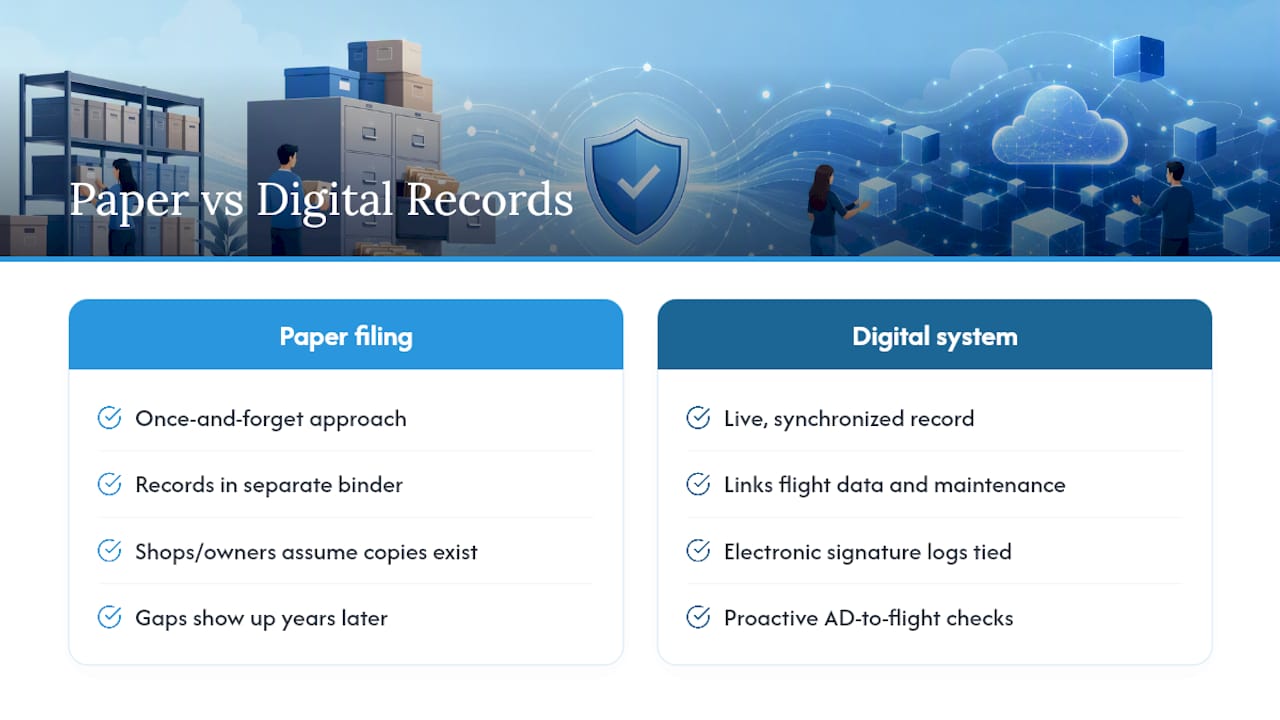
The gap usually shows up years later, when a mechanic who never touched the original installation is left guessing whether a placard, a weight-and-balance note, or a permission letter actually exists. Owners assume the shop kept a copy. Shops assume the owner did. Nobody checks until a pre-buy inspector asks for it directly.
A digital system that links flight data, maintenance entries, and AD compliance in one place removes most of that ambiguity. SquawkFree was built around that exact problem for general aviation owners and flight schools, tying component time tracking to actual flight hours and keeping electronic signature logs tied to the record they belong to, rather than a separate binder nobody updates. The compliance tracking process it runs on links ADs to flight data automatically, which is precisely the kind of proactive check that keeps a permission letter from quietly disappearing between owners.
— Trent
Keep Your STC Records Audit-Ready With SquawkFree
A digital maintenance system can turn the checklist above into something you don’t have to manage by hand. Document versioning can track every ICA revision and Form 337 amendment automatically, so you’re never guessing which copy is current. Automated flight data integration links component time directly to actual flight hours, keeping recurring ICA tasks tied to real usage instead of estimates. Electronic signature logs provide FAA-ready entries immediately when a mechanic signs off work, closing the gap that trips up many pre-buy inspections.

If your STC records are still split between email threads, a filing cabinet, and a mechanic’s memory, start a free trial with SquawkFree and import your existing records into one searchable archive. Flight schools consolidating fleet paperwork from another system can also use free migration support to move records over without re-entering everything by hand. For owners still holding decades of paper logs, the logbook digitization service converts them into a permanent digital set you can hand to any mechanic or buyer in seconds.
Sources
- 14 CFR §91.403 — Responsibility for airworthiness
- 14 CFR §43.9 — Content, form, and disposition of maintenance, preventive maintenance, rebuilding, and alteration records
FAQ
What is the most commonly missing STC document?
The permission-to-use letter from the STC holder. Owners frequently assume verbal or implied approval is enough, but §91.403(d) requires it in writing and kept in the permanent record.
Do I need to keep the Form 337 forever?
Yes. Major alteration records tied to an STC are permanent records under §43.9 and stay with the aircraft, not the owner, through every sale.
What happens if the STC holder is no longer in business?
Contact the FAA Aircraft Certification Office that issued the STC. The FAA’s own guidance directs owners there when the original holder is unreachable for permission or ICA copies.
Can SquawkFree store my STC and Form 337 records?
Yes. SquawkFree centralizes maintenance documents, AD compliance, and version history in one place, and current pricing and plan details are listed on the SquawkFree site.
How do I prove STC compliance during a pre-buy inspection?
Present a consolidated PDF set containing the Form 337, ICA, AFM supplement, and permission letter, with serial numbers matching the installed parts, ideally as a single read-only archive.
Recommended
No credit card required · read-only after trial